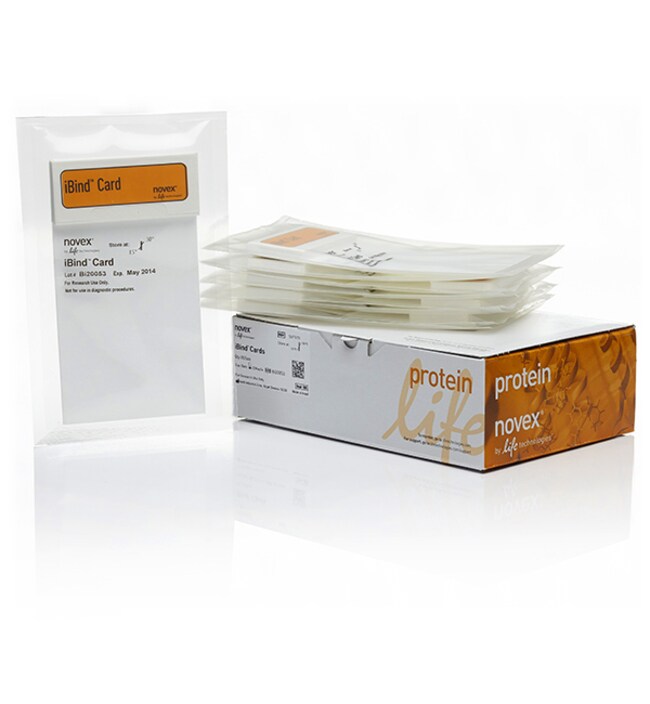
iBind™ Cards
iBind™ Cards
Invitrogen™

iBind™ Cards

iBind Cards are used with the iBind Western Device, which is an automated western-processing device that performs every step inRead more
Have Questions?
Catalog NumberQuantity
SLF101010 cards
Catalog number SLF1010
Price (CNY)
2,112.00
10 cards
Add to cart
Quantity:
10 cards
Price (CNY)
2,112.00
10 cards
Add to cart
iBind Cards are used with the iBind Western Device, which is an automated western-processing device that performs every step in the western workflow from blocking to washes to antibody incubations. The iBind Western Device performs the steps via sequential lateral flow (SLF). SLF allows the timely release and flow of solutions and antibodies to the membrane without need of an external power source, shakers, or trays.

Learn more about the iBind western systems >

iBind Card features include:
Glass-fiber matrix allowing optimal and homogenous flow of immunodetection solutions
Long shelf life—store iBind Cards for 12 months at room temperature
Better antigen-antibody interaction—solutions flow between the iBind Card and membrane for maximum interaction between protein and antibody

The iBind Cards, together with the iBind Western Device and iBind Solution Kit or iBind Fluorescent Detection (FD) Solution Kit, bring automation and simplicity to your western protocol. Each iBind Card can run one mini-membrane, and each box contains 10 cards. An iBind Western Device is required for use of the cards.
For Research Use Only. Not for use in diagnostic procedures.
Specifications
Quantity10 cards
Capacity1 Mini Blot/Card
For Use With (Application)Western Blot
For Use With (Equipment)iBind Western Device
Membrane CompatibilityNitrocellulose, PVDF
Product LineiBind
Throughput1 Mini Blot/Card
TypeCard
Unit Size10 cards
Contents & Storage
Store at room temperature.

Frequently asked questions (FAQs)

What procedure should I follow when stripping and reprobing my blot processed using the iBind Western Device or iBind Flex Western Device?

To strip and reprobe your blot processed using the iBind Western Device or iBind Flex Western Device, first strip the blot outside the system using your preferred protocol. After the stripping protocol, wash the blot in distilled water for 5 min. Reblocking is unnecessary as the iBind Solution will perform this step during reprobing. Finally, reprobe with new antibodies using the iBind Western Device or iBind Flex Western Device, starting with the membrane preparation step.

Find additional tips, troubleshooting help, and resources within our Protein Electrophoresis and Western Blotting Support Center.

Can I multiplex antibodies using the iBind Western Device or iBind Flex Western Device?

Yes, for each midi blot, mini blot, or vertically cut strip, prepare appropriate primary antibodies together in a single tube of iBind FD/ iBind Flex FD Solution, Prepare appropriate secondary antibodies together in a different tube of iBind FD/ iBind Flex FD Solution. Do not mix primary and secondary antibodies prior to loading in the device. All primary and secondary antibodies should be diluted according to the recommendations outlined in the user manual or quick reference card. When detecting several targets of the same species, the same concentration of secondary antibody can be used as when detecting one target. There is no need to increase the concentration for each additional target. Load multiplexed antibodies into the device as normal.
Caution: Consider cross-reactivity of secondary antibodies when multiplexing (e.g., rabbit anti-goat IgG and goat anti-mouse IgG are likely to cross-react).

Find additional tips, troubleshooting help, and resources within our Protein Electrophoresis and Western Blotting Support Center.

Can I use the iBind Western Device or iBind Flex Western Device with Alexa Fluor Plus conjugated secondary antibodies?

Yes, both the iBind Western Device and iBind Flex Western Device work well with Alexa Fluor Plus conjugated secondary antibodies.

Find additional tips, troubleshooting help, and resources within our Protein Electrophoresis and Western Blotting Support Center.

With the iBind Western Device and iBind Flex Western Device, how do I know if I am rolling the membrane firmly enough?

When firmly rolling, the iBind/iBind Flex Card will slightly dip in the membrane area, causing the top and bottom of the card to lift. See the iBind/iBind Flex user manual for additional details.

Find additional tips, troubleshooting help, and resources within our Protein Electrophoresis and Western Blotting Support Center.

I used the iBind Western system and my membrane is very "spotted". What could have caused this?

Here are possible causes and solutions:

- Poor or incomplete transfer: Repeat blot.
- Membrane pads are dirty or contaminated: Soak with detergent and rinse thoroughly with purified water before use. Replace pads when they become worn or discolored.
- Membrane not completely wet: Follow instructions for prewetting the membrane.
- Membrane is contaminated by fingerprints or keratin proteins: Wear clean gloves at all times and use forceps when handling membranes. Always handle membranes around the edges.
- Uneven blocking: The incubation dish must be small enough to allow thorough coverage of membrane.
- Ink used to label membrane: Any labeling of the membrane with ink should be limited to the low MW region of the blot.
- iBind Card damaged: Replace with new card. Ensure that rolling of the membrane on the card is limited to membrane region.
- Membrane is not in proper contact with the iBind Card: Place the membrane on the iBind Card immediately after adding a 1 mL pool of 1X iBind Solution/ iBind FD Solution. Use the roller provided to ensure proper contact.

Find additional tips, troubleshooting help, and resources within our Protein Electrophoresis and Western Blotting Support Center.