Search


Citations & References (7)
Invitrogen™
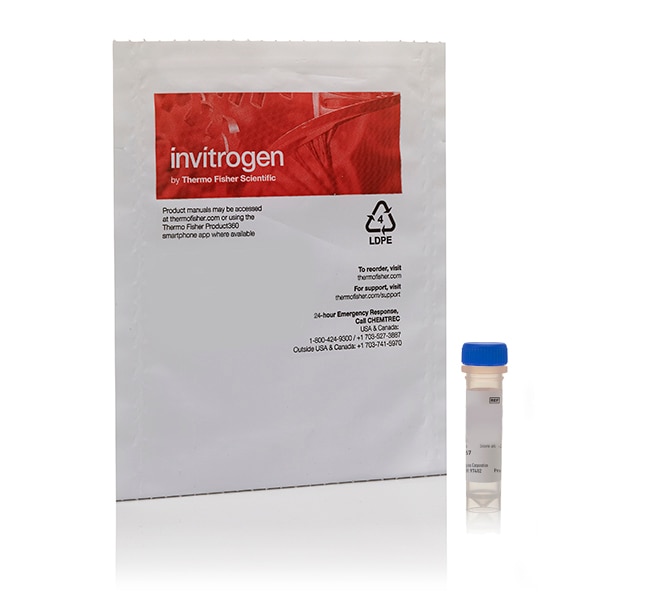
Tetramethylrhodamine (TAMRA) Alkyne (5-Carboxytetramethylrhodamine, Propargylamide), 5-isomer
The red-fluorescent tetramethylrhodamine (TAMRA) alkyne can be reacted with azides via a copper-catalyzed click reaction. Click chemistry describes a classRead more
| Catalog Number | Quantity |
|---|---|
| T10183 | 0.5 mg |
Catalog number T10183
Price (CNY)
6,685.00
0.5 mg
Quantity:
0.5 mg
Price (CNY)
6,685.00
0.5 mg
The red-fluorescent tetramethylrhodamine (TAMRA) alkyne can be reacted with azides via a copper-catalyzed click reaction. Click chemistry describes a class of chemical reactions that use bio-orthogonal or biologically unique moities to label and detect a molecule of interest using a two-step procedure. The two-step reaction procedure involves a copper-catalyzed triazole formation of an azide and an alkyne. Click reactions have several characteristics: the reaction between the detection moieties is efficient; no extreme temperatures or solvents are required; the reaction product is stable; the components of the reaction are bioinert; and perhaps most importantly, no side reactions occur – the label and detection tags react selectively and specifically with one another. Unlike traditional chemical reactions utilizing succinimidyl esters or maleimides that target amines and sulfhydryls – functional groups that are not unique – click chemistry-labeled molecules can be applied to complex biological samples and be detected with unprecedented sensitivity due to extremely low background.
For Research Use Only. Not for use in diagnostic procedures.
Specifications
Chemical ReactivityAzide
Detection MethodFluorescence
FormatSolid
Label or DyeTAMRA™ Isomers, TMR (Tetramethylrhodamine)
Molecular Weight (g/mol)467.53 Da
Product TypeTetramethylrhodamine Alkyne
Quantity0.5 mg
Reactive GroupAlkyne
Reactive MoietyAlkyne
Shipping ConditionRoom Temperature
SolubilityDMSO (Dimethylsulfoxide)
ColorOrange
Label TypeClassic Dyes
Product LineMolecular Probes
Unit Size0.5 mg
Contents & Storage
Store at ≤-20°C, desiccated and protected from light.
Frequently asked questions (FAQs)
I am using Click-iT AHA (L-azidohomoalanine) kit to label nascent proteins in live cells, then detecting with TAMRA alkyne after fixation and permeabilization and a click reaction. But I'm seeing nucleolar labeling in the cells. It this expected?
Citations & References (7)
Citations & References
Abstract
Protein synthesis in distal axons is not required for growth cone responses to guidance cues.
Journal:J Neurosci
PubMed ID:19158291
'Recent evidence suggests that growth cone responses to guidance cues require local protein synthesis. Using chick neurons, we investigated whether protein synthesis is required for growth cones of several types to respond to guidance cues. First, we found that global inhibition of protein synthesis stops axonal elongation after 2 h.
Direct in-gel fluorescence detection and cellular imaging of O-GlcNAc-modified proteins.
Journal:J Am Chem Soc
PubMed ID:18683930
'We report an advanced chemoenzymatic labeling strategy for direct fluorescence detection of O-GlcNAc proteins in gels that facilitates proteomic studies and greatly extend the reach of existing technologies. These new tools also enable the expression and dynamics of O-GlcNAc modifications to be monitored by imaging in cells and tissues.
The cytoplasmic tail dileucine motif LL572 determines the glycosylation pattern of membrane-type 1 matrix metalloproteinase.
Journal:J Biol Chem
PubMed ID:18955496
'Membrane-type 1 matrix metalloproteinase (MT1-MMP; MMP-14) drives fundamental physiological and pathological processes, due to its ability to process a broad spectrum of substrates. Because subtle changes in its activity can produce profound physiological effects, MT1-MMP is tightly regulated. Currently, many aspects of this regulation remain to be elucidated. It has
A novel approach to tag and identify geranylgeranylated proteins.
Journal:Electrophoresis
PubMed ID:19784953
A recently developed proteomic strategy, the
New insights into metabolic signaling and cell survival: the role of beta-O-linkage of N-acetylglucosamine.
Journal:J Pharmacol Exp Ther
PubMed ID:18768779
The involvement of glucose in fundamental metabolic pathways represents a core element of biology. Late in the 20th century, a unique glucose-derived signal was discovered, which appeared to be involved in a variety of cellular processes, including mitosis, transcription, insulin signaling, stress responses, and potentially, Alzheimer's disease, and diabetes. By