Search


Citations & References (75)
Invitrogen™
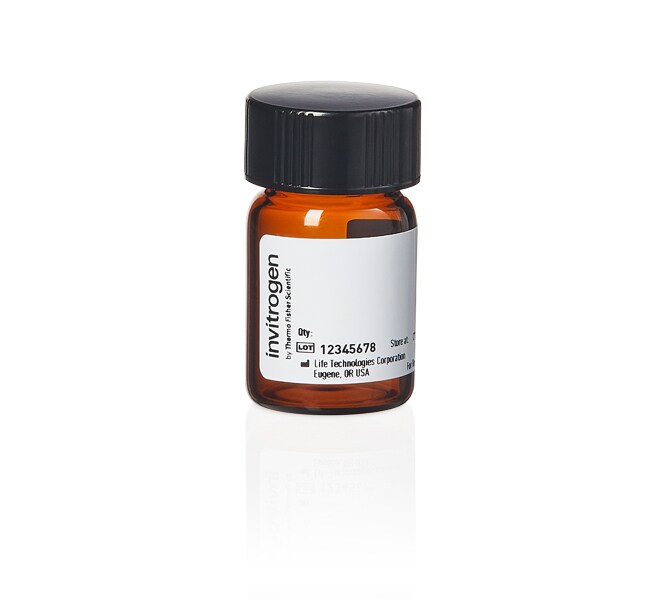
Tetramethylrhodamine-5-Maleimide, single isomer
Tetramethylrhodamine-5-Maleimide, single isomer
| Catalog Number | Quantity |
|---|---|
| T6027 | 5 mg |
Catalog number T6027
Price (CNY)
6,970.00
5 mg
Quantity:
5 mg
Price (CNY)
6,970.00
5 mg
Tetramethylrhodamine-5-maleimide is a thiol-reactive dye that yields photostable, pH-insensitive, red-orange—fluorescent conjugates.
For Research Use Only. Not for use in diagnostic procedures.
Specifications
Chemical ReactivityThiol
Label or DyeTMR (Tetramethylrhodamine)
Product TypeTetramethylrhodamine-5-Maleimide
Quantity5 mg
Reactive MoietyMaleimide
Shipping ConditionRoom Temperature
Label TypeClassic Dyes
Unit Size5 mg
Contents & Storage
Store in freezer (-5 to -30°C) and protect from light.
Citations & References (75)
Citations & References
Abstract
Nuclear import of the ran exchange factor, RCC1, is mediated by at least two distinct mechanisms.
Journal:J Cell Biol
PubMed ID:10811825
'RCC1, the only known guanine-nucleotide exchange factor for the Ran GTPase, is an approximately 45-kD nuclear protein that can bind chromatin. An important question concerns how RCC1 traverses the nuclear envelope. We now show that nuclear RCC1 is not exported readily in interphase cells and that the import of RCC1
Evidence that translocation of the proteinase precedes its acylation in the serpin inhibition pathway.
Journal:J Biol Chem
PubMed ID:10753871
'The inhibition of proteinases by serpins involves cleavage of the serpin, acylation, and translocation of the proteinase. To see whether acylation precedes or follows translocation, we have investigated the pH dependence of the interaction of fluorescein isothiocyanate-elastase with rhodamine alpha(1)-proteinase inhibitor (alpha(1)PI) using two independent methods: (i) kinetics of fluorescence
Differential behavior of two cysteine residues on the myosin head in muscle fibers.
Journal:Biochemistry
PubMed ID:2523734
'We have previously shown that the orientation of (iodoacetamido)tetramethylrhodamine labels on SH1 thiol of S-1 moieties changes when MgADP is added to the fibers in rigor [Borejdo, J., Assulin, O., Ando, T., & Putnam, S. (1982) J. Mol. Biol. 158, 391-414. Burghardt, T.P., Ando, T., & Borejdo, J. (1983) Proc.
Subunit interactions of GTP-binding proteins.
Journal:Eur J Biochem
PubMed ID:1312936
'Fluorescence energy transfer [cf. Förster, T. (1948) Ann. Phys. 6, 55-75] was tested for its suitability to study quantitative interactions of subunits of G0 with each other and these subunits or trimeric G0 with the beta 1-adrenoceptor in detergent micelles or after reconstitution into lipid vesicles [according to Feder, D.,
Myosin II filament assemblies in the active lamella of fibroblasts: their morphogenesis and role in the formation of actin filament bundles.
Journal:J Cell Biol
PubMed ID:7490299
'The morphogenesis of myosin II structures in active lamella undergoing net protrusion was analyzed by correlative fluorescence and electron microscopy. In rat embryo fibroblasts (REF 52) microinjected with tetramethylrhodamine-myosin II, nascent myosin spots formed close to the active edge during periods of retraction and then elongated into wavy ribbons of