Search


Citations & References (4)
Invitrogen™
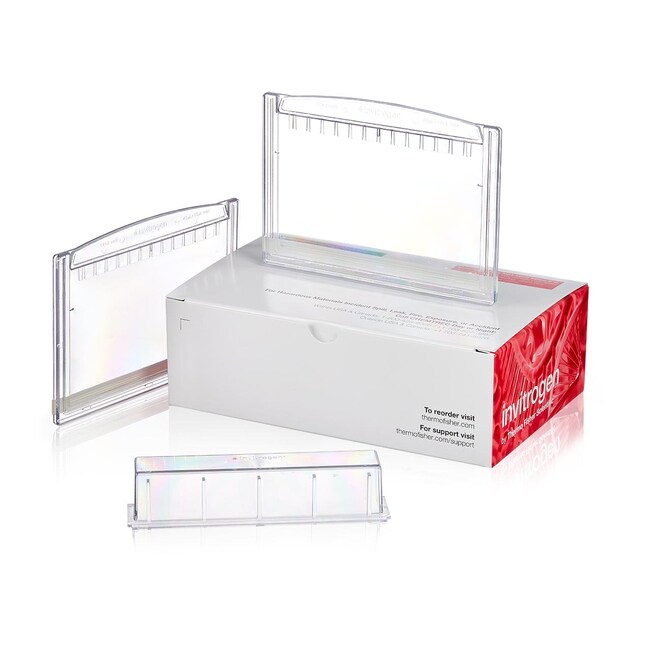
NuPAGE™ Tris-Acetate Midi Protein Gels, 3 to 8%, 1.0 mm
Invitrogen NuPAGE Tris-Acetate protein gels provide excellent separation of large molecular weight proteins. They are high performance polyacrylamide gels that simulate the denaturing or native conditions of the traditional laemmli system.
Have Questions?
Change view

| Catalog Number | Wells |
|---|---|
| WG1601A | 12 + 2-well, w/adapters |
| WG1601BOX | 12 + 2-well |
| WG1602BOX | 20-well |
| WG1602A | 20-well, w/adapters |
| WG1603BOX | 26-well |
| WG1603A | 26-well, w/adapters |
Catalog number WG1601A
Price (CNY)
1,429.00
10 gels (1 box)
Wells:
12 + 2-well, w/adapters
Price (CNY)
1,429.00
10 gels (1 box)
Invitrogen NuPAGE Tris-Acetate protein gels provide excellent separation of large molecular weight proteins. They are high performance polyacrylamide gels that simulate the denaturing or native conditions of the traditional laemmli system. The unique buffer formulation maintains a low operating pH during electrophoresis, resulting in superior resolution of high molecular weight proteins compared to traditional Tris-glycine SDS-PAGE gels.
Features of NuPAGE Tris-Acetate gels:
• High resolution—gels offer optimal separation of high molecular weight proteins
• Better protein integrity—sample preparation process has been optimized to help preserve proteins
• Longer self life—gels can be stored for at least eight months
Choose the right NuPAGE Tris-Acetate gel for your protein separation
Obtain optimal separation of your high molecular weight proteins by choosing the right combination of gel and running buffer. NuPAGE Tris-Acetate protein gels come in a polyacrylamide concentration of 7% and a 3–8% gradient. Gels come in two sizes: mini (8 cm x 8 cm) or midi (8.7 cm x 13.3 cm) and either 1.0 mm (mini and midi gels) or 1.5 mm (mini gel format only) in thickness. NuPAGE Tris-Acetate gels also come in multiple well formats. Mini gels can be run using our XCell SureLock Mini-Cell (EI0001) or Mini Gel Tank (A25977). Midi gels can be run using our XCell4 SureLock Midi-Cell (WR0100) or conveniently with the Bio-Rad Criterion™ Cell using our adapters (WA0999).
Run your proteins in native or denatured form
NuPAGE Tris-Acetate protein gels do not contain SDS and can be used to separate proteins in native or denatured form. For denatured proteins, we recommend using NuPAGE LDS Sample Buffer (NP0007) and NuPAGE Tris-Acetate SDS Running Buffer (LA0041). For native proteins, we recommend using Novex Tris-Glycine Native Sample Buffer (LC2673) and Novex Tris-Glycine Native Running Buffer (LC26720.
For transfer of proteins to a membrane, we recommend using NuPAGE Transfer Buffer (NP00061) for traditional wet transfer using the XCell II Blot Module (EI9051) or the Mini Blot Module (B1000). Alternatively, rapid semi-dry transfer can be done using the Invitrogen Power Blotter or rapid dry transfer using the iBlot 2 Gel Transfer Device (IB210010).
For Research Use Only. Not for use in diagnostic procedures.
Specifications
AdaptersIncludes Adapters
For Use With (Equipment)Bio-Rad Criterion Cell
Gel Thickness1.0 mm
Length (Metric)8 cm
Mode of SeparationMolecular Weight
Quantity10 gels (1 box)
Recommended ApplicationsDenaturing, Native
Sample Loading VolumeUp to 45 μL + 15 μL
Shelf Life8 Months
Shipping ConditionWet Ice
Storage RequirementsStore at 2°C to 8°C. Do not freeze.
Width (Metric)13 cm
Gel Percentage3 to 8%
Gel SizeMidi
Gel TypeTris-Acetate
Product LineNuPAGE
Separation Range36 to 500 kDa
Separation TypeDenaturing, Native
Wells12 + 2-well, w/adapters
Unit Size10 gels (1 box)
Frequently asked questions (FAQs)
Can I prepare my protein sample with the reducing agent and store it for future use?
My LDS or SDS sample buffer precipitates when stored at 4 degrees C. Can I warm it up? Can I store it at room temperature?
How are Bolt gels different than NuPAGE gels?
Do I need to add water or buffer to the Displacement Dam when I run one or two gels in the XCell4 SureLock Midi-Cell?
What are the maximum load volumes for the NuPAGE Midi Gels?
Citations & References (4)
Citations & References
Abstract
Tethering sigma70 to RNA polymerase reveals high in vivo activity of sigma factors and sigma70-dependent pausing at promoter-distal locations.
Journal:Genes Dev
PubMed ID:14630944
Bacterial sigma factors compete for binding to RNA polymerase (RNAP) to control promoter selection, and in some cases interact with RNAP to regulate at least the early stages of transcript elongation. However, the effective concentration of sigmas in vivo, and the extent to which sigma can regulate transcript elongation generally,
The 'involution' of mannose-binding lectin.
Journal:Hum Mol Genet
PubMed ID:16115813
Mannose-binding lectin (MBL) acts as a serum opsonin in innate immune defense and induces complement activation by the lectin pathway. In humans, low levels of functional serum MBL are caused by the dominant action of three single nucleotide substitutions in exon 1 that disrupt the glycine-rich backbone structure of the
The cytoplasmic tail of L-selectin interacts with members of the Ezrin-Radixin-Moesin (ERM) family of proteins: cell activation-dependent binding of Moesin but not Ezrin.
Journal:J Biol Chem
PubMed ID:11706008
L-selectin regulates the recruitment of naive lymphocytes from the bloodstream to secondary lymphoid organs, mediating their initial capture and subsequent rolling along high endothelial cell surface-expressed ligands in peripheral lymph nodes. In vivo, distribution of L-selectin and cell surface levels determine the tethering efficiency and rolling velocity of leukocytes, respectively.
Complement factor H is a serum-binding protein for adrenomedullin, and the resulting complex modulates the bioactivities of both partners.
Journal:J Biol Chem
PubMed ID:11116141
Adrenomedullin (AM) is an important regulatory peptide involved in both physiological and pathological states. We have previously demonstrated the existence of a specific AM-binding protein (AMBP-1) in human plasma. In the present study, we developed a nonradioactive ligand blotting assay, which, together with high pressure liquid chromatography/SDS-polyacrylamide gel electrophoresis purification