Search


Citations & References (4)
Invitrogen™
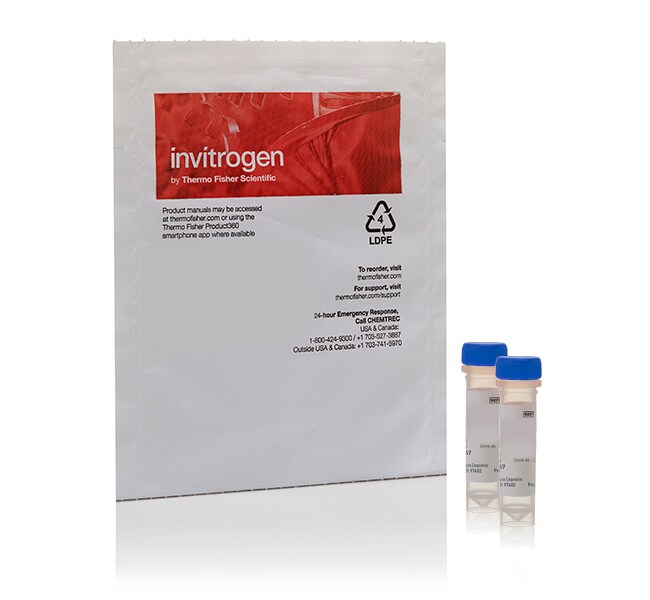
Zenon™ Rabbit IgG Labeling Kits
Generate antibody (IgG) conjugates for immunocytochemistry (ICC), immunohistochemistry (IHC), flow cytometry, and cell imaging with the Invitrogen Zenon™ Rabbit IgG Labeling Kits.
Have Questions?
Change view

| Catalog Number | Quantity | Excitation/Emission | Label or Dye |
|---|---|---|---|
| Z25305 | 50 Reactions kit | 555/565 nm | Alexa Fluor 555 |
| Z25302 | 50 Reactions kit | 495/519 nm | Alexa Fluor 488 |
| Z25303 also known as Z-25303 | 50 Reactions kit | 531/554 nm | Alexa Fluor 532 |
| Z25306 | 50 Reactions kit | 578/603 nm | Alexa Fluor 568 |
| Z25307 | 50 Reactions kit | 590/617 nm | Alexa Fluor 594 |
| Z25308 | 50 Reactions kit | 650/668 nm | Alexa Fluor 647 |
| Z25313 | 50 Reactions kit | 402/421 nm | Alexa Fluor 405 |
| Z25351 | 25 Reactions kit | 650/660 nm | APC (Allophycocyanin) |
| Z25355 | 25 Reactions kit | 496, 546, 565/578 nm | R-PE (R-Phycoerythrin) |
Catalog number Z25305
Price (CNY)
7,483.00
1 kit
Quantity:
50 Reactions kit
Excitation/Emission:
555/565 nm
Label or Dye:
Alexa Fluor 555
Price (CNY)
7,483.00
1 kit
Generate antibody (IgG) conjugates for immunocytochemistry (ICC), immunohistochemistry (IHC), flow cytometry, and cell imaging with the Invitrogen Zenon™ Rabbit IgG Labeling Kits. Simplify your laboratory applications and reduce antibody cross-reactivity while also achieving efficient labeling of antibodies in serum, ascites fluid, or hybridoma suspensions.
Achieve fast, versatile, and reliable fluorophore-, biotin-, or enzyme-labeled IgG primary antibodies with the Zenon™ rabbit IgG labeling kits. These kits utilize Alexa Fluor fluorophores, biotin, Pacific Blue, or enzymes such as R-phycoerythrin and allophycocyanin, which are attached to monovalent, affinity purified Fab fragments. The Fab fragments, in turn, are directed against and bind with the Fc portion of IgG primary antibodies. Only a small amount of starting material is required, and the method is optimized for efficient labeling of antibodies in serum, ascites fluid, or hybridoma suspensions. Because the Zenon labeling method is based on immunoselectivity, it does not require the removal of exogenous proteins (such as serum) or amine-containing buffers from the target antibody, simplifying the process.
Zenon labeling technology greatly simplifies the use of multiple mouse-derived antibodies in the same staining protocol. Zenon tricolor labeling kits contain sufficient materials for 10 labeling reactions of each of three different fluorescent colors.
Important features of Zenon labeling technology:
• Labeled antibodies are typically ready to use in 10 minutes
• Requires only 1–20 μg primary antibody
• Simple—no purification required
• Flexible—choose from different fluorophores, biotin, HRP, alkaline phosphatase
• Multiplex with other mouse monoclonal antibodies simultaneously
• Can be used in a variety of applications including ICC, IHC, flow cytometry, and cell imaging.
Advantages of using Zenon antibody labeling kits include:
Cost savings
Zenon antibody labeling kits offer a cost-conscious and reproducible method of tagging as little as 0.4 μg in 2 μL of primary antibody, with minimal waste of expensive or difficult-to-obtain antibodies, or excessive washing steps that pose the risk of product loss.
Sensitivity
Label your primary antibodies without compromising their antigen binding affinity: Zenon dye- and enzyme-labeled Fab fragments, which are targeted to the Fc tail, are affinity purified during their preparation to ensure high affinity and selectivity for the Fc portion of the corresponding primary antibody. The procedure for chemical labeling of the Zenon Fab fragments protects their Fc-binding site, resulting in more active labeling reagents.
Speed
No purification procedure is required prior to using Zenon Fab fragments in your laboratory applications. Formation of the Fab-antibody complex occurs in fewer than five minutes, followed by a five-minute blocking step. During this time, almost all the primary antibody in the mixture is labeled with the labeled Fab fragments.
Simplicity
The Fab-antibody complexes display fluorescence or enzymatic activity that is similar in intensity to that of directly labeled primary antibodies. Varying the extent of the antibody labeling is as simple as changing the amount of added Zenon labeling reagent during the reaction. Once the labeling complexes are formed, they can used immediately, without need for antibody purification.
Reliability
The Zenon Fab-antibody complex is stable and allows subsequent or simultaneous labeling of different target cells and tissues with different complexes. After staining, an aldehyde-based fixing step may be used to prevent the transfer of different labels between different primary antibodies, preserving the initial staining pattern.
Customization
We offer custom antibody conjugation services that are efficient and confidential, and we stand by the quality of our work. We are ISO 13485:2000 certified.
For Research Use Only. Not for use in diagnostic procedures.
Specifications
ColorOrange
Excitation/Emission555/565 nm
Label TypeAlexa Fluor
Labeling Scale< 1–20 μg
Product LineZenon
Product TypeLabeling Kit
Quantity50 Reactions kit
SpeciesRabbit
Labeling TargetIgG
Label or DyeAlexa Fluor 555
Unit Size1 kit
Contents & Storage
Contains 1 vial of Zenon Alexa Fluor 555 rabbit IgG labeling reagent (250 μL), and 1 vial of Zenon blocking reagent (rabbit IgG, 250 μL).
Store in refrigerator (2–8°C) and protect from light.
Store in refrigerator (2–8°C) and protect from light.
Citations & References (4)
Citations & References
Abstract
Differential localization of the centromere-specific proteins in the major centromeric satellite of Arabidopsis thaliana.
Journal:J Cell Sci
PubMed ID:15161939
'The 180 bp family of tandem repetitive sequences, which constitutes the major centromeric satellite in Arabidopsis thaliana, is thought to play important roles in kinetochore assembly. To assess the centromere activities of the 180 bp repeats, we performed indirect fluorescence immunolabeling with antibodies against phosphorylated histone H3 at Ser10, HTR12
Activity-dependent phosphorylation of tyrosine hydroxylase in dopaminergic neurons of the rat retina.
Journal:J Neurosci
PubMed ID:15115820
'We studied in vivo activity-dependent phosphorylation of tyrosine hydroxylase (TH) in dopaminergic (DA) neurons of the rat retina. TH phosphorylation (TH-P) was evaluated by immunocytochemistry, using antibodies specific for each of three regulated phosphorylation sites. TH synthesis rate was measured by dihydroxyphenylalanine (DOPA) accumulation in the presence of NSD-1015, an
Microtubule-associated [corrected] protein 7 increases the membrane expression of transient receptor potential vanilloid 4 (TRPV4).
Journal:J Biol Chem
PubMed ID:14517216
'The molecular mechanism of the transmission of changes in the shape of the cell surface to ion channels remains obscure. Ca2+ influx induced by cell deformity is inhibited by actin-freezing reagents, suggesting that the actin microfilament couples with an ion channel. Transient receptor potential vanilloid 4 (TRPV4) is a candidate
Multiplex detection of RNA expression in Drosophila embryos.
Journal:Science
PubMed ID:15297669
We present a fluorescence-based, multiplex in situ hybridization method that permits the simultaneous detection of five differently labeled antisense RNA probes and up to seven differ-ent transcripts in a single Drosophila embryo. We also show that it should be possible to increase the number of detected transcripts substantially with nascent