Search


引用和文献 (6)
Gibco™
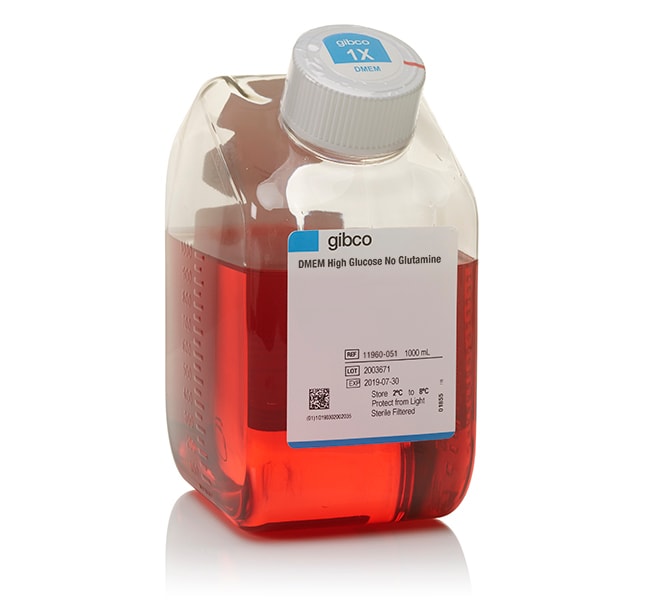
DMEM,高糖,不含谷氨酰胺
DMEM (Dulbecco's Modified Eagle Medium)是一种广泛使用的基础培养基,可用于支持很多种类的哺乳动物细胞生长。已经在 DMEM 中成功培养出的细胞包括原代成纤维细胞、神经元、胶质细胞了解更多信息
Have Questions?
更改视图

| 货号 | 数量 |
|---|---|
| 11960077 | 6 x 1000 mL |
| 11960044 | 500 mL |
| 11960069 | 10 x 500 mL |
| 11960051 | 1000 mL |
货号 11960077
价格(CNY)
3,247.00
飞享价
Ends: 31-Dec-2026
4,059.00共减 812.00 (20%)
Each
数量:
6 x 1000 mL
价格(CNY)
3,247.00
飞享价
Ends: 31-Dec-2026
4,059.00共减 812.00 (20%)
Each
DMEM (Dulbecco's Modified Eagle Medium)是一种广泛使用的基础培养基,可用于支持很多种类的哺乳动物细胞生长。已经在 DMEM 中成功培养出的细胞包括原代成纤维细胞、神经元、胶质细胞、HUVEC、平滑肌细胞,以及 HeLa、293、Cos-7 和 PC-12 等细胞系。针对广泛的细胞培养应用,提供了多种组分的 DMEM 改良培养基。使用培养基选择工具查找适合的配方。
这种 DMEM 的改良方式如下:
可提供完整配方。
使用 DMEM
DMEM 与其他培养基的不同之处在于其含有相当于初始 Eagle 最低必需培养基 4 倍浓度的氨基酸和维生素。DMEM 最初采用低浓度葡萄糖 (1 g/L) 和丙酮酸钠配制,但通常在含/不含丙酮酸钠的高糖环境下使用。DMEM 不含蛋白质、脂质或生长因子。因此,DMEM 需要补充营养成分,通常需要添加 10% 胎牛血清 (FBS)。DMEM 使用碳酸氢钠缓冲系统 (3.7 g/L),因此需要 5–10% CO2 的环境来维持生理 pH 值。
cGMP 生产和质量体系
DMEM 在位于纽约格兰德岛上符合 cGMP 要求的工厂内生产。该工厂是在FDA登记的医疗器械生产商,且通过ISO 13485标准认证。
这种 DMEM 的改良方式如下:
| 包含 | 不含 |
| •高糖 | •L-谷氨酰胺 |
| •酚红 | •丙酮酸钠 |
| • HEPES |
可提供完整配方。
使用 DMEM
DMEM 与其他培养基的不同之处在于其含有相当于初始 Eagle 最低必需培养基 4 倍浓度的氨基酸和维生素。DMEM 最初采用低浓度葡萄糖 (1 g/L) 和丙酮酸钠配制,但通常在含/不含丙酮酸钠的高糖环境下使用。DMEM 不含蛋白质、脂质或生长因子。因此,DMEM 需要补充营养成分,通常需要添加 10% 胎牛血清 (FBS)。DMEM 使用碳酸氢钠缓冲系统 (3.7 g/L),因此需要 5–10% CO2 的环境来维持生理 pH 值。
cGMP 生产和质量体系
DMEM 在位于纽约格兰德岛上符合 cGMP 要求的工厂内生产。该工厂是在FDA登记的医疗器械生产商,且通过ISO 13485标准认证。
仅用于研究和生产用途。不可用于临床诊断或直接用于人类或动物。
规格
细胞系HeLa、293、Cos-7 和 PC-12
细胞类型原代成纤维细胞、神经元、神经胶质细胞、HUVEC、平滑肌细胞
最大浓度1 X
培养环境CO2
适用于(应用)Mammalian Cell Culture
产品规格Bottles
生产质量cGMP-compliant under the ISO 13485 standard
产品线Gibco
产品类型DMEM(Dulbecco 改良 Eagle 培养基)
数量6 x 1000 mL
有效期自生产之日起 12 个月
运输条件室温
分类非动物源性
培养类型Mammalian Cell Culture
形式液体
血清水平标准血清
无菌无菌过滤
灭菌方法无菌过滤
加有添加剂高糖, 酚红
不加添加剂无谷氨酰胺, 不含 HEPES, 不含丙酮酸钠
Unit SizeEach
内容与储存
储存条件:2°C 至 8°C(避光)
运输条件:环境
有效期:自生产之日起 12 个月
运输条件:环境
有效期:自生产之日起 12 个月
常见问题解答 (FAQ)
加入血清后的培养基可以使用多久?
我的培养基是室温条件下运送来的,但注明应保存于冷藏条件下。这会有影响么?
我该如何去除细胞培养基中的支原体污染?
我发现培养物的生长速率变缓。我该如何处理?
我的细胞不能贴附于培养容器。我该如何处理?
引用和文献 (6)
引用和文献
Abstract
Fibroblast growth factor receptor-1 signaling induces osteopontin expression and vascular smooth muscle cell-dependent adventitial fibroblast migration in vitro.
Journal:Circulation
PubMed ID:12176960
'BACKGROUND: Increased expression of osteopontin (OPN), fibroblast growth factors (FGFs), and their type-1 receptor (FGFR-1) is associated with neointima formation and atherosclerosis. This study tested the hypothesis that ligand activation of FGFR-1 stimulates OPN expression in rat aortic smooth muscle cells (RASMCs), explored the signaling pathway involved, and assessed the
The PAX3-FKHR fusion protein created by the t(2;13) translocation in alveolar rhabdomyosarcomas is a more potent transcriptional activator than PAX3.
Journal:Mol Cell Biol
PubMed ID:7862145
Alveolar rhabdomyosarcomas are pediatric solid tumors with a hallmark cytogenetic abnormality: translocation of chromosomes 2 and 13 [t(2;13) (q35;q14)]. The genes on each chromosome involved in this translocation have been identified as the transcription factor-encoding genes PAX3 and FKHR. The NH2-terminal paired box and homeodomain DNA-binding domains of PAX3 are
Isolation of mouse mesenchymal stem cells on the basis of expression of Sca-1 and PDGFR-a.
Journal:Nat Protoc
PubMed ID:23154782
Platelet-derived growth factor receptor a (PDGFR-a) and stem cell antigen 1 (Sca-1) have recently been identified as selective markers of mouse mesenchymal stem cells (MSCs). PDGFR-a(+)Sca-1(+) (PaS) MSCs have augmented growth potential and robust tri-lineage differentiation compared with standard culture-selected MSCs. In addition, the selective isolation of PaS MSCs avoids
Ascorbic-acid transporter Slc23a1 is essential for vitamin C transport into the brain and for perinatal survival.
Journal:Nat Med
PubMed ID:11984580
The only proven requirement for ascorbic acid (vitamin C) is in preventing scurvy, presumably because it is a cofactor for hydroxylases required for post-translational modifications that stabilize collagen. We have created mice deficient in the mouse ortholog (solute carrier family 23 member 1 or Slc23a1) of a rat ascorbic-acid transporter,
Characterization of the 46-kDa intermediates of matrix metalloproteinase 3 (stromelysin 1) obtained by site-directed mutation of phenylalanine 83.
Journal:J Biol Chem
PubMed ID:8631880
The precursor of matrix metalloproteinase 3 (MMP-3/ stromelysin 1) is activated in vitro by proteinases or mercurial compounds by stepwise processes which include the initial formation of short-lived intermediates and the subsequent intermolecular cleavage of the His82-Phe83 bond to generate the fully activated mature MMP-3 (Nagase, H., Enghild, J. J.,