Search


引用和文献 (9)
Gibco™
Advanced DMEM/F-12
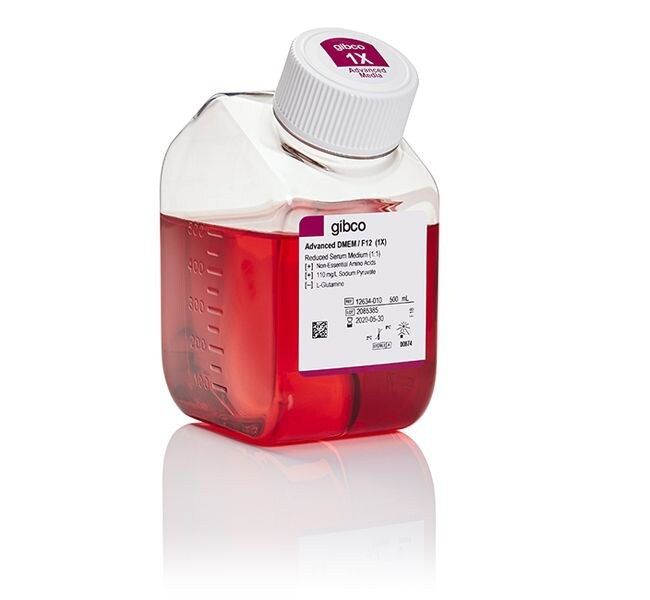
Advanced DMEM/F-12(Dulbecco 改良 Eagle 培养基/Ham's F-12)是一种广泛使用的基础培养基,可在减少胎牛血清 (FBS) 添加量的情况下培养哺乳动物细胞了解更多信息
Have Questions?
更改视图

| 货号 | 数量 |
|---|---|
| 12634010 | 500 mL |
| 12634028 | 10 x 500 mL |
货号 12634010
价格(CNY)
563.00
飞享价
Ends: 26-Sep-2026
750.00共减 187.00 (25%)
Each
数量:
500 mL
价格(CNY)
563.00
飞享价
Ends: 26-Sep-2026
750.00共减 187.00 (25%)
Each
Advanced DMEM/F-12(Dulbecco 改良 Eagle 培养基/Ham's F-12)是一种广泛使用的基础培养基,可在减少胎牛血清 (FBS) 添加量的情况下培养哺乳动物细胞。与经典 DMEM/F-12 相比,血清添加量可减少 50–90%,而细胞生长速率或形态无变化。无需适应即可在 Advanced DMEM/F-12 中成功培养的细胞包括 MRC-5、SP2、Vero、WI-38 和 Jurkat。
可提供完整配方。
使用 Advanced DMEM/F-12
相比其他培养基,Advanced DMEM/F-12 之所以具有可减少血清添加量的独特效果,是因为添加了以下成分:乙醇胺、谷胱甘肽、抗坏血酸、胰岛素、转铁蛋白、细胞培养用 AlbuMAX™ II 富含脂质牛血清白蛋白以及多种微量元素(亚硒酸钠、偏钒酸铵、硫酸铜和氯化锰)。Advanced DMEM/F-12 需要补充 1–5% 胎牛血清和 4 mM L-谷氨酰胺或 GlutaMAX™ 补充剂。许多细胞系不需要适应即可使用这种培养基。必须针对每种细胞系优化 FBS 浓度以较大限度减少血清添加量。Advanced DMEM/F-12 使用碳酸氢钠缓冲系统 (3.7 g/L),因此需要 5–10% CO2 环境来维持生理 pH 值。
cGMP 生产和质量体系
为确保供应链的稳定,同时在位于纽约格兰德岛和英国苏格兰的两家独立工厂生产 Advanced DMEM/F-12。两家工厂均符合 cGMP 生产要求,并通过 ISO 13485 认证,是在 FDA 注册的医疗器械生产商。
该 Advanced DMEM/F-12 的生产方式如下:
| 包含 | 不含 |
| •葡萄糖 | •L-谷氨酰胺 |
| •非必需氨基酸 | •HEPES: |
| •丙酮酸钠 | |
| • 酚红 |
可提供完整配方。
使用 Advanced DMEM/F-12
相比其他培养基,Advanced DMEM/F-12 之所以具有可减少血清添加量的独特效果,是因为添加了以下成分:乙醇胺、谷胱甘肽、抗坏血酸、胰岛素、转铁蛋白、细胞培养用 AlbuMAX™ II 富含脂质牛血清白蛋白以及多种微量元素(亚硒酸钠、偏钒酸铵、硫酸铜和氯化锰)。Advanced DMEM/F-12 需要补充 1–5% 胎牛血清和 4 mM L-谷氨酰胺或 GlutaMAX™ 补充剂。许多细胞系不需要适应即可使用这种培养基。必须针对每种细胞系优化 FBS 浓度以较大限度减少血清添加量。Advanced DMEM/F-12 使用碳酸氢钠缓冲系统 (3.7 g/L),因此需要 5–10% CO2 环境来维持生理 pH 值。
cGMP 生产和质量体系
为确保供应链的稳定,同时在位于纽约格兰德岛和英国苏格兰的两家独立工厂生产 Advanced DMEM/F-12。两家工厂均符合 cGMP 生产要求,并通过 ISO 13485 认证,是在 FDA 注册的医疗器械生产商。
仅供科研使用。不可用于诊断程序。
规格
细胞系MRC-5、SP2、Vero、WI-38 和 Jurkat
最大浓度1 X
生产质量cGMP-compliant under the ISO 13485 standard
产品线Gibco
产品类型DMEM(Dulbecco 改良 Eagle 培养基)/F-12
数量500 mL
有效期自生产之日起 12 个月
运输条件室温
分类动物来源
形式液体
血清水平Advanced(减血清)
无菌无菌过滤
灭菌方法无菌过滤
加有添加剂高糖, 酚红, 丙酮酸钠, 非必需氨基酸
不加添加剂无谷氨酰胺, 不含 HEPES
Unit SizeEach
内容与储存
储存条件:2-8°C。避光储存
运输条件:环境
有效期:自生产之日起 12 个月
运输条件:环境
有效期:自生产之日起 12 个月
常见问题解答 (FAQ)
加入血清后的培养基可以使用多久?
我的培养基是室温条件下运送来的,但注明应保存于冷藏条件下。这会有影响么?
我该如何去除细胞培养基中的支原体污染?
我发现培养物的生长速率变缓。我该如何处理?
我的细胞不能贴附于培养容器。我该如何处理?
引用和文献 (9)
引用和文献
Abstract
Development of a Three-Dimensional Bioengineering Technology to Generate Lung Tissue for Personalized Disease Modeling.
Journal:Stem cells translational medicine
PubMed ID:28191779
Stem cell technologies, especially patient-specific, induced stem cell pluripotency and directed differentiation, hold great promise for changing the landscape of medical therapies. Proper exploitation of these methods may lead to personalized organ transplants, but to regenerate organs, it is necessary to develop methods for assembling differentiated cells into functional, organ-level
Long-term expansion of epithelial organoids from human colon, adenoma, adenocarcinoma, and Barrett's epithelium.
Journal:Gastroenterology
PubMed ID:21889923
Background & aims: We previously established long-term culture conditions under which single crypts or stem cells derived from mouse small intestine expand over long periods. The expanding crypts undergo multiple crypt fission events, simultaneously generating villus-like epithelial domains that contain all differentiated types of cells. We have adapted the culture
Single Lgr5 stem cells build crypt-villus structures in vitro without a mesenchymal niche.
Journal:Nature
PubMed ID:19329995
The intestinal epithelium is the most rapidly self-renewing tissue in adult mammals. We have recently demonstrated the presence of about six cycling Lgr5(+) stem cells at the bottoms of small-intestinal crypts. Here we describe the establishment of long-term culture conditions under which single crypts undergo multiple crypt fission events, while
Directed differentiation of human pluripotent stem cells into intestinal tissue in vitro.
Journal:Nature
PubMed ID:21151107
Studies in embryonic development have guided successful efforts to direct the differentiation of human embryonic and induced pluripotent stem cells (PSCs) into specific organ cell types in vitro 1,2. For example, human PSCs have been differentiated into monolayer cultures of liver hepatocytes and pancreatic endocrine cells3–6 that have therapeutic efficacy
In vitro generation of human pluripotent stem cell derived lung organoids.
Journal:eLife
PubMed ID:25803487
Recent breakthroughs in 3-dimensional (3D) organoid cultures for many organ systems have led to new physiologically complex in vitro models to study human development and disease. Here, we report the step-wise differentiation of human pluripotent stem cells (hPSCs) (embryonic and induced) into lung organoids. By manipulating developmental signaling pathways hPSCs