Search


引用和文献 (7)
Thermo Scientific™
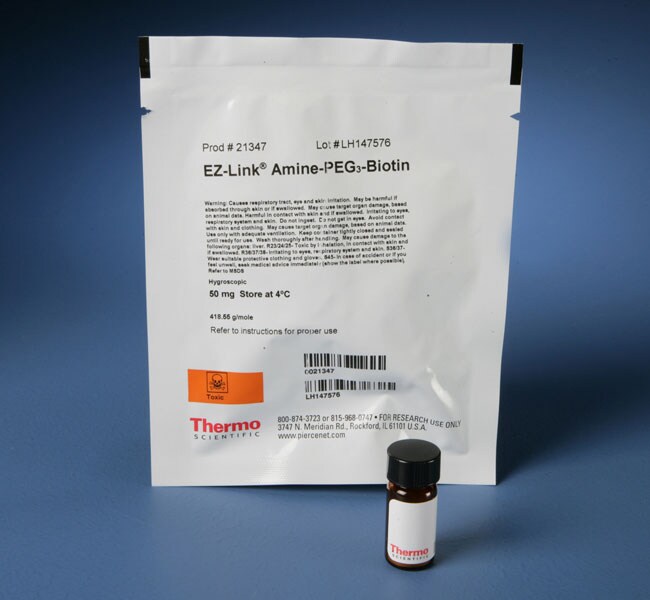
EZ-Link™ 胺-PEG3-生物素
Thermo Scientific EZ-Link 胺-PEG3-生物素是一种水溶性生物素化合物,含有聚乙二醇 (PEG) 间隔臂和末端伯胺,通过 EDC 和其他交联剂方法进行偶联。EZ-Link 胺-PEG3-生物素的特点:•生物素化—用于涉及亲和素或链霉素亲和素探针和树脂的检测或亲和纯化方法的标记分子和表面•胺活化—伯胺可使用了解更多信息
| 货号 | 数量 |
|---|---|
| 21347 | 50 mg |
货号 21347
价格(CNY)
7,209.00
Each
数量:
50 mg
价格(CNY)
7,209.00
Each
Thermo Scientific EZ-Link 胺-PEG3-生物素是一种水溶性生物素化合物,含有聚乙二醇 (PEG) 间隔臂和末端伯胺,通过 EDC 和其他交联剂方法进行偶联。
EZ-Link 胺-PEG3-生物素的特点:
•生物素化—用于涉及亲和素或链霉素亲和素探针和树脂的检测或亲和纯化方法的标记分子和表面
•胺活化—伯胺可使用 EDC 和其他交联剂与蛋白和材料表面交联
•聚乙二醇化—间隔臂中聚乙二醇 (PEG) 基团提高生物素化分子的水溶性
• 中等长度—间隔臂(添加至靶标的总长度)为 22.9 埃
胺-PEG2-生物素和胺-PEG3-生物素是三种含聚乙二醇 (PEG)间隔臂的胺修饰生物素化合物中较短的两种。短 PEG 片段具有亲水性,与仅含碳氢化合物间隔的试剂相比,赋予标记蛋白更高的溶解度。可使用 EDC(产品编号 22980)(一种水溶性碳二亚胺交联剂)将这些聚乙二醇化生物素试剂的伯胺与羧基末端、天冬氨酸残基或谷氨酸残基偶联。EDC 激活羧基与氨基-生物素的—NH2 基团结合,形成酰胺键。
我们生产生物素试剂,以确保尽可能使预期研究应用的总体产品完整性、一致性和性能达到最高水平。
氨基-生物素化合物可以通过多种方式与蛋白和其他分子的官能团偶联。较常用的方法是使用将末端伯胺交联至羧基基团。羧基基团 (-COOH) 存在于天冬氨酸或谷氨酸残基和多肽的羧基末端。当用 EDC(产品编号 22980)活化时,羧酸盐与氨基 (—NH2) 基团反应形成酰胺键。可使用 EDC 和 Sulfo-NHS(产品编号 24510)对羧酸盐分子和表面材料进行预活化,以与伯胺进行后续反应(参见 NHS 酯化学试剂)。
相关产品
EZ-Link™ 胺-PEG2-生物素
EZ-Link 胺-PEG3-生物素的特点:
•生物素化—用于涉及亲和素或链霉素亲和素探针和树脂的检测或亲和纯化方法的标记分子和表面
•胺活化—伯胺可使用 EDC 和其他交联剂与蛋白和材料表面交联
•聚乙二醇化—间隔臂中聚乙二醇 (PEG) 基团提高生物素化分子的水溶性
• 中等长度—间隔臂(添加至靶标的总长度)为 22.9 埃
胺-PEG2-生物素和胺-PEG3-生物素是三种含聚乙二醇 (PEG)间隔臂的胺修饰生物素化合物中较短的两种。短 PEG 片段具有亲水性,与仅含碳氢化合物间隔的试剂相比,赋予标记蛋白更高的溶解度。可使用 EDC(产品编号 22980)(一种水溶性碳二亚胺交联剂)将这些聚乙二醇化生物素试剂的伯胺与羧基末端、天冬氨酸残基或谷氨酸残基偶联。EDC 激活羧基与氨基-生物素的—NH2 基团结合,形成酰胺键。
我们生产生物素试剂,以确保尽可能使预期研究应用的总体产品完整性、一致性和性能达到最高水平。
氨基-生物素化合物可以通过多种方式与蛋白和其他分子的官能团偶联。较常用的方法是使用将末端伯胺交联至羧基基团。羧基基团 (-COOH) 存在于天冬氨酸或谷氨酸残基和多肽的羧基末端。当用 EDC(产品编号 22980)活化时,羧酸盐与氨基 (—NH2) 基团反应形成酰胺键。可使用 EDC 和 Sulfo-NHS(产品编号 24510)对羧酸盐分子和表面材料进行预活化,以与伯胺进行后续反应(参见 NHS 酯化学试剂)。
相关产品
EZ-Link™ 胺-PEG2-生物素
仅供科研使用。不可用于诊断程序。
规格
细胞渗透性细胞不可透过性
标签类型生物素& 类似物
产品线EZ-Link
产品类型胺基-PEG3-生物素
数量50 mg
反应一部分胺
化学反应性羧酸, 酮, 醛
标签或染料生物素
溶解度水
间隔子中等长度,聚乙二醇化
Unit SizeEach
内容与储存
储存于 4°C。
引用和文献 (7)
引用和文献
Abstract
Site-specific incorporation of quadricyclane into a protein and photocleavage of the quadricyclane ligation adduct.
Journal:Bioorg Med Chem
PubMed ID:29754834
'The quadricyclane (QC) ligation is a bioorthogonal reaction between a quadricyclane moiety and a nickel bis(dithiolene) derivative. Here we show that a QC amino acid can be incorporated into a protein site-specifically using the pyrrolysine-based genetic code expansion platform, and subsequently used for ligation chemistry. Additionally, we exploited the photolability
Application of the fluctuation theorem for noninvasive force measurement in living neuronal axons.
Journal:Mol Biol Cell
PubMed ID:30281391
'Although its importance is recently widely accepted, force measurement has been difficult in living biological systems, mainly due to the lack of the versatile noninvasive force measurement methods. The fluctuation theorem, which represents the thermodynamic properties of small fluctuating nonequilibrium systems, has been applied to the analysis of the thermodynamic
Capsular Polysaccharide (CPS) Release by Serotype 3 Pneumococcal Strains Reduces the Protective Effect of Anti-Type 3 CPS Antibodies.
Journal:Clin Vaccine Immunol
PubMed ID:26677201
The efficacy of the serotype 3 (ST3) pneumococcal conjugate vaccine (PCV) remains unclear. While the synthesis of capsular polysaccharide (CPS) of most serotypes is wzy dependent, the strains of two serotypes, 3 and 37, synthesize CPS by the synthase-dependent pathway, resulting in a polysaccharide that is not covalently linked to
RNA Aptamers with Specificity for Heparosan and Chondroitin Glycosaminoglycans.
Journal:ACS Omega
PubMed ID:30411046
In this study, two respective groups of RNA aptamers have been selected against two main classes of glycosaminoglycans (GAGs), heparosan, and chondroitin, as they have proven difficult to specifically detect in biological samples. GAGs are linear, anionic, polydisperse polysaccharides found ubiquitously in nature, yet their detection remains problematic. GAGs comprised
Glycosaminoglycans from bovine eye vitreous humour and interaction with collagen type II.
Journal:Glycoconj J
PubMed ID:29305777
Glycosaminoglycans (GAGs) play an important role in stabilizing the gel state of eye vitreous humour. In this study, the composition of GAGs present in bovine eye vitreous was characterized through disaccharide analysis by liquid chromatography-mass spectrometry. The interaction of GAGs with collagen type II was assessed using surface plasmon resonance