Search


引用和文献 (4)
Invitrogen™
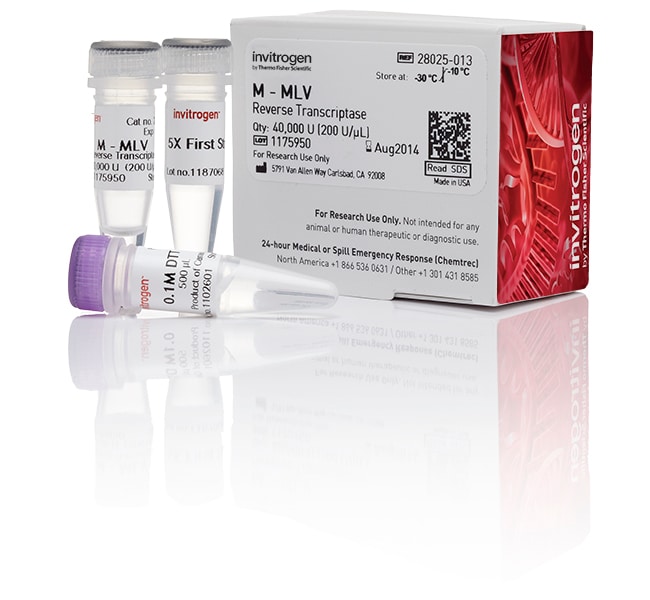
M-MLV 反转录酶 (200 U/μL)
M-MLV 反转录酶是一种以单链 RNA、DNA 或 RNA:DNA 杂交体为模板合成互补 DNA 链的重组 DNA了解更多信息
Have Questions?
更改视图

| 货号 | 反应次数 |
|---|---|
| 28025013 | 200 次反应 |
| 28025021 | 1,000 次反应 |
货号 28025013
价格(CNY)
2,203.00
飞享价
Ends: 31-Dec-2026
3,147.00共减 944.00 (30%)
Each
反应次数:
200 次反应
价格(CNY)
2,203.00
飞享价
Ends: 31-Dec-2026
3,147.00共减 944.00 (30%)
Each
M-MLV 反转录酶是一种以单链 RNA、DNA 或 RNA:DNA 杂交体为模板合成互补 DNA 链的重组 DNA 聚合酶。与 AMV RT 相比,莫洛尼鼠白血病病毒反转录酶 (M-MLV RT) 缺乏 DNA 核酸内切酶活性,RNase H 活性较低。该酶的特点:
•热稳定性—在 37°C 下活性极佳
•cDNA 大小—M-MLV 可用于合成长达 7 kb 的第一链 cDNA
•应用—合成第一链 cDNA、引物延伸、dsDNA 测序、cDNA 文库和 RT-PCR
来源
纯化自表达质粒所带 M-MLV pol 基因的大肠杆菌
性能和质量检测
SDS-PAGE 纯度;脱氧核糖核酸内切酶、脱氧核糖核酸外切酶及核糖核酸酶检测;cDNA 产物的得率和长度
单位定义
一个单位的 M-MLV RT 是指在 37°C、10 分钟条件下使用 poly(A)oligo(dT)25 作为模板-引物将 1 nmole 脱氧核糖核酸掺入酸性可沉淀材料所需的酶量。
单位反应条件
50 mM Tris-HCl(pH 值 8.3)、40 mM KCl、6 mM MgCl2、1 mM DTT、0.5 mM [3H]dTTP、0.1 mM poly(A)、0.1 mM oligo(dT)25、0.1 mg/mL BSA 和酶,50 µL,10 min,37°C。
•热稳定性—在 37°C 下活性极佳
•cDNA 大小—M-MLV 可用于合成长达 7 kb 的第一链 cDNA
•应用—合成第一链 cDNA、引物延伸、dsDNA 测序、cDNA 文库和 RT-PCR
来源
纯化自表达质粒所带 M-MLV pol 基因的大肠杆菌
性能和质量检测
SDS-PAGE 纯度;脱氧核糖核酸内切酶、脱氧核糖核酸外切酶及核糖核酸酶检测;cDNA 产物的得率和长度
单位定义
一个单位的 M-MLV RT 是指在 37°C、10 分钟条件下使用 poly(A)oligo(dT)25 作为模板-引物将 1 nmole 脱氧核糖核酸掺入酸性可沉淀材料所需的酶量。
单位反应条件
50 mM Tris-HCl(pH 值 8.3)、40 mM KCl、6 mM MgCl2、1 mM DTT、0.5 mM [3H]dTTP、0.1 mM poly(A)、0.1 mM oligo(dT)25、0.1 mg/mL BSA 和酶,50 µL,10 min,37°C。
仅供科研使用。不可用于诊断程序。
规格
最终产品类型第一链 cDNA
产品规格管装
反应次数200 次反应
最佳反应温度37°C
数量200 次反应;40,000 单位
反应形式单独组分
试剂类型反转录
逆转录酶M-MLV
核糖核酸酶 H 活性是
运输条件湿冰
尺寸(最终产品)长达 7 kb
原始材料RNA
技术反转录
最大浓度200 U/μL
反应速度50 min。
Unit SizeEach
内容与储存
• M-mLV RT,200 μL (200 U/μL)
• 5X 第一链缓冲液,1 mL
• DTT,500 μL (100 mM)
储存在 –20°C 下。
常见问题解答 (FAQ)
PCR反应要加入多少第一链cDNA反应产物?
How much of the first-strand cDNA reaction should I load for PCR?
How can reverse transcriptases be inactivated?
What is the highest temperature that SuperScript III , SuperScript II, MMLV, or ThermoScript can be used?
Can I use a DNA-RNA hybrid as a template for M-MLV Reverse Transcriptase (Cat. No. 28025013, 28025021)? Can other reverse transcriptases, such as SuperScript reverse transcriptase, be used in the same way?
引用和文献 (4)
引用和文献
Abstract
Raloxifene Upregulated Mesangial Cell MMP-2 Activity via ER-ß Through Transcriptional Regulation.
Journal:Cell Biochem Biophys
PubMed ID:23471663
'Raloxifene, a second-generation selective estrogen receptor modulator, exerts estrogen-like effects in specific tissues. In this present study, we examined the effect of raloxifene on mesangial cell matrix metalloproteinase-2 (MMP-2) activity in streptozotocin-induced diabetic mice. Raloxifene increased the MMP-2 level in a dose-dependent and receptor-mediated manner. An antibody against estrogen receptor-ß
Single cell rt-PCR identification of odorant receptors expressed by olfactory neurons.
Journal:Methods Mol Biol
PubMed ID:23585038
'Mammals have between 400 and 1,300 functional odorant receptor (OR) genes in their genomes. Each olfactory sensory neuron in the nose expresses only one single type of OR out of this vast repertoire. The OR expressed by an olfactory sensory neuron determines its functional activity and wiring to the olfactory
Fast-mode duplex qPCR for BCR-ABL1 molecular monitoring: innovation, automation, and harmonization.
Journal:Am J Hematol
PubMed ID:22566190
Reverse transcription quantitative polymerase chain reaction (RTqPCR)is currently the most sensitive tool available for the routine monitoring of disease level in patients undergoing treatment for BCRABL1 associated malignancies. Considerable effort has been invested at both the local and international levels to standardise the methodology and reporting criteria used to assess
Transforming growth factor-ß is required for vasculogenic mimicry formation in glioma cell line U251MG.
Journal:Cancer Biol Ther
PubMed ID:22104964
Both vasculogenic mimicry (VM) and transforming growth factor-ß (TGFß) are positively correlated with malignancy in glioma. Accordingly, we supposed that TGFß might be related with VM, and aimed to detect whether TGFß could influence VM formation in two glioma cell lines U251MG and SHG44, which were different in malignancy. We