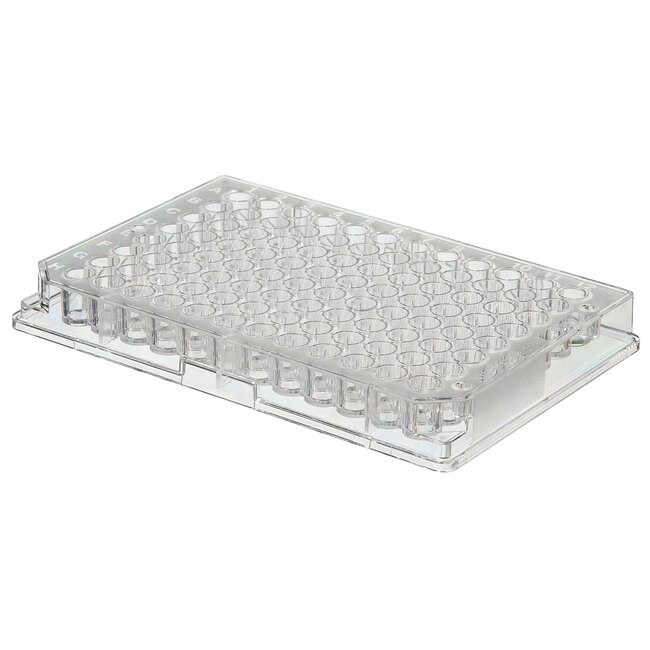
For Clear Flat-Bottom Immuno Nonsterile 96-Well Plates, is the surface treatment solely on the bottom of the well, or is it also applied to the sides?
For energy treated plates, the entire plate surface receives the energy treatment. The MaxiSorp, PolySorp, MediSorp and MultiSorp plates are energy treated plates. For traditionally treated plates, the well surface is treated up to the listed working volume.
What length of peptide is ideal for binding to the Thermo Scientific MaxiSorp surface? What are the detection limitations?
We have tested and found that a 3 amino acid peptide (Pro, Leu, Gly) cannot be detected when passively adsorbed on the MaxiSorp surface. However, this peptide can be detected when covalently immobilized using CovaLink NH Modules and CovaLink NH2 Modules and Plates. Using covalent immobilization of small peptide residues, you can typically obtain a better orientation of the molecule and reduced problems with antibody recognition of the peptide due to masking of the epitope. We have discovered that a 7 amino acid peptide from the MHC Class II antigen can be detected when adsorbed on the MaxiSorp surface. We state that the detection limitation using the MaxiSorp surface is between 3 and 7 amino acid residues.
One additional note is that detection is contingent upon the orientation of the peptide when immobilized. If the active site is inactivated or hidden at the site facing the solid phase, no detection signal is observed.
Can I bind either single- or double-stranded DNA to the Thermo Scientific MaxiSorp surface?
Single-stranded DNA can be adsorbed to our MaxiSorp surface using approximately 10 µg ssDNA per mL PBS, pH 8.2, although the stability is uncertain. Based on our experience, ssDNA immobilized on the MaxiSorp surface is so loosely bound that it can be removed by stringent washing.
Double-stranded DNA will not bind to the MaxiSorp surface. DNA, however, can be covalently bound to Nunc NucleoLink Strips.
For Nunc Immuno plates and modules, what are the advantages of one well geometry type over another? Which types should I use for various applications?
The following list describes the geometries of wells available for Nunc Immuno-plates and modules:
- Flat bottom (F): Allows maximum transmission of light. These plates can be read on a monochromatic reader.
- Round bottom (U): This geometry optimizes washing and coating. These plates can be read using a dual wavelength reader.
- "C" bottom (C): This design of the well is a combination of both flat and round bottoms. Basically, it is a flat bottomed well with curved edges at the bottom. These plates also can be read using a monochromatic reader combining optimal reading and washing.
- StarWell: These wells have a modified "C" shape geometry with eight fins strategically placed at the bottom. This feature increases surface area, allowing more molecules to become immobilized which reduces incubation times.
What is the difference between certified and non-certified MaxiSorp plates and modules?
Both of these surfaces are identical. The only difference between them is that for the certified plates, a representative sample from each manufacturing lot undergoes a Binding Capacity test. This test is an ELISA-like assay used in our quality control laboratories to ensure binding capabilities.