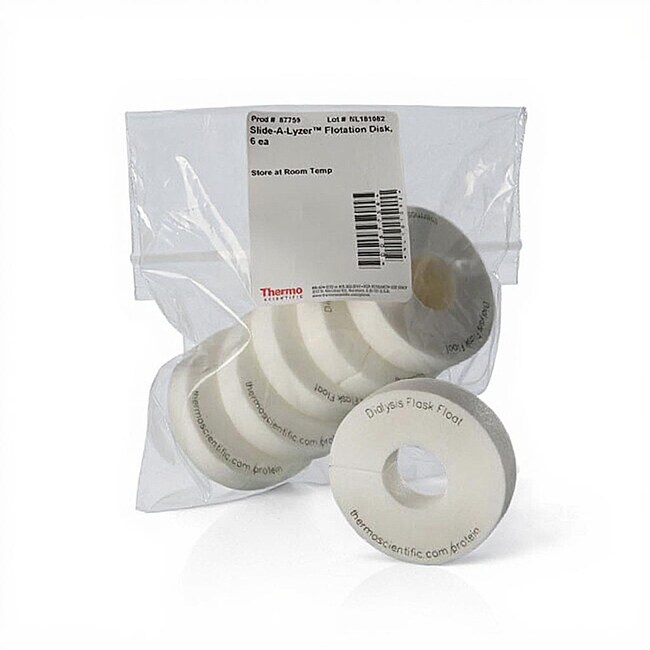
Slide-A-Lyzer™ 透析浮选盘
Thermo Scientific™

Slide-A-Lyzer™ 透析浮选盘

便利的浮选盘可与各 Thermo Scientific Slide-A-Lyzer 透析瓶配合使用。当与透析瓶颈部连接时,浮动盘可使透析瓶在垂直位置进行浮动,以便简单安全地进行操作。更多产品数据•透析膜的分离特性相关产品Slide-A-Lyzer™ 透析瓶,10K MWCO,250 mLSlide-A-Lyzer™了解更多信息
Have Questions?
货号数量
877596片
货号 87759
价格(CNY)
380.00
Each
数量:
6片
请求批量或定制报价
价格(CNY)
380.00
Each
便利的浮选盘可与各 Thermo Scientific Slide-A-Lyzer 透析瓶配合使用。当与透析瓶颈部连接时,浮动盘可使透析瓶在垂直位置进行浮动,以便简单安全地进行操作。

更多产品数据
透析膜的分离特性

相关产品
Slide-A-Lyzer™ 透析瓶,10K MWCO,250 mL
Slide-A-Lyzer™ 透析瓶,2K MWCO,250 mL
Slide-A-Lyzer™ 透析瓶,3.5K MWCO,230 mL
Slide-A-Lyzer™ 透析瓶,20K MWCO,250 mL
For Research Use Only. Not for use in diagnostic procedures.
规格
纤维素膜,透析
产品线Slide-A-Lyzer
产品类型Dialysis Flotation Disks
数量6片
产品规格细胞培养瓶 (T75)
样品体积(公制)250 mL
Unit SizeEach
内容与储存
在环境温度运输。收到后,请在室温下储存。

常见问题解答 (FAQ)

If the Slide-A-Lyzer Dialysis Cassette is not reusable, why are there four portholes?

It is possible to add reagents to the Slide-A-Lyzer Dialysis Cassette at different times using different portholes, allow a reaction to occur, and then dialyze in the same Slide-A-Lyzer Dialysis Cassette, reducing sample loss through reduced sample handling.

Find additional tips, troubleshooting help, and resources within our Protein Purification and Isolation Support Center.

Why did my sample volume increase during dialysis?

Most likely it‘s because osmotic pressure from dialyzing from high osmolarity to low osmolarity solutions causes a sample volume increase, as each sample component-including water-will move towards equilibrium concentration on both sides of the membrane.

What is the protein recovery after dialysis when using the 96-well Microdialysis plate?

Typical protein recovery is greater than 90% after dialysis.

Do I need to use all 96 wells in the Pierce 96-well microdalysis plate at one time?

The plate comprises detachable strips so that you can pull out the exact number of wells needed for an experiment (scalable from 1-96 samples).

How much sample will I lose in the Slide-A-Lyzer Dialysis Cassette?

The Slide-A-Lyzer Dialysis Cassette is the same regenerated cellulose as other dialysis tubing so you can expect about the same amount of protein loss as with tubing. As a guide, a 1 mg/mL solution will have a recovery rate of greater than 95%; at 100 mg/mL the recovery drops to 75-80%; and in solutions as dilute 10 µg/mL users may observe only a 50% (or less) recovery.