Search


引用和文献 (2)
Invitrogen™
用于活细胞成像的 TRA-1-60 Alexa Fluor™ 488 偶联试剂盒
Molecular Probes™ 人多能干细胞 (PSC) 活细胞成像试剂盒提供用于优质人活 PSC 成像的试剂。该 TRA-1-60 Alexa了解更多信息
| 货号 | 数量 |
|---|---|
| A25618 | 50 tests |
货号 A25618
价格(CNY)
6,491.00
Each
数量:
50 tests
价格(CNY)
6,491.00
Each
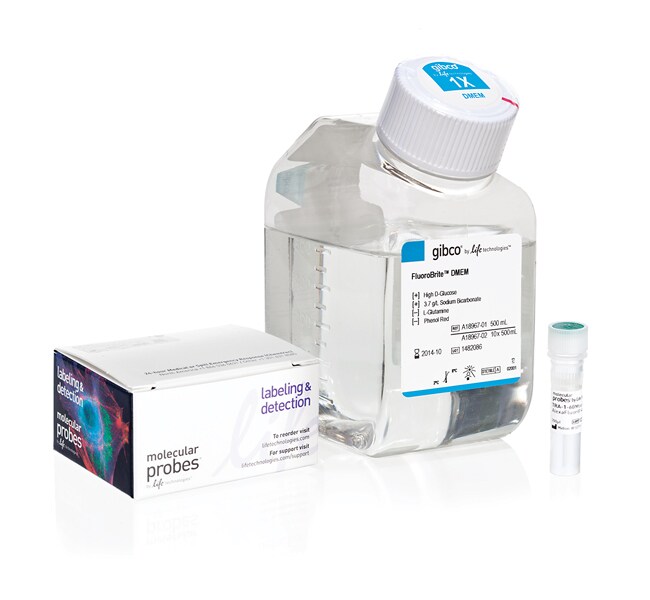
Molecular Probes™ 人多能干细胞 (PSC) 活细胞成像试剂盒提供用于优质人活 PSC 成像的试剂。该 TRA-1-60 Alexa Fluor™ 488 偶联试剂盒包括一个与减少背景成像介质 (FluoroBrite™ DMEM) 配对的良好标记的一抗,用于特异性检测 PSC 标志物 TRA-1-60。对于 PSC 标志物和胚层标志物的固定细胞染色,我们推荐使用多能干细胞 4-标志物免疫细胞化学技术试剂盒。
使用活细胞成像用 TRA-1-60 Alexa Fluor™ 488 偶联试剂盒,您可以:
•使用极佳染料偶联抗体确认关键多能干细胞标志物的表达
•保持细胞健康并增强 FluoroBrite™ DMEM 荧光信号
•使用检测不含常见污染物的试剂对活细胞样品进行有把握的染色
确认关键 PSC 标志物的表达
通过使用高性能的明亮、光稳定 Alexa Fluor™染料,本试剂盒能够对表面 PSC 标志物 TRA-1-60 进行可靠活细胞检测。已证实这种抗体偶联物与 FluoroBrite™ DMEM 配合使用时可显示出卓越的染色结果。
可维持细胞健康并增强信号
FluoroBrite™ DMEM 中的染色细胞使细胞健康较大化,并在进行活细胞荧光成像时提高信噪比。
对活细胞样品进行有把握的染色
与大多数其他偶联抗体不同,本试剂盒中提供的试剂均经 0.2 µm 无菌过滤,且经检测不含常见污染物。
产品包装规格
可轻松扩展至任何培养板、培养皿或玻片规格,TRA-1-60 Alexa Fluor™ 488 偶联试剂盒所含试剂使用 200 µL 染色体积足以对 50 份样品进行染色,包括:
•200 µL Alexa Fluor™ 488 小鼠抗人 TRA-1-60(50X 浓缩)
• 500 mL FluoroBrite™ DMEM
使用活细胞成像用 TRA-1-60 Alexa Fluor™ 488 偶联试剂盒,您可以:
•使用极佳染料偶联抗体确认关键多能干细胞标志物的表达
•保持细胞健康并增强 FluoroBrite™ DMEM 荧光信号
•使用检测不含常见污染物的试剂对活细胞样品进行有把握的染色
确认关键 PSC 标志物的表达
通过使用高性能的明亮、光稳定 Alexa Fluor™染料,本试剂盒能够对表面 PSC 标志物 TRA-1-60 进行可靠活细胞检测。已证实这种抗体偶联物与 FluoroBrite™ DMEM 配合使用时可显示出卓越的染色结果。
可维持细胞健康并增强信号
FluoroBrite™ DMEM 中的染色细胞使细胞健康较大化,并在进行活细胞荧光成像时提高信噪比。
对活细胞样品进行有把握的染色
与大多数其他偶联抗体不同,本试剂盒中提供的试剂均经 0.2 µm 无菌过滤,且经检测不含常见污染物。
产品包装规格
可轻松扩展至任何培养板、培养皿或玻片规格,TRA-1-60 Alexa Fluor™ 488 偶联试剂盒所含试剂使用 200 µL 染色体积足以对 50 份样品进行染色,包括:
•200 µL Alexa Fluor™ 488 小鼠抗人 TRA-1-60(50X 浓缩)
• 500 mL FluoroBrite™ DMEM
仅供科研使用。不可用于诊断程序。
规格
产品类型偶联试剂盒
数量50 tests
偶联物Alexa Fluor 488
产品线Alexa Fluor
Unit SizeEach
内容与储存
- 200 µL Alexa Fluor™ 488 小鼠抗人 TRA-1-60(50 x 浓缩)(在 2°C 至 8°C 下储存)
- 500 mL FluoroBrite™ DMEM
- 在 2°C 至 8°C 下避光储存
引用和文献 (2)
引用和文献
Abstract
Improved Generation of Induced Pluripotent Stem Cells From Hair Derived Keratinocytes - A Tool to Study Neurodevelopmental Disorders as ADHD.
Journal:Front Cell Neurosci
PubMed ID:30319360
'In the last decade, there is an increasing application of induced pluripotent stem cells (iPSCs) for disease modeling. The iPSC technology enables the study of patient-specific neuronal cell lines in vitro to evaluate dysfunction at the cellular level and identify the responsible genetic factors. This approach might be particularly valuable
Lineage-Specific Differentiation Is Influenced by State of Human Pluripotency.
Journal:Cell Rep
PubMed ID:28380358
Human pluripotent stem cells (hPSCs) have been reported in naive and primed states. However, the ability to generate mature cell types remains the imperative property for utility of hPSCs. Here, we reveal that the naive state enhances self-renewal while restricting lineage differentiation in vitro to neural default fate. Molecular analyses indicate