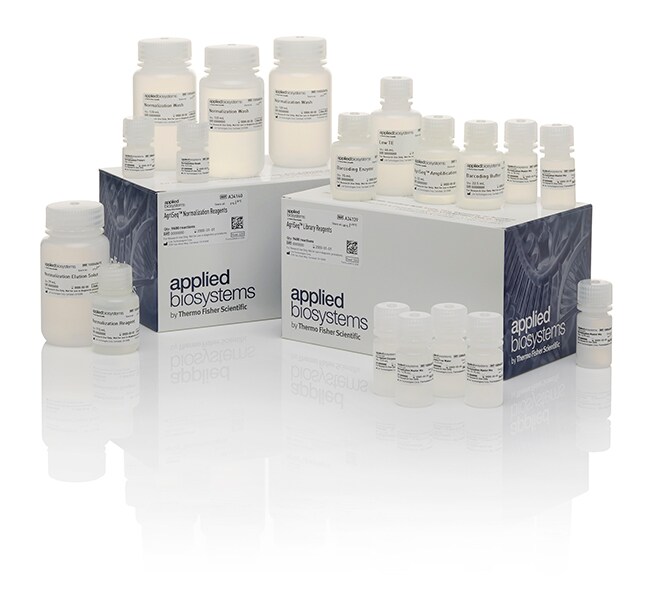
AgriSeq ™ 高通量筛选建库试剂盒
Applied Biosystems™

AgriSeq ™ 高通量筛选建库试剂盒

Applied Biosystems AgriSeq 高通量筛选建库试剂盒专门设计用于农业基因组学靶向测序法基因分型 (GBS) 应用中的扩增子文库的高通量制备。主要产品特点包括:•多重靶向扩增的卓越均一性可获得稳定的可重现的结果•简化的工作流程使得可进行高通量的样品处理•方便的试剂盒组分包含文库标准化试剂和足够用于自动化平台的试剂量出色的数据质量AgriSeq 文库制备已针对 100–5000 个扩增子范围的靶向了解更多信息
Have Questions?
更改视图buttonViewtableView
货号反应次数
A341439600 Reactions
A34144960 Reactions
货号 A34143
价格(CNY)
-
反应次数:
9600 Reactions
Applied Biosystems AgriSeq 高通量筛选建库试剂盒专门设计用于农业基因组学靶向测序法基因分型 (GBS) 应用中的扩增子文库的高通量制备

。主要产品特点包括:
•多重靶向扩增的卓越均一性可获得稳定的可重现的结果
•简化的工作流程使得可进行高通量的样品处理
•方便的试剂盒组分包含文库标准化试剂和足够用于自动化平台的试剂量

出色的数据质量
AgriSeq 文库制备已针对 100–5000 个扩增子范围的靶向 GBS panel 进行了优化。AgriSeq 扩增采用高效且特异的多重技术,基于一组最近设计的 9 个panel(涉及 7 个不同物种中的 62–3000 个扩增子范围),可产生高均一性 (87.2%–99.3%)、在靶率 (85.7%–99.7%)和总体基因型检出率 (87.5%–99.7%) 的文库。下图显示了 192 份样品中一个 3000个扩增子的panel的平均均一性为 98.2%(即以至少 0.2X 的平均读取深度覆盖了 98% 的碱基)。均一的覆盖度是非常重要的,因为它可以减少获得一致的基因型检出所需的测序量,所以降低了每份样品的测序成本。相比之下,竞品技术 TruSeq 报告了较弱的多重扩增性能,仅可提供 88% 的平均均一性以及最多为 1536个扩增子的多重检测能力见参考数据)。

高通量的样品处理
可以在 96 孔或 384 孔板中运行 AgriSeq 文库构建的工作流程(参见下图),使用低至 10 ng 的DNA 起始量/反应进行高通量样品处理。该工作流程经过优化,可通过处理混合样品,最大程度地减少了样品处理工作和相关试剂的使用。这使得工作流程可通过较少的移液步骤完成,有助于减少出错的可能性,并可简化常用第三方平台(如 Tecan 或 Hamilton 系统)上的自动化设置。标准数据分析处理包括使用配套的 Torrent Suite 软件和 Variant Caller 插件进行自动质量评估、校准和基因型检出,无需生物信息学家、较为昂贵的数据存储或第三方程序。

方便的包装包含文库标准化试剂和足够用于自动化平台的试剂量
AgriSeq 高通量筛选试剂盒可提供大包装(960 或 9600 次反应)从而满足高通量农业基因组学项目的需求,同时减少不必要的包装的成本和浪费。AgriSeq 高通量筛选试剂盒不仅包括文库制备试剂,而且包含文库标准化所需的所有组分,有助于在样品之间获得一致性结果,并提供充足的富余量以配套自动化工作流程。对于农业基因组学用户而言,每份样品的检测成本很低,因此 AgriSeq 靶向GBS技术 是一种可产生高通量基因分型数据以推进您的育种项目的经济方法。

仅供科研使用。不可用于诊断程序。
规格
适用于(应用)测序
适用于(设备)Ion GeneStudio S5 系统
靶向测序库
反应次数9600 Reactions
产品线AgriSeq
产品类型HTS 文库试剂盒
数量9600 reactions
样品类型DNA
运输条件经验证可在室温下或者采用冰袋或干冰运输
工作流程步骤文库生成
产品规格试剂盒
测序类型基因组和 DNA 测序
Unit SizeEach
内容与储存
在冷冻冰箱(-5 至 -30°C)中储存。

常见问题解答 (FAQ)

With the AgriSeq HTS Library Kit, I see high molecular weight material present during sequencing. Why is this?

Here are possible causes and recommended solutions:
-High molecular weight DNA may not have been removed during purification of the amplified library. No action is required.
-Inserts may have formed concatemers during the ligation step. We recommend reducing the nucleic acid input, requantifying using the Qubit 1X dsDNA HS Assay Kit, Qubit dsDNA HS Assay Kit, or the Quant-iT DNA Assay Kit, High Sensitivity and Qubit Fluorometer, and reducing the target amplification cycle number.
Note: High molecular weight DNA does not interfere with sequencing.

Find additional tips, troubleshooting help, and resources within our Capillary Electrophoresis Applications Support Center.

Why is my library concentration high with the AgriSeq HTS Library Kit?

Here are possible causes and recommended solutions:
-The sample DNA may have been misquantified. We recommend requantifying using the Qubit 1X dsDNA HS Assay Kit, Qubit dsDNA HS Assay Kit, or the Quant-iT DNA Assay Kit, High Sensitivity and Qubit Fluorometer.
-More than 10 ng of sample DNA may have been used. We recommend adding the recommended amount of DNA (10 ng) or decreasing the number of target amplification cycles.
Note: Library yield is not indicative of quality.

Find additional tips, troubleshooting help, and resources within our Capillary Electrophoresis Applications Support Center.

Why is my library concentration low with the AgriSeq HTS Library Kit?

Here are possible causes and recommended solutions:
-The sample may have been misquantified. We recommend requantifying the sample DNA using the Qubit 1X dsDNA HS Assay Kit, Qubit dsDNA HS Assay Kit, or the Quant-iT DNA Assay Kit, High Sensitivity and Qubit Fluorometer.
-Residual ethanol from AMPure purification may have inhibited library amplification. We recommend carefully removing all drops of ethanol before library amplification, then centrifuging the plate, if needed. Repeat residual ethanol removal.
-The sample quality may have been low. We recommend adding more DNA or increasing target amplification cycles and ensuring that the input DNA is free of PCR inhibitors. Please contact Technical Support at techsupport@thermofisher.com for details.
-The PCR, digestion, or ligation reactions may have been inefficient. We recommend ensuring proper dispensing and mixing of viscous components at each step.
-The AMPure XP beads may have been overdried. We recommend not drying the AMPure XP beads for more than 1 min.
-The Normalization Beads may not have been washed. We recommend ensuring that the Normalization Beads are washed before use.
-The wrong Normalization Primers may have been used. We recommend using the Normalization Primers that are provided in the AgriSeq HTS Library Kit.
-Residual Normalization Wash may have been present after was. We recommend carefully removing all the Normalization Wash before elution.
Note: Library yield is not indicative of quality.

Find additional tips, troubleshooting help, and resources within our Capillary Electrophoresis Applications Support Center.

What can I use IonCode Barcode Adapters, 1153-1536 for?

When used in combination with other IonCode barcode adapters (Cat. Nos. A31173, A36546, and A44599) and the AgriSeq HTS Library Kit (Cat. Nos. A34143 and A34144), IonCode Barcode Adapters, 1153-1536 enables pooling up to 1,536 amplicon libraries to conduct multiplexed sequencing analysis.

Find additional tips, troubleshooting help, and resources within our Next-Generation Sequencing Support Center.

What is the total hands-on time for the AgriSeq workflow?

The AgriSeq workflow requires less than 4 hours of hands-on time, from sample preparation through data analysis.

Find additional tips, troubleshooting help, and resources within our Capillary Electrophoresis Applications Support Center.