Search


引用和文献 (6)
Invitrogen™
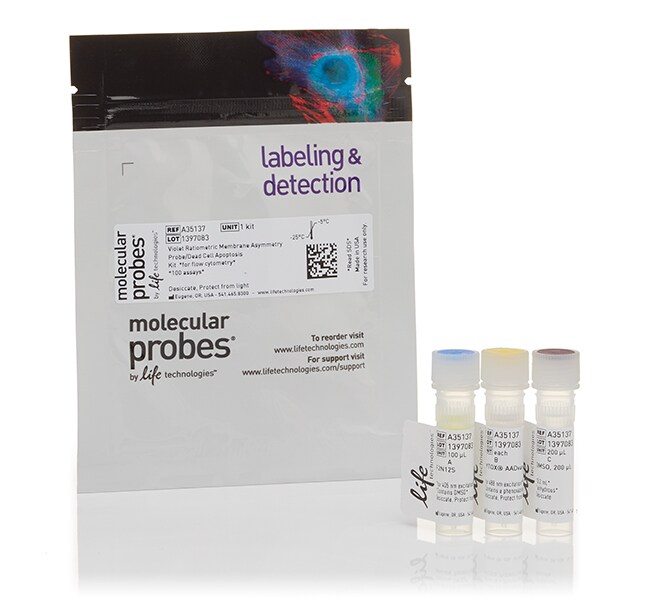
紫色膜不对称性比率式探针/死细胞凋亡检测试剂盒,用于流式细胞分析
紫色膜不对称性比率式探针/死细胞凋亡检测试剂盒,用于流式细胞分析
| 货号 | 数量 |
|---|---|
| A35137 | 1 kit |
货号 A35137
价格(CNY)
5,635.00
飞享价
Ends: 31-Dec-2026
7,488.00共减 1,853.00 (25%)
Each
数量:
1 kit
价格(CNY)
5,635.00
飞享价
Ends: 31-Dec-2026
7,488.00共减 1,853.00 (25%)
Each
紫色膜不对称性比率式探针/死细胞凋亡检测试剂盒提供了简单而快速的检测细胞凋亡与细胞死亡的流式细胞分析方法。紫色不对称性比率式探针,4'-N,N-二乙氨基-6-(N,N,N-十二烷基-甲基氨基-磺丙基)-甲基-3-羟基黄酮 (F2N12S) 是一种新型可激发紫色染料,用于检测凋亡过程中细胞膜上磷脂的不对称性变化。该染料能产生激发态分子内质子转移 (ESIPT) 效应,产生波长为530 nm 和585 nm 的双发射光谱带,可对表面电荷的变化产生双重颜色比率式响应。对比传统荧光染料标记试剂,比率式探针具有多个优点。因此,该比率式探针是一种凋亡形态变化的自校准绝对参数,不受探针浓度、细胞大小和仪器变化(激光强度或检测器灵敏度波动等)的影响。由于细胞凋亡改变了质膜外层的表面电荷,通过两种染料的发射光谱带的相对强度的变化,F2N12S 可用于监测凋亡时膜不对称性的变化。F2N12S 探针与 SYTOX(R) AADvanced 死细胞染色剂结合使用,该染色剂只能通过凋亡晚期或坏死细胞的细胞膜,以此来识别早期凋亡细胞。样品在室温孵育 5 分钟即可进行分析,不需要特别的缓冲液或者清洗步骤。该试剂盒可以与其他试剂如 MitoProbe™ DiIC1(5)或膜联蛋白 V 配合以用于细胞凋亡和活性的多参数分析。本试剂盒让研究人员能够通过利用紫色激光较大程度地发挥仪器的性能。每个试剂盒所含的试剂足以进行 ∼100 次流式细胞分析检测。
查看用于流式细胞分析的所有细胞凋亡试验的选择指南。
查看用于流式细胞分析的所有细胞凋亡试验的选择指南。
仅供科研使用。不可用于诊断程序。
规格
激发/发射SYTOX™ AADvanced™: 546/647
F2N12S:405/530
F2N12S:405/530
流式细胞仪激光线路405、488
适用于(应用)流式细胞分析
适用于(设备)流式细胞仪
标签类型其他标记或染料
标签或染料F2N12S、SYTOX AADvanced 死细胞染色剂
反应次数100
产品类型死细胞细胞凋亡试剂盒
数量1 kit
运输条件干冰
检测方法荧光
产品规格管装
Unit SizeEach
内容与储存
包含1瓶 F2N12S (100 µL)、1瓶 SYTOX™ AADvanced™ 死细胞染色剂,以及1瓶 DMSO (200 µL)。
请储存于 -20°C 下的避光干燥处。
请储存于 -20°C 下的避光干燥处。
引用和文献 (6)
引用和文献
Abstract
Visualization of lipid domains in giant unilamellar vesicles using an environment-sensitive membrane probe based on 3-hydroxyflavone.
Journal:Biochim Biophys Acta
PubMed ID:19027712
'We characterized the recently introduced environment-sensitive fluorescent membrane probe based on 3-hydroxyflavone, F2N12S, in model lipid membranes displaying liquid disordered (Ld) phase, liquid ordered (Lo) phase, or their coexistence. Steady-state fluorescence studies in large unilamellar vesicles show that the probe dual emission drastically changes with the lipid bilayer phase, which
Monitoring biophysical properties of lipid membranes by environment-sensitive fluorescent probes.
Journal:Biophys J
PubMed ID:19413953
We review the main trends in the development of fluorescence probes to obtain information about the structure, dynamics, and interactions in biomembranes. These probes are efficient for studying the microscopic analogs of viscosity, polarity, and hydration, as well as the molecular order, environment relaxation, and electrostatic potentials at the sites
Excited state proton transfer and solvent relaxation of a 3-hydroxyflavone probe in lipid bilayers.
Journal:J Phys Chem B
PubMed ID:18729506
The photophysics of a ratiometric fluorescent probe, N-[[4'- N, N-diethylamino-3-hydroxy-6-flavonyl]methyl]- N-methyl- N-(3-sulfopropyl)-1-dodecanaminium, inner salt (F2N12S), incorporated into phospholipid unilamellar vesicles is presented. The reconstructed time-resolved emission spectra (TRES) unravels a unique feature in the photophysics of this probe. TRES exhibit signatures of both an excited-state intramolecular proton transfer (ESIPT) and
Fluorescent biomembrane probe for ratiometric detection of apoptosis.
Journal:J Am Chem Soc
PubMed ID:17256940
Herein, we developed the first ratiometric fluorescent probe for apoptosis detection. This probe incorporates selectively into the outer leaflet of the cell plasma membrane and senses the loss of the plasma membrane asymmetry occurring during the early steps of apoptosis. The high specificity to the plasma membranes was achieved by
Death receptor 5 is activated by fucosylation in colon cancer cells.
Journal:FEBS J
PubMed ID:30589515
'The remarkable pro-apoptotic properties of tumour necrosis factor (TNF)-related apoptosis-inducing ligand (TRAIL) have led to considerable interest in this protein as a potential anticancer therapeutic. However, TRAIL is largely ineffective in inducing apoptosis in certain cancer cells, and the mechanisms underlying this selectivity are unknown. In colon adenocarcinomas, posttranslational modifications