Search


引用和文献 (18)
Invitrogen™
CellROX™ Orange 试剂(用于氧化应激检测)
用于测量活细胞氧化应激的新型荧光探针
| 货号 | 数量 |
|---|---|
| C10443 | 250 μL |
货号 C10443
价格(CNY)
5,951.00
飞享价
Ends: 31-Dec-2026
8,265.00共减 2,314.00 (28%)
Each
数量:
250 μL
价格(CNY)
5,951.00
飞享价
Ends: 31-Dec-2026
8,265.00共减 2,314.00 (28%)
Each
CellROX™ Orange 试剂是一种用于测量活细胞氧化应激的新型荧光探针。这种细胞可透过性染料在还原状态时不发出荧光,经活性氧簇 (ROS) 氧化后发出明亮的橙色荧光,最大吸收/发射波长 ∼545/565 nm。虽然本试剂与甲醛固定不兼容,但它可以与其他活细胞兼容的探针联用,如 GFP、CellEvent™ Caspase 3/7 Green 试剂、Image-iT™ DEAD Green、Green 和 Deep Red MitoTracker™ 染料以及 NucBlue™ 试剂。
CellROX™ Orange 试剂可与多种平台兼容,如传统的荧光显微镜检查、高内涵筛选 (HCS) 和流式细胞仪。本试剂还可与 Tali™ 成像型多色细胞分析仪兼容。
此外,CellROX™ Orange 试剂:
• 与其他活细胞探针(包括 GFP)兼容,可直接添加到含血清的生长培养基中
• 以稳定的即用型 DMSO 溶液形式提供,具有简单的方案,与荧光显微镜检查的标准工作流程兼容
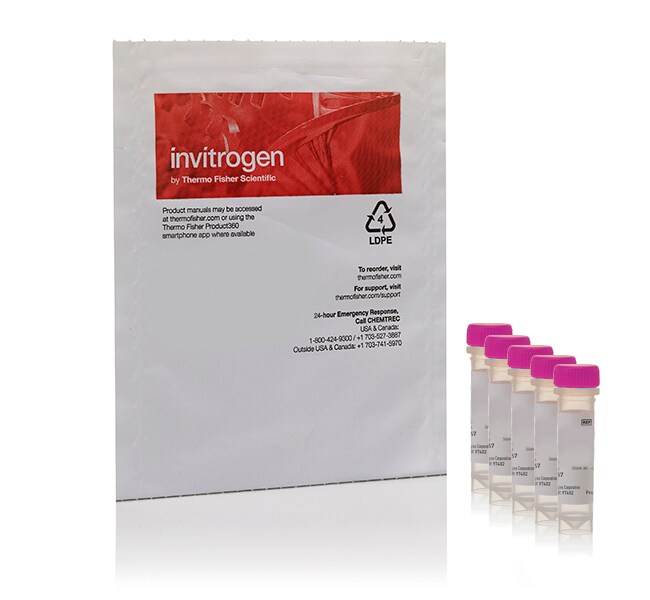
• 以 5 个一次性使用的样品瓶提供,所含总试剂量足够用于五个 96 孔板或 100 个盖玻片反应
由于活性氧簇 (ROS) 的生成和细胞清除活性氧簇的能力之间的失衡而造成氧化应激。ROS 在多种疾病(包括炎症、动脉粥样硬化、衰老和年龄相关退行性疾病)的进展中发挥重要作用。
仅供科研使用。不得用于任何动物或人类的治疗或诊断。
CellROX™ Orange 试剂可与多种平台兼容,如传统的荧光显微镜检查、高内涵筛选 (HCS) 和流式细胞仪。本试剂还可与 Tali™ 成像型多色细胞分析仪兼容。
此外,CellROX™ Orange 试剂:
• 与其他活细胞探针(包括 GFP)兼容,可直接添加到含血清的生长培养基中
• 以稳定的即用型 DMSO 溶液形式提供,具有简单的方案,与荧光显微镜检查的标准工作流程兼容
• 以 5 个一次性使用的样品瓶提供,所含总试剂量足够用于五个 96 孔板或 100 个盖玻片反应
由于活性氧簇 (ROS) 的生成和细胞清除活性氧簇的能力之间的失衡而造成氧化应激。ROS 在多种疾病(包括炎症、动脉粥样硬化、衰老和年龄相关退行性疾病)的进展中发挥重要作用。
仅供科研使用。不得用于任何动物或人类的治疗或诊断。
仅供科研使用。不可用于诊断程序。
规格
颜色橙色
最大浓度2.5 mM stabilized solution in DMSO
适用于(设备)Imaging, HCS, Cytometer
产品规格冰冻
数量250 μL
检测方法Live Cell Imaging
激发/发射545/565 nm
指示器Oxidative stress
产品线CellROX
Unit SizeEach
内容与储存
Store at ≤–20°C. Protect from light and desiccate.
常见问题解答 (FAQ)
哪些染料可以用来检测细菌内的活性氧(ROS)?
我试着用活性氧(ROS)指示染料标记我的细胞,但没有观察到信号的明显差异。这是怎么回事?
What dyes can I use to detect reactive oxygen species (ROS) in my bacteria?
I am trying to label my cells with a reactive oxygen species (ROS) indicator dye, but I am not seeing a significant difference in signal. What could be happening?
引用和文献 (18)
引用和文献
Abstract
MicroRNA-27 (miR-27) Targets Prohibitin and Impairs Adipocyte Differentiation and Mitochondrial Function in Human Adipose-derived Stem Cells.
Journal:
PubMed ID:24133204
Prohibitin (PHB) has been reported to play a crucial role in adipocyte differentiation and mitochondrial function. However, the regulative mechanism of PHB during adipogenesis remains unclear. In this study, we determined that the levels of both microRNA (miR)-27a and miR-27b were down-regulated following adipogenic induction of human adipose-derived stem cells,
Mitohormesis in Hypothalamic POMC Neurons Mediates Regular Exercise-Induced High-Turnover Metabolism.
Journal:Cell Metab
PubMed ID:33535098
Anti-inflammatory effect of strawberry extract against LPS-induced stress in RAW 264.7 macrophages.
Journal:Food Chem Toxicol
PubMed ID:28130090
'A common denominator in the pathogenesis of most chronic inflammatory diseases is the involvement of oxidative stress, related to ROS production by all aerobic organisms. Dietary antioxidants from plant foods represent an efficient strategy to counteract this condition. The aim of the present study was to evaluate the protective effects
Targeting Breast Cancer Stem Cell State Equilibrium through Modulation of Redox Signaling.
Journal:Cell Metab
PubMed ID:29972798
Integrative Omics Analyses Reveal Epigenetic Memory in Diabetic Renal Cells Regulating Genes Associated With Kidney Dysfunction.
Journal:Diabetes
PubMed ID:32747424