Search


引用和文献 (17)
Invitrogen™
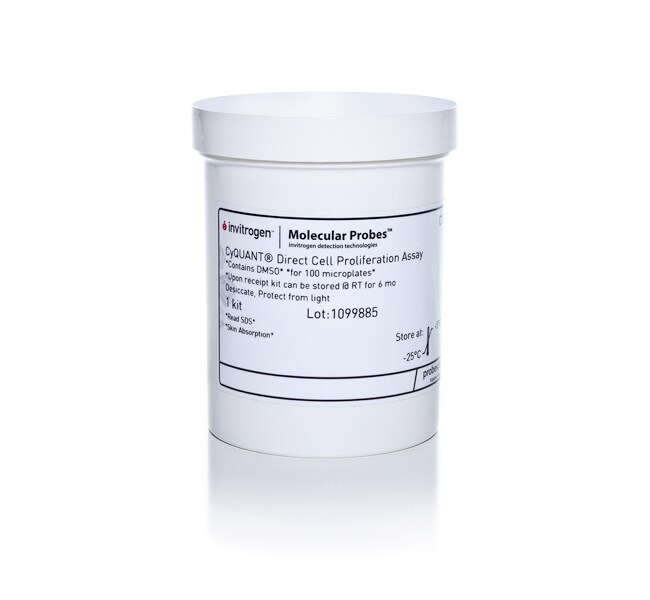
CyQUANT™ NF 细胞增殖检测
CyQUANT™ NF 细胞增殖检测提供了在微孔板内对群体内细胞进行定量的快速灵敏方法。CyQUANT™ NF 细胞增殖检测的特点为:•比 MTT 或 AlamarBlue™ 测定试剂盒更灵敏•线性检测范围为每孔100至20,000个细胞了解更多信息
Have Questions?
更改视图

| 货号 | 细胞类型 | 数量 |
|---|---|---|
| C35012 | Direct Cell | 100 Microplates |
| C35011 | Direct Cell | 10 Microplates |
| C35013 | Direct Red Cell | 10块微孔板 |
| C35007 | NF Cell | 200 Assays |
| C7026 | For cells in culture | 1000 次检测 |
| C35006 | NF Cell | 1000 Assays |
| C7027 | Cell Lysis Buffer | 50 mL |
货号 C35012
价格(CNY)
51,884.00
Each
细胞类型:
Direct Cell
数量:
100 Microplates
价格(CNY)
51,884.00
Each
CyQUANT™ NF 细胞增殖检测提供了在微孔板内对群体内细胞进行定量的快速灵敏方法。
CyQUANT™ NF 细胞增殖检测的特点为:
•比 MTT 或 AlamarBlue™ 测定试剂盒更灵敏
•线性检测范围为每孔100至20,000个细胞(96孔微孔板)
•测定试剂盒可以在一小时内完成
快速简单的细胞增殖检测方法
CyQUANT™ NF 细胞增殖测定试剂盒不需要细胞裂解、长时间孵育、放射性标记或从细胞中去除染色剂。CyQUANT™ NF 检测无需进行原始 CyQUANT™ 细胞增殖检测的冻融细胞裂解步骤,代之以一种细胞通透性的 DNA 结合染料和一种质膜通透性的试剂。CyQUANT™ NF 细胞增殖测定试剂盒可以在96孔或384孔微孔板内使用,有两种包装形式:200次测定试剂盒 (C35007),适用于较小样本量,以及1000次测定试剂盒 (C35006),适用于高通量应用。
AlamarBlue™ 是 TREK Diagnostic Systems 公司的注册商标。
CyQUANT™ NF 细胞增殖检测的特点为:
•比 MTT 或 AlamarBlue™ 测定试剂盒更灵敏
•线性检测范围为每孔100至20,000个细胞(96孔微孔板)
•测定试剂盒可以在一小时内完成
快速简单的细胞增殖检测方法
CyQUANT™ NF 细胞增殖测定试剂盒不需要细胞裂解、长时间孵育、放射性标记或从细胞中去除染色剂。CyQUANT™ NF 检测无需进行原始 CyQUANT™ 细胞增殖检测的冻融细胞裂解步骤,代之以一种细胞通透性的 DNA 结合染料和一种质膜通透性的试剂。CyQUANT™ NF 细胞增殖测定试剂盒可以在96孔或384孔微孔板内使用,有两种包装形式:200次测定试剂盒 (C35007),适用于较小样本量,以及1000次测定试剂盒 (C35006),适用于高通量应用。
AlamarBlue™ 是 TREK Diagnostic Systems 公司的注册商标。
仅供科研使用。不可用于诊断程序。
规格
细胞类型Direct Cell
培养环境悬浮细胞培养、贴壁细胞培养
检测方法荧光
染料类型CyQuant
发射波长535 nm
激发/发射508/527 nm
激发波长480 nm
产品规格96-well Plate, 384-well Plate, 1536-well Plate
孵育时间60 min
数量100 Microplates
运输条件室温
颜色绿色
适用于(应用)Cell Proliferation
适用于(设备)微孔板读数仪, 分光光度计, 显微镜
产品线CyQUANT、Molecular Probes
产品类型细胞增殖测定试剂盒
Unit SizeEach
内容与储存
- 5 mL CyQUANT™ Direct 核酸染色剂(组分 A)
- 25 ml CyQUANT™ Direct 背景抑制剂 I(组分 B)
- 2°C 到25°C 下储存。干燥避光保存。
常见问题解答 (FAQ)
你们提供测定神经元细胞健康的产品吗?
MTT cell proliferation plate assays require cellular metabolism to modify the reagent and thus, only live cells will be counted. Is this true for CyQUANT Direct Cell Proliferation Assay, too?
MTT cell proliferation assays require cellular metabolism to turn over the reagent, and thus only live cells will be counted. Is this true for CyQUANT Direct as well?
What volumes should I use to make a 10X stock solution for the CyQUANT Direct Cell Proliferation Assay (Cat. No. C35011, C35012)?
Are the components of the CyQUANT Direct Red Cell Proliferation Assay and CyQuant Direct Cell Proliferation Assay kits interchangeable?
引用和文献 (17)
引用和文献
Abstract
Application of a high-content multiparameter cytotoxicity assay to prioritize compounds based on toxicity potential in humans.
Journal:J Biomol Screen
PubMed ID:18566484
'Prioritization of compounds based on human hepatotoxicity potential is currently a key unmet need in drug discovery, as it can become a major problem for several lead compounds in later stages of the drug discovery pipeline. The authors report the validation and implementation of a high-content multiparametric cytotoxicity assay based
Activator of G protein signaling 3 promotes epithelial cell proliferation in PKD.
Journal:J Am Soc Nephrol
PubMed ID:20488951
'The activation of heterotrimeric G protein signaling is a key feature in the pathophysiology of polycystic kidney diseases (PKD). In this study, we report abnormal overexpression of activator of G protein signaling 3 (AGS3), a receptor-independent regulator of heterotrimeric G proteins, in rodents and humans with both autosomal recessive and
The matricellular protein cysteine-rich protein 61 (CCN1/Cyr61) enhances physiological adaptation of retinal vessels and reduces pathological neovascularization associated with ischemic retinopathy.
Journal:J Biol Chem
PubMed ID:21212276
'Retinal vascular damages are the cardinal hallmarks of retinopathy of prematurity (ROP), a leading cause of vision impairment and blindness in childhood. Both angiogenesis and vasculogenesis are disrupted in the hyperoxia-induced vaso-obliteration phase, and recapitulated, although aberrantly, in the subsequent ischemia-induced neovessel formation phase of ROP. Yet, whereas the histopathological
Selective blockade of cytoskeletal actin remodeling reduces experimental choroidal neovascularization.
Journal:Invest Ophthalmol Vis Sci
PubMed ID:21178140
'The efficacy of the peptide Ac-EEED on reducing cell adhesion and proliferation in vitro and choroidal neovascularization (CNV) in vivo was examined. The peptide chimera containing the Ac-EEED sequence was chemically linked to the N terminus of the XMTM delivery peptide from the E(rns) viral surface protein. Ac-EEED or scrambled
Loss of activator of G-protein signaling 3 impairs renal tubular regeneration following acute kidney injury in rodents.
Journal:FASEB J
PubMed ID:21343176
The intracellular mechanisms underlying renal tubular epithelial cell proliferation and tubular repair following ischemia-reperfusion injury (IRI) remain poorly understood. In this report, we demonstrate that activator of G-protein signaling 3 (AGS3), an unconventional receptor-independent regulator of heterotrimeric G-protein function, influences renal tubular regeneration following IRI. In rat kidneys exposed to