Search

Invitrogen™
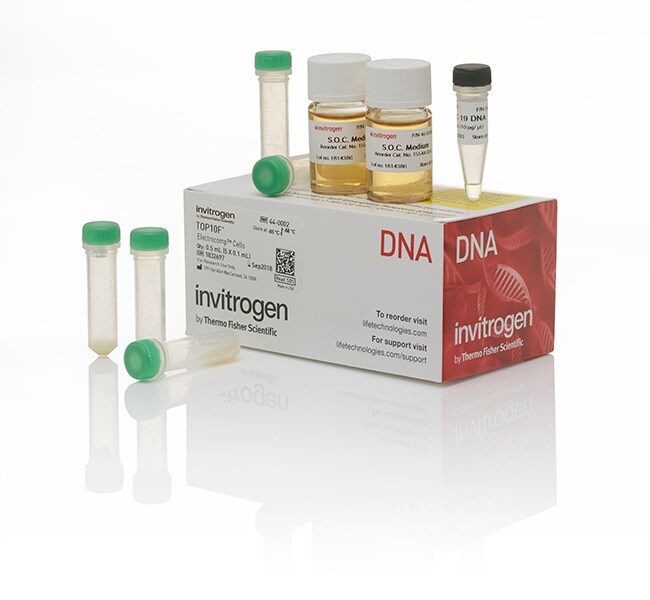
TOP10F' Electrocomp™ 试剂盒
TOP10F´ Electrocomp Kit E. coli cells are identical to TOP10 cells, with the addition of an F´ episome. The F´了解更多信息
| 货号 | 数量 |
|---|---|
| C66511 | 10 x 100μL |
货号 C66511
价格(CNY)
3,586.00
飞享价
Ends: 31-Dec-2026
4,483.00共减 897.00 (20%)
Each
数量:
10 x 100μL
价格(CNY)
3,586.00
飞享价
Ends: 31-Dec-2026
4,483.00共减 897.00 (20%)
Each
TOP10F´ Electrocomp Kit E. coli cells are identical to TOP10 cells, with the addition of an F´ episome. The F´ episome carries the tetracycline resistance gene and allows isolation of single-stranded DNA (ssDNA) from vectors that have an f1 origin of replication. In addition, the F´ episome carries the lacIq repressor for inducible expression from trc, tac, and lac promoters using IPTG.
TOP10F´ competent cells are transformed via electroporation, thus achieving higher transformation efficiencies than chemically competent cells and may be used in more challenging applications, including cloning a low amount of DNA or cDNA and gDNA library construction. These cells allow stable replication of high copy number plasmids and are provided at a transformation efficiency of >1 x 10¹⁰ cfu/ μg supercoiled DNA and are ideal for high-efficiency cloning and plasmid propagation.
As a derivative of TOP10, TOP10F´ cells carry mutations in the methylation-dependent restriction system (mcrA, mcrBC, and mrr) allowing one to clone both prokaryotic and eukaryotic genomic DNA, as well as efficient plasmid rescue from eukaryotic genomes. Similar to other DH strains, the TOP10 strain also has recA1 and endA1 mutations to increase insert stability and improve the quality of plasmid DNA prepared from minipreps.
TOP10F´ Electrocomp Kit E. coli cells offer:
• Transformation efficiencies of >1 x 10¹⁰ cfu/μg
• Stable F´ episome that allows isolation of ssDNA and carries lacIq repressor for inducible expression from trc, tac, and lac promoters
• hsdR for efficient transformation of unmethylated DNA from PCR amplifications
• mcrA for efficient transformation of methylated DNA from genomic preparations
• lacZΔM15 for blue/white color screening of recombinant clones on plates containing either X-Gal or Bluo-Gal
• endA1 for cleaner DNA preparations and better results in downstream applications due to elimination of nonspecific digestion by Endonuclease I
• recA1 for reduced occurrence of nonspecific recombination in cloned DNA
Note: TOP10F´ cells require IPTG induction for blue-white color screening. A high-voltage electroporation apparatus is also required.
Genotype
F´ [lacIq, Tn10(TetR)] mcrA Δ(mrr-hsdRMS-mcrBC) φ80lacZΔM15 ΔlacX74 recA1 araD139 Δ(ara-leu)7697 galU galK rpsL(StrR) endA1 nupG
Find the strains and formats that fit your needs
We offer other DH strains in chemically competent and electrocompetent cell.
Electroporation cuvettes with 0.1 cm, 0.2 cm, and 0.4 cm gaps are available.
The TOP10 strain is available in several MultiShot formats for high throughput applications.
We offer other strains for ssDNA production, such as DH12S.
Explore bacterial growth media formats.
仅供科研使用。不可用于诊断程序。
规格
蓝色/白色筛查是
是否可克隆甲基化 DNA是
克隆不稳定 DNA不适合克隆不稳定DNA
提高质粒质量是
质粒可用于 > 20 kb 的质粒
制备无甲基化 DNA不适合制备未甲基化DNA
产品线DH10B,Electrocomp
产品类型Electrocomp 试剂盒
数量10 x 100μL
减少克隆重组现象是
运输条件Dry Ice
转化效率级别高效率 (> 10^9 cfu⁄μg)
产品规格One Shot
种属大肠杆菌
Unit SizeEach
内容与储存
该试剂盒含有足够用于 20 x 40 μL 反应或 40 x 20 μL 反应的电转感受态细胞。有关反应规模建议,请参见产品手册。