Search


引用和文献 (4)
Thermo Scientific™
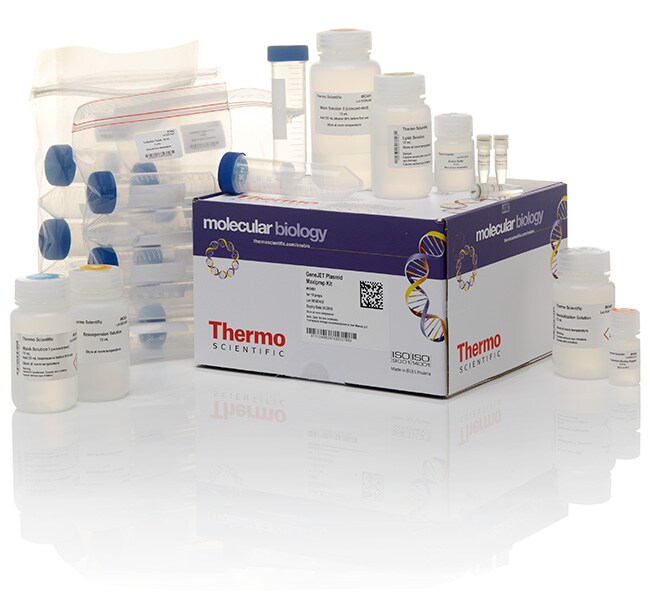
GeneJET 质粒大提试剂盒
Thermo Scientific GeneJET 质粒大提试剂盒足够用于 25 次制备,采用便捷离心柱形式的硅胶膜技术。每次制备可回收高达 750 μg 的高拷贝质粒了解更多信息
Have Questions?
更改视图

| 货号 | 反应次数 |
|---|---|
| K0491 | 10 次制备 |
| K0492 | 25 次制备 |
货号 K0491
价格(CNY)
-
反应次数:
10 次制备
Thermo Scientific GeneJET 质粒大提试剂盒足够用于 25 次制备,采用便捷离心柱形式的硅胶膜技术。每次制备可回收高达 750 μg 的高拷贝质粒 DNA,可用于各种分子生物学程序,例如限制性核酸内切酶酶切、PCR、克隆、转化、自动测序、体外转录和稳健细胞系转染。
产品优势
•高效—在 250 mL 细菌培养物中获得高达 750 μg 的高质量质粒 DNA
•高浓度的纯化 DNA—> 400 ng/μL
• 便捷—离心柱形式、离心或真空方案
•快速—程序需 60 分钟,比使用重力流柱快得多
应用
•分离的质粒 DNA 适用于所有常规分子生物学程序,包括:
•稳健细胞系转染
• FastDigest 限制性内切酶酶切
•自动荧光测序
•PCR
•克隆
•转化
•体外转录
产品优势
•高效—在 250 mL 细菌培养物中获得高达 750 μg 的高质量质粒 DNA
•高浓度的纯化 DNA—> 400 ng/μL
• 便捷—离心柱形式、离心或真空方案
•快速—程序需 60 分钟,比使用重力流柱快得多
应用
•分离的质粒 DNA 适用于所有常规分子生物学程序,包括:
•稳健细胞系转染
• FastDigest 限制性内切酶酶切
•自动荧光测序
•PCR
•克隆
•转化
•体外转录
仅供科研使用。不可用于诊断程序。
规格
色谱柱类型离心柱
最大浓度400 ng/µL
适用于(应用)实时荧光定量 PCR (qPCR)、转染、克隆、测序、体外转录、转化、核酸标记、PCR
高通量能力不兼容高通量应用(手动)
反应次数10 次制备
制备规模> 200 μg(大规模)质粒 DNA
产品线GeneJET
产品类型质粒 MaxiPrep 试剂盒
数量10 次制备
样品类型细菌
规格Maxi
靶标质粒 DNA
测试时间60 min。
产品规格离心柱
分离技术硅胶柱
Unit SizeEach
常见问题解答 (FAQ)
Can I use water instead of Elution Buffer in the elution step of GeneJET and MagJET nucleic acid purification kits?
Are MagJET and GeneJET plasmid purification kits compatible with EndA+ bacterial strains?
Can I use a vacuum manifold with GeneJET kits?
At what temperature should I perform centrifugation steps in the GeneJET kits?
Are GeneJET spin columns or MagJET magnetic beads available separately?
引用和文献 (4)
引用和文献
Abstract
Biochemical characterization of the human ubiquitous glucose-6-phosphatase in neutrophil granulocytes.
Journal:FEBS open bio
PubMed ID:39548727
Glucose‐6‐phosphatase‐β (G6PC3) is a ubiquitous phosphatase present in the endoplasmic reticulum, which, unlike G6PC1, is not responsible for maintaining blood glucose level under starvation. Recently, G6PC3 has been shown to play an important role in neutrophil granulocytes, eliminating the toxic metabolite 1,5‐anhydroglucitol‐6‐phosphate. The present study aimed to look for alternative
Universal Glycosyltransferase Continuous Assay for Uniform Kinetics and Inhibition Database Development and Mechanistic Studies Illustrated on ST3GAL1, C1GALT1, and FUT1.
Journal:ACS omega
PubMed ID:38645360
[Image: see text] Chemical systems glycobiology requires experimental and computational tools to make possible big data analytics benefiting genomics and proteomics. The impediment to tool development is that the nature of glycan construction and mutation is not template driven but rests on cooperative glycosyltransferase (GT) catalytic synthesis. What is needed
Inhibition of a lower potency target drives the anticancer activity of a clinical p38 inhibitor.
Journal:Cell chemical biology
PubMed ID:37827156
The small-molecule drug ralimetinib was developed as an inhibitor of the p38α mitogen-activated protein kinase, and it has advanced to phase 2 clinical trials in oncology. Here, we demonstrate that ralimetinib resembles EGFR-targeting drugs in pharmacogenomic profiling experiments and that ralimetinib inhibits EGFR kinase activity in vitro and in cellulo.
Low dietary fiber intake impairs small intestinal Th17 and intraepithelial T cell development over generations.
Journal:Cell reports
PubMed ID:37768824
Dietary fiber strongly impacts the microbiota. Here, we show that a low-fiber diet changes the small intestinal (SI) microbiota and impairs SI Th17, TCRαβ( )CD8αβ( ) and TCRαβ( )CD8αα( ) intraepithelial T cell development. We restore T cell development with dietary fiber supplementation, but this defect becomes persistent over generations