Search


引用和文献 (11)
Invitrogen™
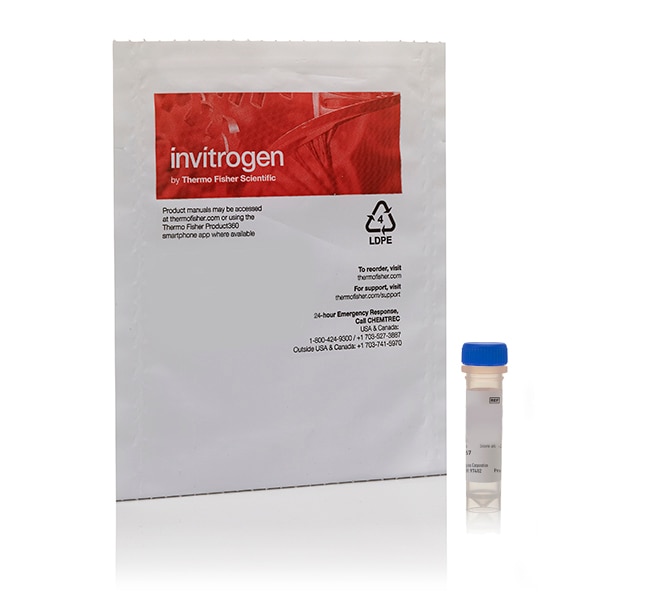
分离自 Griffonia simplicifolia 的凝集素 GS-II,Alexa Fluor™ 647偶联物
外源凝集素 GS-II 分离自热带非洲豆类 Griffonia simplicifolia,分子量为 113,000 道尔顿,由相同亚单位组成。每个亚单位都含有末端非还原型 a- 或了解更多信息
| 货号 | 数量 |
|---|---|
| L32451 | 500 μg |
货号 L32451
价格(CNY)
2,549.00
Each
数量:
500 μg
价格(CNY)
2,549.00
Each
外源凝集素 GS-II 分离自热带非洲豆类 Griffonia simplicifolia,分子量为 113,000 道尔顿,由相同亚单位组成。每个亚单位都含有末端非还原型 a- 或 ß- 连接 N-乙酰基-D-葡萄糖苷酶的单个特异性结合位点。和许多其他外源凝集素不同,GS-II 不会与任何特定血型反应。远红荧光外源凝集素 GS-II Alexa Fluor™ 647 偶联物可用于荧光显微镜检查或流式细胞分析。
查看荧光染料结合外源凝集素的完整列表›
查看荧光染料结合外源凝集素的完整列表›
仅供科研使用。不可用于诊断程序。
规格
标签类型Alexa Fluor 染料
产品线Alexa Fluor
蛋白质子类型Lectins
数量500 μg
运输条件室温
来源Africa Shrub legume
偶联物Alexa Fluor 647
形式Lyophilized
Unit SizeEach
内容与储存
储存在冰箱(-5 至 -30°C)中并避光。
引用和文献 (11)
引用和文献
Abstract
GM130 and GRASP65-dependent lateral cisternal fusion allows uniform Golgi-enzyme distribution.
Journal:Nat Cell Biol
PubMed ID:16489344
'The mammalian Golgi apparatus exists as stacks of cisternae that are laterally linked to form a continuous membrane ribbon, but neither the molecular requirements for, nor the purpose of, Golgi ribbon formation are known. Here, we demonstrate that ribbon formation is mediated by specific membrane-fusion events that occur during Golgi
Cross-talks of glycosylphosphatidylinositol biosynthesis with glycosphingolipid biosynthesis and ER-associated degradation.
Journal:Nat Commun
PubMed ID:32054864
Up-regulation of Aquaporin 5 Defines Spasmolytic Polypeptide-Expressing Metaplasia and Progression to Incomplete Intestinal Metaplasia.
Journal:Cell Mol Gastroenterol Hepatol
PubMed ID:34455107
Light sheet fluorescence microscopy guided MALDI-imaging mass spectrometry of cleared tissue samples.
Journal:Sci Rep
PubMed ID:32879402
Grb7 and Hax1 may colocalize partially to mitochondria in EGF-treated SKBR3 cells and their interaction can affect Caspase3 cleavage of Hax1.
Journal:J Mol Recognit
PubMed ID:26869103