Search


引用和文献 (19)
Invitrogen™
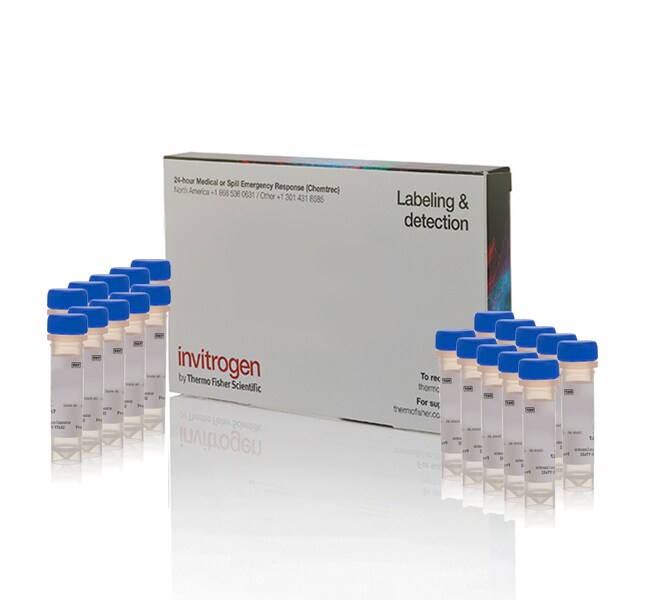
LysoSensor™ Blue DND-167 - 特殊包装
LysoSensor Blue DND-167 可用于测量溶酶体等酸性细胞器的 pH 值。LysoSensor 染料在酸性环境下的荧光会增强。LysoSensor Blue了解更多信息
| 货号 | 数量 |
|---|---|
| L7533 | 20 x 50 μL |
货号 L7533
价格(CNY)
5,868.00
Each
数量:
20 x 50 μL
价格(CNY)
5,868.00
Each
LysoSensor Blue DND-167 可用于测量溶酶体等酸性细胞器的 pH 值。LysoSensor 染料在酸性环境下的荧光会增强。LysoSensor Blue DND-167 的 pKa 为 ∼5.1。
仅供科研使用。不可用于诊断程序。
规格
最大浓度1 mM
检测方法荧光
数量20 x 50 μL
运输条件室温
子细胞定位溶酶体
颜色蓝色
发射波长范围373⁄425
适用于(设备)荧光显微镜
产品线LysoSensor
产品类型染料
Unit SizeEach
内容与储存
在冷冻冰箱(-5°C 至 -30°C)中避光储存。
常见问题解答 (FAQ)
Can I use a plate reader to measure the pH of acidic organelles, such as lysosomes, with LysoSensor ratiometric probes?
What reagents would you recommend for measuring the pH in acidic organelles, such as lysosomes?
引用和文献 (19)
引用和文献
Abstract
Expression of the voltage-gated sodium channel NaV1.5 in the macrophage late endosome regulates endosomal acidification.
Journal:J Immunol
PubMed ID:17548620
'Voltage-gated sodium channels expressed on the plasma membrane activate rapidly in response to changes in membrane potential in cells with excitable membranes such as muscle and neurons. Macrophages also require rapid signaling mechanisms as the first line of defense against invasion by microorganisms. In this study, our goal was to
Fluorescence lifetime characterization of novel low-pH probes.
Journal:Anal Biochem
PubMed ID:11444806
'The structures and functions of the cellular acidic compartments are strongly dependent on the pH gradients across vesicular membranes. Measurement and imaging of the vesicular pH require fluorophores with appropriate pK(a) values. In this report, we characterized the pH-dependent lifetime responses of a family of acidotropic probes, LysoSensors, to evaluate
Expression and localization of cathepsin k in adult rat sertoli cells.
Journal:Biol Reprod
PubMed ID:14585819
'The cathepsins are a family of cysteine proteases that have been broadly implicated in proteolytic processes during cell growth, cell development, and normal adult cellular function. Cathepsin L is a major secretory product of rat and mouse Sertoli cells, the absence of which in furless mice is associated with atrophy
Fluorescent indicators for intracellular pH.
Journal:Chem Rev
PubMed ID:19831417
This review is about intracellular pH sensors, includingsmall fluorescent organic molecules, nanoparticles, andfluorescent proteins, e.g., GFP. It focuses on their preparations, photophysical properties, and advantages/disadvantagesfor intracellular pH measurements. The discussion is limitedto fluorescent indicators that have been applied to measureintracellular pH values since 1980.
Tamoxifen inhibits acidification in cells independent of the estrogen receptor.
Journal:Proc Natl Acad Sci U S A
PubMed ID:10200279
Tamoxifen has been reported to have numerous physiological effects that are independent of the estrogen receptor, including sensitization of resistant tumor cells to many chemotherapeutic agents. Drug-resistant cells sequester weak base chemotherapeutics in acidic organelles away from their sites of action in the cytosol and nucleus. This work reports that