Search


引用和文献 (54)
Invitrogen™
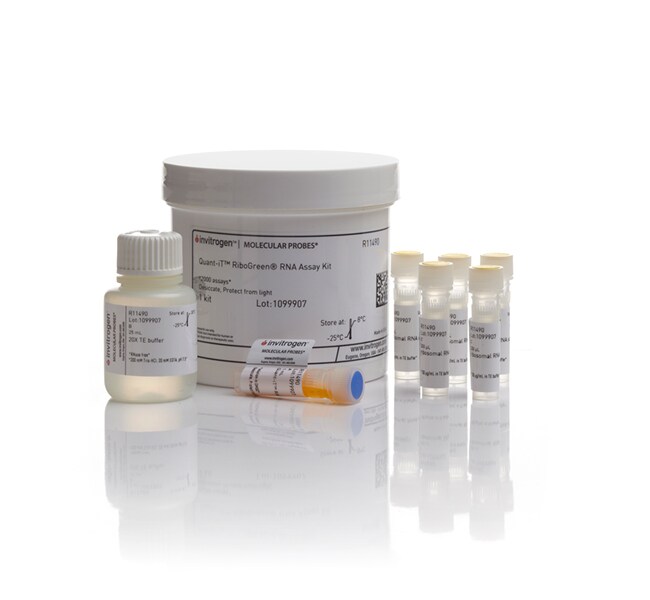
Quant-iT™ RiboGreen RNA 定量试剂盒与 RiboGreen RNA 试剂、RediPlate™ 96 RiboGreen™ RNA 定量试剂盒
Quant-iT RiboGreen RNA Reagent is an ultrasensitive fluorescent nucleic acid stain for quantitating RNA in solution. The Quant-iT RiboGreen RNA Assay Kit comes with reagent, dilution buffer, and rRNA standards to provide a linear detection range of 1–200 ng of RNA.
Have Questions?
更改视图

| 货号 | 数量 | 产品类型 | 定量范围 |
|---|---|---|---|
| R11490 | 1 kit | Quant-iT RiboGreen RNA 试剂盒 | 1 至 200 ng |
| R11491 | 1 mL | Quant-iT RiboGreen RNA 试剂 | 1 至 200 ng |
| R32700 | 1 kit | RediPlate 96 RiboGreen RNA 试剂盒 | 3 至 200 ng |
货号 R11490
价格(CNY)
5,080.00
Online exclusive
Ends: 26-Sep-2026
7,815.00共减 2,735.00 (35%)
Each
数量:
1 kit
产品类型:
Quant-iT RiboGreen RNA 试剂盒
定量范围:
1 至 200 ng
价格(CNY)
5,080.00
Online exclusive
Ends: 26-Sep-2026
7,815.00共减 2,735.00 (35%)
Each
Quant-iT RiboGreen RNA Reagent is an ultrasensitive fluorescent nucleic acid stain for quantitating RNA in solution. The Quant-iT RiboGreen RNA Assay Kit comes with reagent, dilution buffer, and rRNA standards to provide a linear detection range of 1–200 ng of RNA.
Workflow
This easy-to-use reagent offers two detection ranges: a high-assay range and a low-assay range for sensitive and broad range detection. To use, simply prepare the working solution by diluting the provided dye with TE-Buffer, then aliquotting 100 µL of the working solution with standards and samples for a total reaction volume of 200 µL. RNA is then quantitated using a fluorescence microplate reader (such as Varioskan ALF) at standard fluorescein wavelengths.
Applications
Detecting and quantitating small amounts of RNA is important in many applications including measuring yields of in vitro transcribed RNA and measuring RNA concentrations before performing Northern blot analyses, S1 nuclease assays, RNase protection assays, cDNA library preparation, reverse transcription PCR, and differential display PCR.
仅供科研使用。不可用于诊断程序。
规格
激发/发射500/525
适用于(设备)微孔板读数仪
反应次数200-2,000 次试管测定,使用 2 mL 测定体积
产品线Quant-iT、RIBOGREEN
产品类型Quant-iT RiboGreen RNA 试剂盒
定量范围1 至 200 ng
数量1 kit
运输条件室温
检测方法荧光
Unit SizeEach
常见问题解答 (FAQ)
为什么我用Qubit Assay检测时会得到负的荧光值?
Quant-iT RNA试剂盒的线性范围是多少?
Quant-iT RNA检测试剂和Quant-iT RiboGreen RNA检测试剂之间有什么区别?
我们可以为Qubit荧光计制定我自己的检测方案吗?
我有一个粗裂解物。使用Quant-iT和Qubit检测试剂能行吗?
引用和文献 (54)
引用和文献
Abstract
microRNAs exhibit high frequency genomic alterations in human cancer.
Journal:Proceedings of the National Academy of Sciences of the United States of America
PubMed ID:16754881
MicroRNAs (miRNAs) are endogenous noncoding RNAs, which negatively regulate gene expression. To determine genomewide miRNA DNA copy number abnormalities in cancer, 283 known human miRNA genes were analyzed by high-resolution array-based comparative genomic hybridization in 227 human ovarian cancer, breast cancer, and melanoma specimens. A high proportion of genomic loci
A fluorescence-based assay for multisubunit DNA-dependent RNA polymerases.
Journal:Anal Biochem
PubMed ID:14690681
The properties of DNA-dependent RNA polymerases have been studied since the 1960s, but considerable interest in probing RNA polymerase structure/function relationships, the roles of different classes of RNA polymerases in cellular processes, and the feasibility of using RNA polymerases as drug targets still exists. Historically, RNA polymerase activity has been
Quantification of mRNA using real-time RT-PCR.
Journal:Nat Protoc
PubMed ID:17406449
'The real-time reverse transcription polymerase chain reaction (RT-qPCR) addresses the evident requirement for quantitative data analysis in molecular medicine, biotechnology, microbiology and diagnostics and has become the method of choice for the quantification of mRNA. Although it is often described as a "gold" standard, it is far from being a
A systemic small RNA signaling system in plants.
Journal:Plant Cell
PubMed ID:15258266
'Systemic translocation of RNA exerts non-cell-autonomous control over plant development and defense. Long-distance delivery of mRNA has been proven, but transport of small interfering RNA and microRNA remains to be demonstrated. Analyses performed on phloem sap collected from a range of plants identified populations of small RNA species. The dynamic
Fibrinogen induces IL-8 synthesis in human neutrophils stimulated with formyl-methionyl-leucyl-phenylalanine or leukotriene B(4).
Journal:J Immunol
PubMed ID:11509634
'Human exudative neutrophils have greatly increased stores of the neutrophil chemoattractant IL-8 compared with peripheral blood cells, but the mechanism for the increase is not defined. In this report, we show that treatment of peripheral blood neutrophils with the chemotactic peptide fMLP or with leukotriene B(4) or fibrinogen results in