Search


Citations & References (12)
Invitrogen™
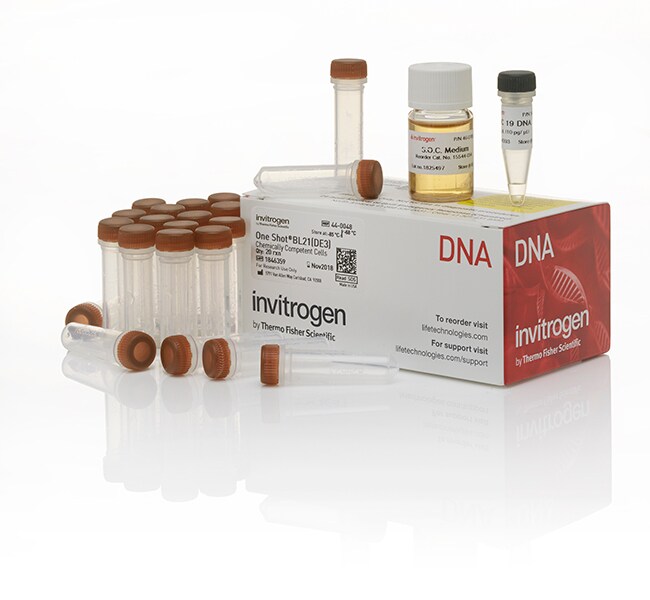
One Shot™ BL21(DE3) Chemically Competent E. coli
One Shot™ BL21(DE3)ケミカルコンピテント大腸菌は、バクテリオファージ T7 プロモーターベースの発現システム(pRSET、PCR™T7詳細を見る
| 製品番号(カタログ番号) | 数量 |
|---|---|
| C600003 | 20x50 μL |
製品番号(カタログ番号) C600003
価格(JPY)お問い合わせください ›
81,300
Each
数量:
20x50 μL
One Shot™ BL21(DE3)ケミカルコンピテント大腸菌は、バクテリオファージ T7 プロモーターベースの発現システム(pRSET、PCR™T7、および PET など)での使用に最適です。BL21(DE3)細胞は、lambda DE3 lysogen を運びます。大腸菌に毒性 のない組換えタンパク質は、BL21(DE3) pLysS または BL21(DE3) pLysE よりも BL21(DE3)細胞において高いレベルで一般的に発現されます。しかし、BL21(DE3) pLysS や BL21(DE3) pLysE よりも、異種遺伝子の基礎発現レベルは有意に高くなっています。
BL21 株について。
BL21 株は大腸菌 B 株に由来し、組換えタンパク質の高レベル発現用に特別に構築されています。これらの菌株は、タンパク質発現に最適な 2 つの重要な特性を持っています。重要な遺伝子マーカーとタンパク質発現の誘導性です。最も重要な遺伝子マーカーは、組換え RNA および / またはタンパク質が分解することなく高レベルに蓄積するのに役立ちます。Inducibility は、一部の組換えタンパク質の毒性の影響を最小限に抑えるのに役立ちます。
BL21 株について。
BL21 株は大腸菌 B 株に由来し、組換えタンパク質の高レベル発現用に特別に構築されています。これらの菌株は、タンパク質発現に最適な 2 つの重要な特性を持っています。重要な遺伝子マーカーとタンパク質発現の誘導性です。最も重要な遺伝子マーカーは、組換え RNA および / またはタンパク質が分解することなく高レベルに蓄積するのに役立ちます。Inducibility は、一部の組換えタンパク質の毒性の影響を最小限に抑えるのに役立ちます。
研究用にのみ使用できます。診断用には使用いただけません。
仕様
抗生物質耐性菌No
青/白スクリーニング不可
メチル化DNAのクローニング不可
F'エピソームを含むF’エピソームが欠落しています
高スループット適合性ハイスループット非対応(手動)
プラスミドの品質を向上不可
Improves Protein StabilityYes (lon, ompT)
Improves RNA StabilityNo
非メチル化DNAの調製Yes (dcm)
製品ラインOne Shot
製品タイプコンピテントセル
数量20x50 μL
組換えを抑制不可
出荷条件Dry Ice
T1ファージ-耐性(tonA)不可
Toxic ProteinsNo
形質転換効率レベル中効率 (10^8-10^9 cfu⁄µg)
フォーマットOne Shot
プロモーターT7
種E. coli
Unit SizeEach
組成および保存条件
内容:
• One Shot™ BL21(DE3)大腸菌:20 バイアル、各 50µ l(合計 1 ml)
• pUC19 DNA( 10 pg/ul):1 バイアル、50 µl
• SOC 培地:1本、6 ml
Competent Cellは-80℃で保存してください。pUC19 DNAは-20℃で保存してください。SOC培地は4℃または室温で保存してください。
• One Shot™ BL21(DE3)大腸菌:20 バイアル、各 50µ l(合計 1 ml)
• pUC19 DNA( 10 pg/ul):1 バイアル、50 µl
• SOC 培地:1本、6 ml
Competent Cellは-80℃で保存してください。pUC19 DNAは-20℃で保存してください。SOC培地は4℃または室温で保存してください。
よくあるご質問(FAQ)
My gene of interest is toxic to bacterial cells. Are there any precautions you can suggest?
I'm trying to express my protein using a bacterial expression system. How do I know if I'm seeing degradation of my protein or if what I’m seeing is codon usage bias?
I'm trying to express my protein using a bacterial expression system and am getting inclusion bodies. What should I do?
I'm getting low protein yield from my bacterial expression system. What can I do to improve this?
My cells are growing very slowly, and I'm not getting any protein expression from my baterial expression system. What can I do to fix this?
引用および参考文献 (12)
引用および参考文献
Abstract
The interaction between HIV-1 Gag and human lysyl-tRNA synthetase during viral assembly.
Journal:J Biol Chem
PubMed ID:12756246
'Human lysyl-tRNA synthetase (LysRS) is a tRNA-binding protein that is selectively packaged into HIV-1 along with its cognate tRNALys isoacceptors. Evidence exists that Gag alone is sufficient for the incorporation of LysRS into virions. Herein, using both in vitro and in vivo methods, we begin to map regions in Gag
The anti-trp RNA-binding attenuation protein (Anti-TRAP), AT, recognizes the tryptophan-activated RNA binding domain of the TRAP regulatory protein.
Journal:J Biol Chem
PubMed ID:11786553
'In Bacillus subtilis, the trp RNA-binding attenuation protein (TRAP) regulates expression of genes involved in tryptophan metabolism in response to the accumulation of l-tryptophan. Tryptophan-activated TRAP negatively regulates expression by binding to specific mRNA sequences and either promoting transcription termination or blocking translation initiation. Conversely, the accumulation of uncharged tRNA(Trp)
The ISG15 isopeptidase UBP43 is regulated by proteolysis via the SCFSkp2 ubiquitin ligase.
Journal:J Biol Chem
PubMed ID:15342634
'The Skp2 oncoprotein belongs to the family of F-box proteins that function as substrate recognition factors for SCF (Skp1, cullin, F-box protein) E3 ubiquitin-ligase complexes. Binding of the substrate to the SCFSkp2 complex catalyzes the conjugation of ubiquitin molecules to the bound substrate, resulting in multi-ubiquitination and rapid degradation by
A proteolytic transmembrane signaling pathway and resistance to beta-lactams in staphylococci.
Journal:Science
PubMed ID:11239156
beta-Lactamase and penicillin-binding protein 2a mediate staphylococcal resistance to beta-lactam antibiotics, which are otherwise highly clinically effective. Production of these inducible proteins is regulated by a signal-transducing integral membrane protein and a transcriptional repressor. The signal transducer is a fusion protein with penicillin-binding and zinc metalloprotease domains. The signal for
The solution structure and interactions of CheW from Thermotoga maritima.
Journal:Nat Struct Biol
PubMed ID:11799399
Using protein from the hyperthermophile Thermotoga maritima, we have determined the solution structure of CheW, an essential component in the formation of the bacterial chemotaxis signaling complex. The overall fold is similar to the regulatory domain of the chemotaxis kinase CheA. In addition, interactions of CheW with CheA were monitored