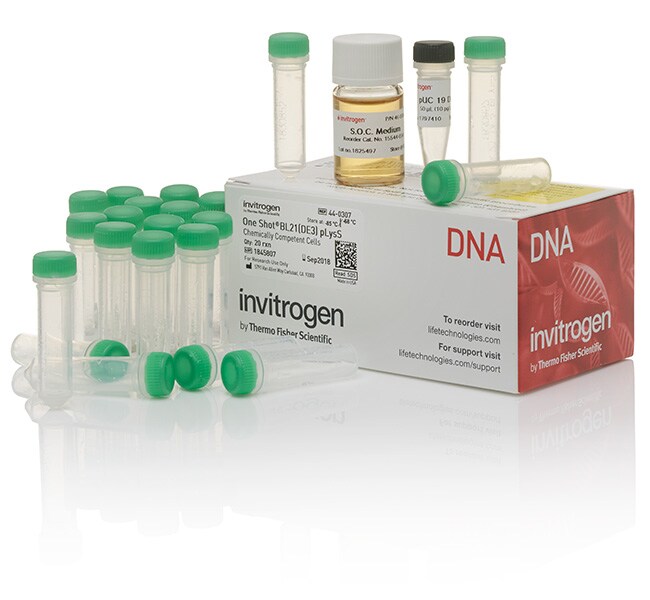
One Shot™ BL21(DE3)pLysS Chemically Competent E. coli
One Shot&trade; BL21(DE3)pLysS Chemically Competent <i>E. coli</i>
Invitrogen™

One Shot™ BL21(DE3)pLysS Chemically Competent E. coli

BL21(DE3)pLysS細胞は、T7プロモーターベースの発現系(例:pRSET、pCR™T7、pET)での使用に最適です。BL21(DE3)pLysS大腸菌は、DE3ライソジェンとプラスミドpLysSの両方を持っています。pLysSはT7リゾチームを恒常的に低レベルで発現し、T7詳細を見る
製品番号(カタログ番号)数量
C60601010x50 μL
C60600320x50 μL
製品番号(カタログ番号) C606010
価格(JPY)
36,600
飞享价
Ends: 27-Mar-2026
52,400
割引額 15,800 (30%)
Each
お問い合わせください ›
数量:
10x50 μL
BL21(DE3)pLysS細胞は、T7プロモーターベースの発現系(例:pRSET、pCR™T7、pET)での使用に最適です。BL21(DE3)pLysS大腸菌は、DE3ライソジェンとプラスミドpLysSの両方を持っています。pLysSはT7リゾチームを恒常的に低レベルで発現し、T7 RNAポリメラーゼの基礎レベルを阻害することで組換え遺伝子の基礎発現を抑制します。
研究用にのみ使用できます。診断用には使用いただけません。
仕様
抗生物質耐性菌Yes (Chloramphenicol)
青/白スクリーニング不可
メチル化DNAのクローニング不可
F'エピソームを含むF’エピソームが欠落しています
高スループット適合性ハイスループット非対応(手動)
プラスミドの品質を向上不可
Improves Protein StabilityYes (lon, ompT)
Improves RNA StabilityYes (pLysS)
非メチル化DNAの調製Yes (dcm)
製品ラインOne Shot
製品タイプコンピテントセル
数量10x50 μL
組換えを抑制不可
出荷条件Dry Ice
T1ファージ-耐性(tonA)不可
Toxic ProteinsNo
形質転換効率レベル中効率 (10^8-10^9 cfu⁄µg)
フォーマットOne Shot
プロモーターT7
E. coli
Unit SizeEach
組成および保存条件
• Chemically Competent cells (11 x 50 μL); store at –80°C
• pUC19 Control DNA (1 x 50 μL); store at –80°C
• S.O.C. Medium (6 mL); store at 4°C or room temperature

よくあるご質問(FAQ)

My gene of interest is toxic to bacterial cells. Are there any precautions you can suggest?

Several precautions may be taken to prevent problems resulting from basal level expression of a toxic gene of interest. These methods all assume that the T7-based or Champion-based expression plasmid has been correctly designed and created.

- Propagate and maintain your expression plasmid in a strain that does not contain T7 RNA polymerase (i.e., DH5α).
- If using BL21 (DE3) cells, try growing cells at room temperature rather than 37 degrees C for 24-48 hr.
- Perform a fresh transformation using a tightly regulated E. coli strain, such as BL21-AI cells.
- After following the transformation protocol, plate the transformation reaction on LB plates containing 100 µg/mL ampicillin and 0.1% glucose. The presence of glucose represses basal expression of T7 RNA polymerase.
- Following transformation of BL21-AI cells, pick 3 or 4 transformants and inoculate directly into fresh LB medium containing 100 µg/mL ampicillin or 50 µg/mL carbenicillin (and 0.1% glucose, if desired). When the culture reaches an OD600 of 0.4, induce expression of the recombinant protein by adding L-arabinose to a final concentration of 0.2%.
- When performing expression experiments, supplement the growth medium with 0.1% glucose in addition to 0.2% arabinose.
- Try a regulated bacterial expression system such as our pBAD system.

Find additional tips, troubleshooting help, and resources within our Protein Expression Support Center.

I'm trying to express my protein using a bacterial expression system. How do I know if I'm seeing degradation of my protein or if what I’m seeing is codon usage bias?

Typically, if you see 1-2 dominant bands, translation stopped prematurely due to codon usage bias. With degradation, you usually see a ladder of bands. With degradation, you can try using a protease inhibitor and add it to the lysis buffer to help prevent degradation. If degradation is the issue, a time point experiment can be done to determine the best time to harvest the cells.

Find additional tips, troubleshooting help, and resources within our Protein Expression Support Center.

I'm trying to express my protein using a bacterial expression system and am getting inclusion bodies. What should I do?

If you are having a solubility issue, try to decrease the temperature or decrease the amount of IPTG used for induction. You can also try a different, more stringent cell strain for expression. Adding 1% glucose to the bacterial culture medium during expression can also help.

Find additional tips, troubleshooting help, and resources within our Protein Expression Support Center.

I'm getting low protein yield from my bacterial expression system. What can I do to improve this?

- Inoculate from fresh bacterial cultures, since higher protein yields are generally obtained from a fresh bacterial colony.

- Check the codon usage in the recombinant protein sequence for infrequently used codons. Replacing the rare codons with more commonly used codons can significantly increase expression levels. For example, the arginine codons AGG and AGA are used infrequently by E. coli, so the level of tRNAs for these codons is low.

- Add protease inhibitors, such as PMSF, to buffers during protein purification. Use freshly made PMSF, since PMSF loses effectiveness within 30 min of dilution into an aqueous solution.

- If you are using ampicillin for selection in your expression experiments, you may be experiencing plasmid instability due to the absence of selective conditions. This occurs as the ampicillin is destroyed by β-lactamase or hydrolyzed under the acidic media conditions generated by bacterial metabolism. You may want to substitute carbenicillin for ampicillin in your transformation and expression experiments.

- The recombinant protein may be toxic to bacterial cells. Try a tighter regulation system for competent cell expression such as BL21-AI. You may also consider trying a different expression system such as the pBAD system.

Find additional tips, troubleshooting help, and resources within our Protein Expression Support Center.

My cells are growing very slowly, and I'm not getting any protein expression from my baterial expression system. What can I do to fix this?

This typically occurs when your gene of interest is toxic. Try using a tighter regulation system, such as BL21 (DE3) (pLysS) or BL21 (DE3) (pLysE), or BL21(AI).

Find additional tips, troubleshooting help, and resources within our Protein Expression Support Center.

引用および参考文献 (1)

引用および参考文献
Abstract
Cloning and characterization of a calcium-binding, histamine-releasing protein from Schistosoma mansoni.
Authors: Rao Kakuturu V N; Chen Lin; Gnanasekar Munirathinam; Ramaswamy Kalyanasundaram;
Journal:J Biol Chem
PubMed ID:12050167
A homologue of the mammalian translationally controlled tumor protein (TCTP) was cloned from the human parasite Schistosoma mansoni (SmTCTP). Sequence analysis showed that SmTCTP differed from other reported TCTPs in having only one signature sequence. Subsequently, SmTCTP was cloned in a T7 expression system and expressed as a histidine-tagged fusion ... More