Search


Citations & References (23)
Gibco™
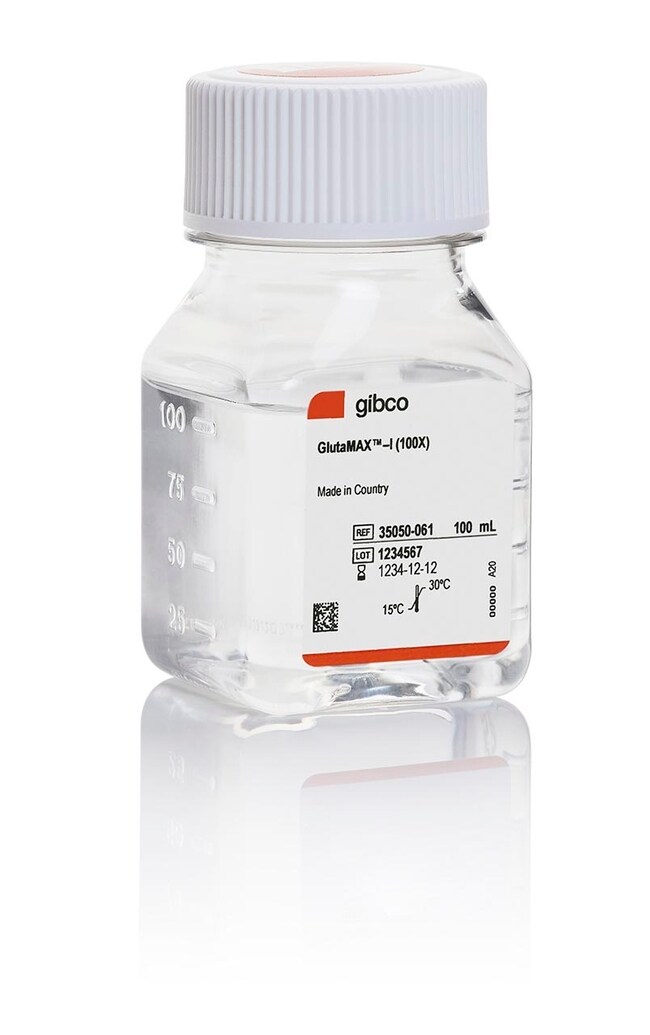
GlutaMAX™ Supplement
GlutaMAX Supplement is an L-alanyl-L-glutamine dipeptide alternative to L-glutamine. It exhibits increased stability over L-glutamine leading to improved cellular health.
Have Questions?
Change view

| Catalog Number | Quantity |
|---|---|
| 35050061 | 100 mL |
| 35050079 | 20 x 100 mL |
Catalog number 35050061
Price (KRW)
75,000
飞享价
Ends: 30-Jun-2026
83,000Save 8,000 (10%)
Each
Quantity:
100 mL
Price (KRW)
75,000
飞享价
Ends: 30-Jun-2026
83,000Save 8,000 (10%)
Each
Gibco GlutaMAX Supplement is an L-alanyl-L-glutamine dipeptide alternative to L-glutamine that exhibits increased stability, leading to improved cell health. L-Glutamine is an amino acid required in cell culture for the formation of purine and pyrimidine nucleotides, amino sugars, glutathione, L-glutamate, and other amino acids, as well as in protein synthesis and glucose production. GlutaMAX Supplement is suitable for adherent and suspension culture of mammalian cells, with no adaptation required. It is formulated as a 200 mM L-alanyl-L-glutamine dipeptide in 0.85% NaCl.
Compared to L-glutamine, GlutaMAX Supplement:
- Minimizes toxic ammonia build-up
- Improves cell viability and growth
- Remains stable across a wide range of temperatures
Minimizes toxic ammonia build-up
Unlike L-glutamine, GlutaMAX Supplement does not spontaneously break down to form ammonia. Instead, cells cleave the dipeptide bond to release L-glutamine as needed. This system prevents waste build-up and maintains a fresh supply of L-glutamine during long-term culture.
Improves cell viability and growth
Cultures with lower levels of ammonia show improved cell viability. In addition, culture conditions are more controlled due to the consistent concentration of GlutaMAX Supplement that is not possible with L-glutamine.
Remains stable across a wide range of temperatures
GlutaMAX Supplement is room-temperature stable and ready to use. It retains full functionality for 24 months at room temperature, 2 to 8°C, or -5 to -30°C for convenient storage and handling. GlutaMAX Supplement is even stable at 37°C for a week or more.
Specifications
Cell TypeMammalian Cells
Concentration100X
Culture TypeMammalian Cell Culture
For Use With (Application)Clinical Research, Translational Research
Manufacturing QualitycGMP-compliant under the ISO 13485 standard
Osmolality430 to 490 mOsm/kg
Product LineGibco, GlutaMAX
Quantity100 mL
Shelf Life24 Months
Shipping ConditionRoom Temperature
SourceAnimal Origin-free
ClassificationAnimal Origin-free
FormLiquid
Product TypeGlutaMax
SterilitySterile-filtered
pH5 to 6
Unit SizeEach
Contents & Storage
Storage conditions: 15°C to 30°C
Alternate storage conditions: -5°C to -20°C and 2°C to 8°C
Shipping conditions: Room temperature
Shelf life: 24 months from date of manufacture
Alternate storage conditions: -5°C to -20°C and 2°C to 8°C
Shipping conditions: Room temperature
Shelf life: 24 months from date of manufacture
Citations & References (23)
Citations & References
Abstract
A comparison between different human hepatocyte models reveals profound differences in net glucose production, lipid composition and metabolism in vitro.
Journal:Experimental cell research
PubMed ID:38499143
Effects of an indole derivative on cell proliferation, transfection, and alternative splicing in production of lentiviral vectors by transient co-transfection.
Journal:PloS one
PubMed ID:38833479
Lentiviral vectors derived from human immunodeficiency virus type I are widely used to deliver functional gene copies to mammalian cells for research and gene therapies. Post-transcriptional splicing of lentiviral vector transgene in transduced host and transfected producer cells presents barriers to widespread application of lentiviral vector-based therapies. The present study
Point mutations identified in Lec8 Chinese hamster ovary glycosylation mutants that inactivate both the UDP-galactose and CMP-sialic acid transporters.
Journal:J Biol Chem
PubMed ID:11319223
'Nucleotide-sugar transporters (NSTs) are critical components of glycosylation pathways in eukaryotes. The identification of structural elements that are involved in NST functions provides an important task. Chinese hamster ovary glycosylation mutants defective in nucleotide-sugar transport provide access to inactive transporters that can define such structure/function relationships. In this study, we
The generation of rhythmic activity in dissociated cultures of rat spinal cord.
Journal:Eur J Neurosci
PubMed ID:11553272
'Locomotion in vertebrates is controlled by central pattern generators in the spinal cord. The roles of specific network architecture and neuronal properties in rhythm generation by such spinal networks are not fully understood. We were able to induce similar patterns of rhythmic activity in dissociated cultures as in slice
Production, concentration and titration of pseudotyped HIV-1-based lentiviral vectors.
Journal:Nat Protoc
PubMed ID:19300443
'Over the past decade, lentiviral vectors have emerged as powerful tools for transgene delivery. The use of lentiviral vectors has become commonplace and applications in the fields of neuroscience, hematology, developmental biology, stem cell biology and transgenesis are rapidly emerging. Also, lentiviral vectors are at present being explored in the