Formalin-fixed, paraffin-embedded (FFPE) tissue is one of the most valuable (and most challenging) sample types in translational research. Hospitals have huge archives of FFPE blocks linked to diagnosis, treatment history, and outcomes, making them a goldmine for retrospective biomarker discovery. But traditional FFPE proteomics can be slow and variable because formaldehyde fixation creates crosslinks and chemical modifications, while paraffin removal and crosslink reversal add extra handling steps that increase variability and reduce throughput. A recent technical note by Thermo Fisher Scientific scientists shows how to flip that script with a streamlined, high-throughput FFPE workflow built around the Thermo Scientific Orbitrap Astral Mass Spectrometer and the Thermo Scientific OptiSpray Ion Source with the aim to reduce manual processing, keep the instrument cleaner, and deliver deep, reproducible data across large cohorts.

In the demonstrated workflow, FFPE lung tumor and matched normal lung sections are deparaffinized (xylene + ethanol washes), proteins are extracted and crosslinks reversed, and digestion/cleanup is handled with an Thermo Scientific EasyPep Mini MS Sample Prep Kit. The technical note highlights that the full process, from sample preparation through LC–MS and data analysis, can be completed in under a day, enabling rapid turnaround for cohort-scale studies.
On the LC–MS side, the authors stress throughput flexibility: 60 samples/day (SPD) with a ~20-minute gradient, 180 SPD with a ~6.8-minute gradient, and 500 SPD with an ultra-fast ~2.3-minute separation. At the deepest setting (60 SPD, 200 ng load), they report up to ~8,600 protein groups and ~105,000 peptides, then show the expected tradeoff as throughput increases while retaining substantial coverage (~70% of proteins at 180 SPD and ~45% at 500 SPD). The throughput doesn’t come at the expense of quantitation. Median protein CVs remain low (about ~5–6% at 60 SPD and ~7–10% at higher-throughput methods), with strong agreement in tumor/normal fold-changes across methods (Pearson r up to 0.93).
Differential expression at 60 SPD identifies ~1,500 significantly changing protein groups between lung tumor and normal tissue, with pathway enrichments consistent with tumor metabolism, hypoxia signaling, ECM remodeling, and immune interactions.
Visit us on LinkedIn: #ffpe #tumor #OrbitrapAstral #OptiSpray

Breaking Sensitivity Barriers: How MS³ is Transforming Biomarker Discovery for ALS and Beyond
Introduction At the recent Thermo Fisher Scientific sponsore...
Read More
Accelerating Biomarker Discovery and Validation: From Discovery to Clinical Utility
At MSACL 2025, a Thermo Fisher Scientific–sponsored worksh...
Read More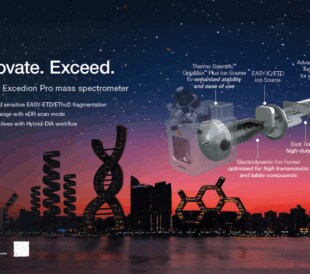
Discover. Innovate. Exceed. — Introducing the Thermo Scientific Orbitrap Excedion Pro Mass Spectrometer
Mass spectrometry is entering a new era of precision, perfor...
Read More
Accelerate Proteomics Research with Smart Automation
Modern proteomics research produces vast quantities of compl...
Read More