Search


引用和文献 (8)
Thermo Scientific™
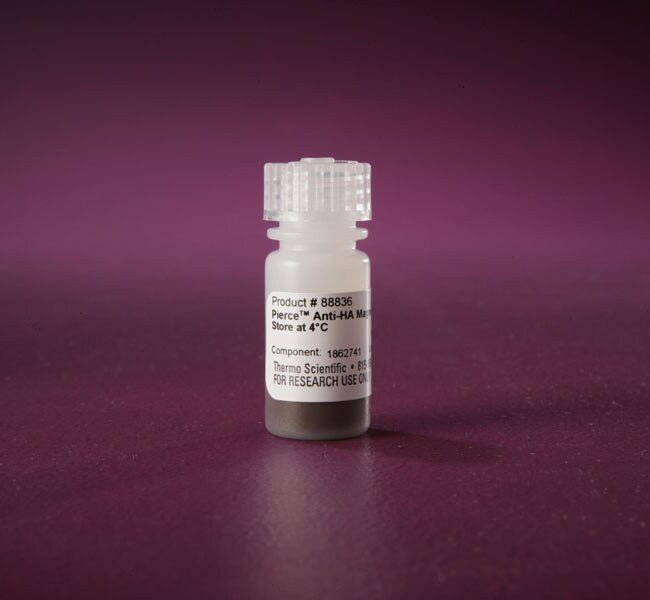
Pierce™ 抗 HA 磁珠
Thermo Scientific Pierce 抗 HA 磁珠是用于借助手动或自动磁性分离器对细菌或哺乳动物细胞或体外系统中表达的重组 HA 标签蛋白进行免疫沉淀的亲和微粒。抗 HA了解更多信息
Have Questions?
更改视图

| 货号 | 数量 |
|---|---|
| 88836 | 1 mL |
| 88837 | 5 mL |
货号 88836
价格(CNY)
2,148.00
飞享价
Ends: 26-Sep-2026
3,477.00共减 1,329.00 (38%)
Each
数量:
1 mL
价格(CNY)
2,148.00
飞享价
Ends: 26-Sep-2026
3,477.00共减 1,329.00 (38%)
Each
Thermo Scientific Pierce 抗 HA 磁珠是用于借助手动或自动磁性分离器对细菌或哺乳动物细胞或体外系统中表达的重组 HA 标签蛋白进行免疫沉淀的亲和微粒。
抗 HA 磁珠的特点:
•特异性—高度特异性抗 HA 单克隆抗体(克隆 2-2.2.14)可实现高得率和高纯度的免疫沉淀
•便利快速—产品说明提供了一个易于遵循的优化方案,可在大约一小时内完成免疫沉淀
•低非特异性结合—稳定、预封闭的磁珠以及特异性抗体尽可能减少了 HA 标签 IP 或 co-IP 实验的脱靶结合
•通用—微珠兼容手动和自动工作流程(例如,Thermo Scientific KingFisher 仪器)
该封闭的磁珠表面包被着抗 HA 抗体,一种高度特异性小鼠 IgG1 单克隆抗体,可识别来源于人流感血凝素 (HA) 蛋白 的 HA 抗原决定簇标签 (YPYDVPDYA)。Pierce 抗 HA 磁珠可与磁力架配合用于手动操作,亦可用于自动化平台,如 Thermo Scientific KingFisher 仪器,以用于高通量工作流程。
规格:
产品详情:
Pierce 抗 HA 磁珠很便利,可用于重组 HA 标签蛋白的免疫沉淀 (IP) 以及其相互作用蛋白的免疫共沉淀 (co-IP)。将微珠与含有 HA 标签蛋白的细胞裂解物一起孵育,并捕获融合蛋白。随后,洗涤微珠,然后使用 0.1 M 甘氨酸(pH 值 2.0)、50 mM NaOH 或 SDS-PAGE 样品缓冲液洗脱靶蛋白。如果需要更温和的洗脱条件,可使用 2 mg/mL Pierce HA 肽。针对上述每个条件对方案进行了优化。抗 HA 抗体可用于通过 Western 印迹分析检测 HA 标签蛋白。
抗 HA 磁珠的特点:
•特异性—高度特异性抗 HA 单克隆抗体(克隆 2-2.2.14)可实现高得率和高纯度的免疫沉淀
•便利快速—产品说明提供了一个易于遵循的优化方案,可在大约一小时内完成免疫沉淀
•低非特异性结合—稳定、预封闭的磁珠以及特异性抗体尽可能减少了 HA 标签 IP 或 co-IP 实验的脱靶结合
•通用—微珠兼容手动和自动工作流程(例如,Thermo Scientific KingFisher 仪器)
该封闭的磁珠表面包被着抗 HA 抗体,一种高度特异性小鼠 IgG1 单克隆抗体,可识别来源于人流感血凝素 (HA) 蛋白 的 HA 抗原决定簇标签 (YPYDVPDYA)。Pierce 抗 HA 磁珠可与磁力架配合用于手动操作,亦可用于自动化平台,如 Thermo Scientific KingFisher 仪器,以用于高通量工作流程。
规格:
产品详情:
Pierce 抗 HA 磁珠很便利,可用于重组 HA 标签蛋白的免疫沉淀 (IP) 以及其相互作用蛋白的免疫共沉淀 (co-IP)。将微珠与含有 HA 标签蛋白的细胞裂解物一起孵育,并捕获融合蛋白。随后,洗涤微珠,然后使用 0.1 M 甘氨酸(pH 值 2.0)、50 mM NaOH 或 SDS-PAGE 样品缓冲液洗脱靶蛋白。如果需要更温和的洗脱条件,可使用 2 mg/mL Pierce HA 肽。针对上述每个条件对方案进行了优化。抗 HA 抗体可用于通过 Western 印迹分析检测 HA 标签蛋白。
仅供科研使用。不可用于诊断程序。
Thermo Scientific™ Pierce 抗 HA 磁珠很便利,可用于重组 HA–标签蛋白的免疫沉淀 (IP) 以及其相互作用蛋白的免疫共沉淀 (co–IP)。将微珠与含有 HA–标签蛋白的细胞裂解物一起孵育,并捕获融合蛋白。随后,洗涤微珠,然后使用 0.1 M 甘氨酸(pH 值 2.0)、50 mM NaOH 或 SDS–PAGE 样品缓冲液洗脱靶蛋白。如果需要更温和的洗脱条件,可使用 2 mg/mL Pierce HA 肽。针对上述每个条件对方案进行了优化。抗 HA 抗体可用于通过 Western 印迹分析检测 HA–标签蛋白。
规格
最大浓度Slurry: 10mg/mL, 1% solids
配基类型抗体
蛋白质形式重组
数量1 mL
靶标HA
容量(公制)1 mL
形式液体
粒径1 μm
产品线Pierce
类型磁珠
Unit SizeEach
内容与储存
储存在 4°C 下。
常见问题解答 (FAQ)
Are the Pierce Anti-HA Magnetic Beads (Cat. No. 88836, 88837) compatible with sodium dodecyl sulfate? If yes, up to which concentration?
引用和文献 (8)
引用和文献
Abstract
MT4-MMP promotes invadopodia formation and cell motility in FaDu head and neck cancer cells.
Journal:Biochemical and biophysical research communications
PubMed ID:31813546
Hypoxia-inducible factor-1α (HIF-1α) induces cancer metastasis. We previously demonstrated that HIF-1α-induced membrane-type 4 matrix metalloproteinase (MT4-MMP) is involved in hypoxia-mediated metastasis in head and neck squamous cell carcinoma (HNSCC). However, the functions and detailed mechanisms of MT4-MMP in cancer metastasis are not well understood. In this study, we investigated whether
A bead-based GPCR phosphorylation immunoassay for high-throughput ligand profiling and GRK inhibitor screening.
Journal:Communications biology
PubMed ID:36352263
Analysis of agonist-driven phosphorylation of G protein-coupled receptors (GPCRs) can provide valuable insights into the receptor activation state and ligand pharmacology. However, to date, assessment of GPCR phosphorylation using high-throughput applications has been challenging. We have developed and validated a bead-based immunoassay for the quantitative assessment of agonist-induced GPCR phosphorylation
Labeling and isolating cell specific neuronal mitochondria and their functional analysis in mice post stroke.
Journal:Experimental neurology
PubMed ID:39719208
Dendritic and axonal plasticity, which mediates neurobiological recovery after a stroke, critically depends on the mitochondrial function of neurons. To investigate, in vivo, neuronal mitochondrial function at the stroke recovery stage, we employed Mito-tag mice combined with cerebral cortical infection of AAV9 produced from plasmids carrying Cre-recombinase controlled by two
Bi-allelic LAMP3 variants in childhood interstitial lung disease: a surfactant-related disease.
Journal:EBioMedicine
PubMed ID:40023045
BACKGROUND: LAMP3 encodes a lysosomal membrane protein associated with lamellar bodies and has recently been proposed as a candidate gene for childhood interstitial lung diseases (chILD). Here, we identified two LAMP3 variants in a proband with chILD and performed functional validation of these variants as well as the previously reported
A novel interaction between RNA m(6)A methyltransferase METTL3 and RREB1.
Journal:Biochemical and biophysical research communications
PubMed ID:39278095
Regulation of gene expression is achieved through the modulation of regulatory inputs both pre- and post-transcriptionally. Methyltransferase-like 3 (METTL3) is a key player in pre-mRNA processing, actively catalyzing N6-methyladenosine (m6A). Among the most enriched mRNA targets of METTL3 is the Ras Responsive Element Binding Protein 1 (RREB1), a transcription factor