Search

Invitrogen™
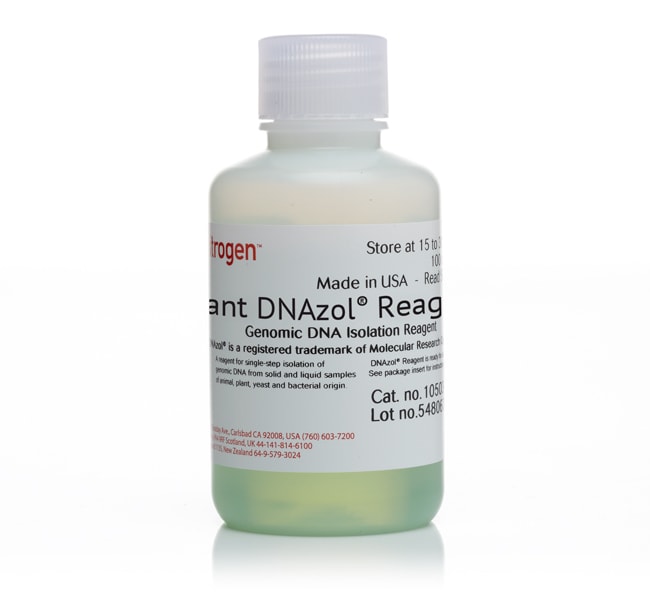
Plant DNAzol™ Reagent
Plant DNAzol™ Reagent is a ready-to-use organic reagent formulated for the isolation of high quality genomic DNA from a varietyRead more
| Catalog Number | Quantity |
|---|---|
| 10978021 | 100 mL |
Catalog number 10978021
Price (CNY)
3,502.00
Each
Quantity:
100 mL
Price (CNY)
3,502.00
Each
Plant DNAzol™ Reagent is a ready-to-use organic reagent formulated for the isolation of high quality genomic DNA from a variety of plant samples.
• Permits use on broad spectrum plant material
• Rapid isolation of genomic DNA
RNA Hydrolysis for Efficient Isolation of Genomic DNA from a Variety of Sample Sources
Plant DNAzol™ Reagent can be used for the efficient isolation of genomic DNA from a variety of plant tissues such as leaf, seed stem, root, and callus. The Plant DNAzol™ procedure is based on the use of a novel guanidine-detergent lysing solution that hydrolyzes RNA and allows the selective precipitation of DNA from the lysate.
Isolate Genomic Plant DNA in About an Hour
In the Plant DNAzol™ procedure, plant samples are pulverized in liquid nitrogen or homogenized, and genomic DNA is extracted from the homogenate with the Plant DNAzol™ Reagent. Following extraction, plant debris is removed by centrifugation and DNA is precipitated from the supernatant with ethanol, and solubilized with TE buffer (pH 8.0). The entire procedure can be completed in approximately 60-70 minutes.
Comparable Yield in Less Time and with Fewer Reagents
Unlike traditional methods for plant DNA extraction (e.g., CTAB), Plant DNAzol™ is quicker, does not require RNase A to remove RNA from genomic DNA preparations, and in the majority of tissues, does not require phenol. Furthermore, use of Plant DNAzol™ generates yields from plant tissue that are comparable with the traditional CTAB method.
Isolated DNA can be used for a Number of Downstream Applications:
• Amplified Fragment Length Polymorphism (AFLP)
• Restriction Fragment Length Polymorphism (RFLP)
• Southern Blotting
• Sequencing
• PCR
• Cloning
For Research Use Only. Not intended for animal or human diagnostic or therapeutic use.
• Permits use on broad spectrum plant material
• Rapid isolation of genomic DNA
RNA Hydrolysis for Efficient Isolation of Genomic DNA from a Variety of Sample Sources
Plant DNAzol™ Reagent can be used for the efficient isolation of genomic DNA from a variety of plant tissues such as leaf, seed stem, root, and callus. The Plant DNAzol™ procedure is based on the use of a novel guanidine-detergent lysing solution that hydrolyzes RNA and allows the selective precipitation of DNA from the lysate.
Isolate Genomic Plant DNA in About an Hour
In the Plant DNAzol™ procedure, plant samples are pulverized in liquid nitrogen or homogenized, and genomic DNA is extracted from the homogenate with the Plant DNAzol™ Reagent. Following extraction, plant debris is removed by centrifugation and DNA is precipitated from the supernatant with ethanol, and solubilized with TE buffer (pH 8.0). The entire procedure can be completed in approximately 60-70 minutes.
Comparable Yield in Less Time and with Fewer Reagents
Unlike traditional methods for plant DNA extraction (e.g., CTAB), Plant DNAzol™ is quicker, does not require RNase A to remove RNA from genomic DNA preparations, and in the majority of tissues, does not require phenol. Furthermore, use of Plant DNAzol™ generates yields from plant tissue that are comparable with the traditional CTAB method.
Isolated DNA can be used for a Number of Downstream Applications:
• Amplified Fragment Length Polymorphism (AFLP)
• Restriction Fragment Length Polymorphism (RFLP)
• Southern Blotting
• Sequencing
• PCR
• Cloning
For Research Use Only. Not intended for animal or human diagnostic or therapeutic use.
For Research Use Only. Not for use in diagnostic procedures.
Specifications
Elution Volume70 μL
Final Product TypeGenomic DNA
For Use With (Application)PCR, Southern blotting, sequencing, nucleic acid labeling, hybridization
High-throughput CompatibilityNot High-throughput Compatible (Manual)
Quantity100 mL
Sample TypePlants
Shipping ConditionRoom Temperature
Starting Material Amount0.1 g
Test Time60 min.
Yield≤300 μg
Isolation TechnologyOrganic Extraction
Unit SizeEach
Contents & Storage
100 mL; room temperature