Search


Citations & References (15)
Invitrogen™
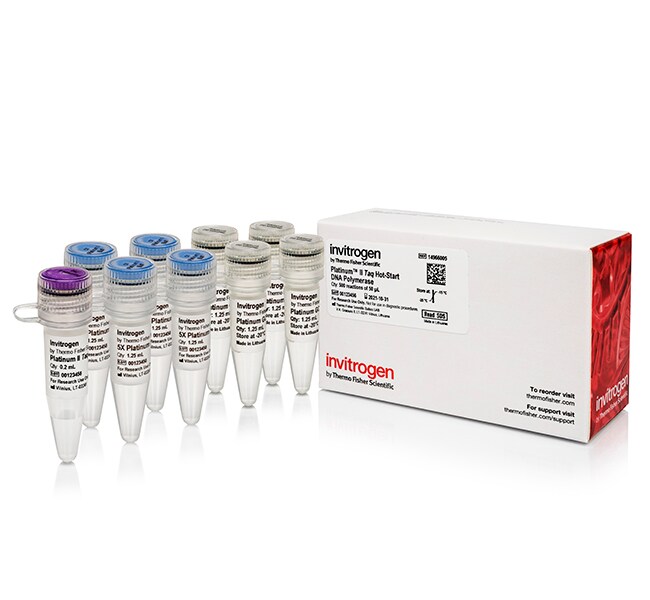
Platinum™ II Taq Hot-Start DNA Polymerase
Invitrogen Platinum II Taq Hot-Start DNA Polymerase is designed for universal primer annealing and fast, easy PCR with its unique combination of innovative buffer, high-performance engineered Taq DNA polymerase, and superior hot-start technology.
Have Questions?
Change view

| Catalog Number | No. of Reactions |
|---|---|
| 14966005 | 500 Reactions |
| 14966001 | 100 Reactions |
| 14966025 | 2500 Reactions |
| 14966100 | 4 x 2500 Reactions |
Catalog number 14966005
Price (CNY)
2,626.00
飞享价
Ends: 31-Dec-2026
5,038.00Save 2,412.00 (48%)
Each
No. of Reactions:
500 Reactions
Price (CNY)
2,626.00
飞享价
Ends: 31-Dec-2026
5,038.00Save 2,412.00 (48%)
Each
Invitrogen Platinum II Taq Hot-Start DNA Polymerase is designed for universal primer annealing and fast, easy PCR with its unique combination of innovative buffer, high-performance engineered Taq DNA polymerase, and superior hot-start technology.
Features of Platinum II Taq Hot-Start DNA Polymerase include:
- Innovative buffer—enables universal annealing temperature by isostabilizing primer-template duplex structures
- Engineered Taq DNA polymerase—confers fast cycling and resistance to common inhibitors
- Platinum hot-start technology—enables superior specificity, sensitivity, and yields; allows for room temperature reaction setup
Platinum II Taq Hot-Start DNA Polymerase is an engineered Taq DNA polymerase that shows increased resistance to reaction inhibitors originating from sample material or DNA purification steps. The polymerase has a higher DNA synthesis rate and delivers PCR results more than two times faster than other Taq DNA polymerases. Proprietary Platinum Taq antibodies block polymerase activity at ambient temperatures and dissociate after the initial denaturation step at 94°C. This automatic 'hot start' provides increased sensitivity, specificity, and yield, while allowing reaction assembly at room temperature.
Due to the unique composition of the Platinum II PCR buffer, the annealing temperature is 60°C for most primer pairs designed following the general design rules. Isostabilizing molecules in the buffer increase primer–template duplex stability during the annealing step and contribute to enhanced specificity without the need to optimize annealing temperature for each primer pair. With Platinum II Taq Hot-Start DNA Polymerase, different PCR assays can be cycled together using the same protocol with universal primer annealing temperature and the extension step selected for the longest fragment to be amplified.
Platinum II Taq Hot-Start DNA Polymerase is provided with the optional Platinum GC Enhancer for specific amplification and improved yields of GC-rich targets.
Use Platinum II Taq Hot-Start DNA Polymerase for the amplification of DNA from complex genomic, viral, and plasmid templates, as well as in RT-PCR, in applications like genotyping, high-throughput PCR, or with samples of suboptimal purity.
For increased convenience, we offer Platinum II Hot-Start PCR Master Mix (2X) (Cat. No. 14000012), where Platinum II Taq Hot-Start DNA Polymerase is provided in a ready-to-use mixture with Platinum II PCR buffer and dNTPs, thus reducing the number of pipetting steps during PCR reaction setup. Platinum II Hot-Start Green PCR Master Mix (2X) is also available, which additionally contains a density reagent and two tracking dyes for direct loading of PCR products on gels, further streamlining the PCR workflow from setup to final analysis of the result.
For Research Use Only. Not for use in diagnostic procedures.
Specifications
Fidelity (vs. Taq)1X
FormatTube
Hot StartBuilt-In Hot Start
No. of Reactions500 Reactions
Overhang3'-A
PolymerasePlatinum II Taq Hot-Start DNA Polymerase
Product TypeHot Start DNA Polymerase
Quantity500 reactions
Reaction FormatSeparate Components
Shipping ConditionRoom Temp or Wet Ice
Size (Final Product)5 kb or less
Starting MaterialDNA
Concentration2X
For Use With (Application)Hot-start PCR
GC-Rich PCR PerformanceHigh
Reaction SpeedFast or Standard
Unit SizeEach
Contents & Storage
• Platinum II Taq HS DNA Polymerase, 200 μL
• 5X Platinum II PCR Buffer, 4 x 1.25 mL
• Platinum GC Enhancer, 4 x 1.25 mL
Store at -20°C in a non-frost-free freezer.
• 5X Platinum II PCR Buffer, 4 x 1.25 mL
• Platinum GC Enhancer, 4 x 1.25 mL
Store at -20°C in a non-frost-free freezer.
Frequently asked questions (FAQs)
What is the storage temperature of Platinum II Taq Hot-Start DNA Polymerase products?
Do the dyes in Platinum II Green PCR Buffer interfere with fragment separation of the PCR product on E-Gel agarose gels?
Do the dyes in Platinum II Green PCR Buffer interfere with PCR performance of Platinum II Taq Hot-Start DNA Polymerase?
Can Platinum II Taq Hot-Start DNA Polymerase be used in master mixes for qPCR?
Can I keep my PCR reactions with Platinum II Taq Hot-Start DNA Polymerase at room temperature before the cycling starts?
Citations & References (15)
Citations & References
Abstract
Monitoring and contamination incidence of gnotobiotic experiments performed in microisolator cages.
Journal:Int J Med Microbiol
PubMed ID:33636479
'With the increased interest in the microbiome research, gnotobiotic animals and techniques emerged again as valuable tools to investigate functional effects of host-microbe and microbe-microbe interactions. The increased demand for gnotobiotic experiments has resulted in the greater need for housing systems for short-term maintenance of gnotobiotic animals. During the last
CircINSR Regulates Fetal Bovine Muscle and Fat Development.
Journal:Front Cell Dev Biol
PubMed ID:33490079
'The level of muscle development in livestock directly affects the production efficiency of livestock, and the contents of intramuscular fat (IMF) is an important factor that affects meat quality. However, the molecular mechanisms through which circular RNA (circRNA) affects muscle and IMF development remains largely unknown. In this study, we
Dynamic regulation of connexins in stem cell pluripotency.
Journal:Stem Cells
PubMed ID:31646713
'Characterization of the pluripotent "ground state" has led to a greater understanding of species-specific stem cell differences and has imparted an appreciation of the pluripotency continuum that exists in stem cells in vitro. Pluripotent stem cells are functionally coupled via connexins that serve in gap junctional intercellular communication (GJIC) and
Four high-quality draft genome assemblies of the marine heterotrophic nanoflagellate Cafeteria roenbergensis.
Journal:Sci Data
PubMed ID:31964893
'The heterotrophic stramenopile Cafeteria roenbergensis is a globally distributed marine bacterivorous protist. This unicellular flagellate is host to the giant DNA virus CroV and the virophage mavirus. We sequenced the genomes of four cultured C. roenbergensis strains and generated 23.53?Gb of Illumina MiSeq data (99-282?×?coverage per strain) and 5.09?Gb of
Generation of an induced pluripotent stem cell line (TRNDi008-A) from a Hunter syndrome patient carrying a hemizygous 208insC mutation in the IDS gene.
Journal:Stem Cell Res
PubMed ID:31071499
'Mucopolysaccharidosis Type II (MPS II), also known as Hunter syndrome, is a rare X-linked genetic disease caused by mutations in the IDS gene encoding iduronate 2-sulfatase (I2S). This is a multisystem disorder with significant variation in symptoms. Here, we document a human induced pluripotent stem cell (iPSC) line generated from