Search


Citations & References (13)
Gibco™
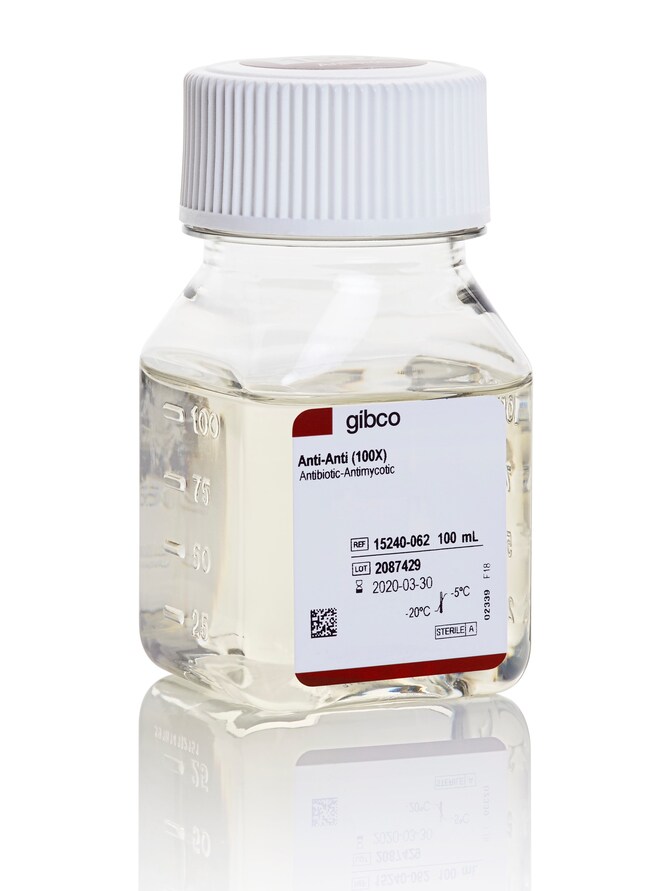
Antibiotic-Antimycotic (100X)
Solution contains penicillin, streptomycin, and Gibco™ Amphotericin B to prevent cell culture contamination.
Have Questions?
Change view

| Catalog Number | Quantity |
|---|---|
| 15240062 | 100 mL |
| 15240096 | 20 mL |
| 15240112 | 20 x 100 mL |
Catalog number 15240062
Price (CNY)
508.00
飞享价
Ends: 31-Dec-2026
797.00Save 289.00 (36%)
Each
Quantity:
100 mL
Price (CNY)
508.00
飞享价
Ends: 31-Dec-2026
797.00Save 289.00 (36%)
Each
Gibco™ Antibiotic-Antimycotic is used to prevent bacterial and fungal contamination. This solution contains 10,000 units/mL of penicillin, 10,000 μg/mL of streptomycin, and 25 μg/mL of Gibco™ Amphotericin B. The antibiotics penicillin and streptomycin prevent bacterial contamination of cell cultures due to their effective combined action against gram-positive and gram-negative bacteria. Amphotericin B prevents fungal contamination of cell cultures due to its inhibition of multi-cellular fungus and yeast.
Penicillin was originally purified from the fungus Penicillium and acts by interfering directly with the turnover of the bacteria cell wall and indirectly by triggering the release of enzymes that further alter the cell wall. Streptomycin was originally purified from Streptomyces griseus. It acts by binding to the 30S subunit of the bacterial ribosome leading to inhibition of protein synthesis and death in susceptible bacteria. Amphotericin B is an antifungal agent that prevents the growth of fungi and yeast by causing an increase in fungal plasma membrane permeability.
For Research Use Only. Not for use in diagnostic procedures.
Specifications
Concentration100 X
Culture TypeMammalian Cell Culture
Quantity100 mL
Shelf Life12 Months
Shipping ConditionDry Ice
FormLiquid
Product TypeAntibiotic-Antimycotic
SterilitySterile-filtered
Sterilization MethodSterile-filtered
Unit SizeEach
Contents & Storage
Storage conditions: -5°C to -20°C
Shipping conditions: Dry ice
Shelf life: 12 months from date of manufacture
Shipping conditions: Dry ice
Shelf life: 12 months from date of manufacture
Frequently asked questions (FAQs)
Can I use pen/strep or other antibiotics for episomal reprogramming of cells?
Can I use antibiotics such as Pen-Strep or Antibiotic-Antimycotic (100X) when culturing Sf9 insect cells?
What is the solvent used in Antibiotic-Antimycotic (100X)?
What are the components of Antibiotic-Antimycotic (100X)?
What is the recommended storage condition for Antibiotic-Antimycotic (100X)?
Citations & References (13)
Citations & References
Abstract
Common variation at 6q16 within HACE1 and LIN28B influences susceptibility to neuroblastoma.
Journal:Nat Genet
PubMed ID:22941191
Neuroblastoma is a cancer of the sympathetic nervous system that accounts for approximately 10% of all pediatric oncology deaths. Here, we report a genome-wide association study of 2,817 neuroblastoma cases and 7,473 controls. We identified two new associations at 6q16, the first within HACE1 (rs4336470; combined P=2.7×10(-11); odds ratio 1.26,
Patient-derived glioblastoma organoids as real-time avatars for assessing responses to clinical CAR-T cell therapy
Journal:Cell Stem Cell
PubMed ID:39657679
Patient-derived tumor organoids have been leveraged for disease modeling and preclinical studies but rarely applied in real time to aid with interpretation of patient treatment responses in clinics. We recently demonstrated early efficacy signals in a first-in-human, phase 1 study of dual-targeting chimeric antigen receptor (CAR)-T cells (EGFR-IL13Rα2 CAR-T cells)
Non-viral-mediated gene transfer of OX40 ligand for tumor immunotherapy.
Journal:Frontiers in immunology
PubMed ID:39007148
BACKGROUND: Immune checkpoint blockade (ICB) is rapidly becoming a standard of care in the treatment of many cancer types. However, the subset of patients who respond to this type of therapy is limited. Another way to promote antitumoral immunity is the use of immunostimulatory molecules, such as cytokines or T
Protocol to generate human liver spheroids to study liver fibrosis induced by metabolic stress.
Journal:STAR protocols
PubMed ID:38833372
Currently, there is no effective treatment for obesity and alcohol-associated liver diseases, partially due to the lack of translational human models. Here, we present a protocol to generate 3D human liver spheroids that contain all the liver cell types and mimic âlivers in a dish.â We describe strategies to induce
Single-Cell Transcriptome Atlas of Murine Endothelial Cells.
Journal:Cell
PubMed ID:32059779
'The heterogeneity of endothelial cells (ECs) across tissues remains incompletely inventoried. We constructed an atlas of >32,000 single-EC transcriptomes from 11 mouse tissues and identified 78 EC subclusters, including Aqp7'