Search


Citations & References (14)
Thermo Scientific™
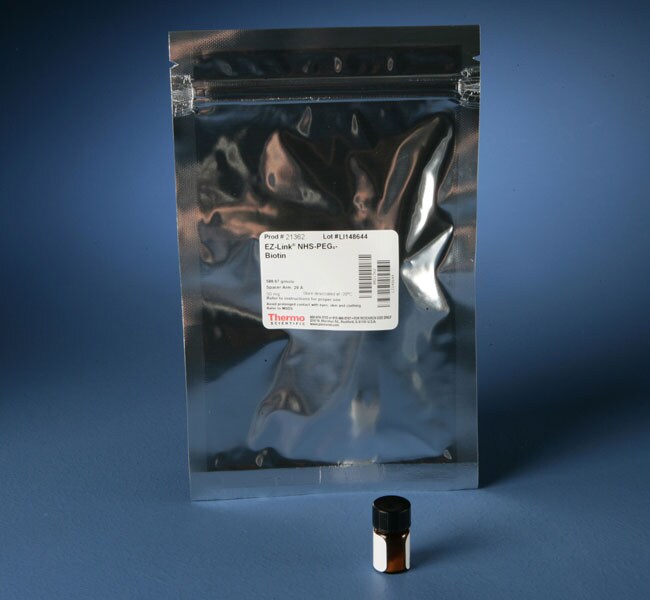
EZ-Link™ NHS-PEG4-Biotin
Thermo Scientific EZ-Link NHS-PEG4-Biotin is a pegylated, water-soluble reagent for simple and efficient biotin labeling of antibodies, proteins and otherRead more
Have Questions?
Change view

| Catalog Number | Quantity |
|---|---|
| 21362 | 50 mg |
| A39259 | 10 x 2 mg |
| 21330 | 25 mg |
| 21363 | 1 g |
Catalog number 21362
Price (CNY)
7,892.00
Each
Quantity:
50 mg
Price (CNY)
7,892.00
Each
Thermo Scientific EZ-Link NHS-PEG4-Biotin is a pegylated, water-soluble reagent for simple and efficient biotin labeling of antibodies, proteins and other primary amine-containing macromolecules.
Features of EZ-Link NHS-PEG4-Biotin:
• Protein labeling—biotinylate antibodies or other proteins for detection or purification using streptavidin probes or resins
• Amine-reactive—reacts with primary amines (-NH2), such as the side-chain of lysines (K) or the amino-termini of polypeptides
• Pegylated – spacer arm contains a hydrophilic, 4-unit, polyethylene glycol (PEG) group
• Enhances solubility – pegylation imparts water solubility to the biotinylated molecule, helping to prevent aggregation of biotinylated antibodies stored in solution
• Irreversible—forms permanent amide bonds; spacer arm cannot be cleaved
• Long reach – spacer arm (total length added to target) is 29 angstroms; this reduces steric hindrance when binding to avidin molecules
NHS-PEG4-Biotin is a long (29.0Å), pegylated, water-soluble, NHS-ester biotinylation reagent to label amines and maximize solubility of antibodies and other proteins. The N-hydroxysuccinimide ester (NHS) group reacts specifically and efficiently with lysine and N-terminal amino groups to form stable amide bonds. The hydrophilic polyethylene glycol (PEG) spacer arm imparts water solubility that is transferred to the biotinylated molecule, thus reducing aggregation of labeled proteins stored in solution. The PEG spacer arm also gives the reagent a long and flexible connection to minimize steric hindrance for binding to avidin molecules.
We manufacture biotin reagents to ensure the highest possible overall product integrity, consistency and performance for the intended research applications.
N-Hydroxysulfosuccinimide (NHS) esters of biotin are the most popular type of biotinylation reagent. NHS-activated biotins react efficiently with primary amino groups (-NH2) in alkaline buffers to form stable amide bonds. Proteins (e.g., antibodies) typically have several primary amines that are available as targets for labeling, including the side chain of lysine (K) residues and the N-terminus of each polypeptide.
Varieties of biotin NHS-ester reagents differ in length, solubility, cell permeability and cleavability. Non-sulfonated NHS-biotins are cell permeable but must be dissolved in organic solvent such as DMSO or DMF. Sulfo-NHS biotins (and those with pegylated spacers) are directly water soluble but not membrane permeable. Varieties containing disulfide bonds can be cleaved using reducing agents, enabling the biotin group to be disconnected from the labeled protein.
Related Products
EZ-Link™ NHS-PEG4 Biotinylation Kit
EZ-Link™ Micro NHS-PEG4-Biotinylation Kit
Features of EZ-Link NHS-PEG4-Biotin:
• Protein labeling—biotinylate antibodies or other proteins for detection or purification using streptavidin probes or resins
• Amine-reactive—reacts with primary amines (-NH2), such as the side-chain of lysines (K) or the amino-termini of polypeptides
• Pegylated – spacer arm contains a hydrophilic, 4-unit, polyethylene glycol (PEG) group
• Enhances solubility – pegylation imparts water solubility to the biotinylated molecule, helping to prevent aggregation of biotinylated antibodies stored in solution
• Irreversible—forms permanent amide bonds; spacer arm cannot be cleaved
• Long reach – spacer arm (total length added to target) is 29 angstroms; this reduces steric hindrance when binding to avidin molecules
NHS-PEG4-Biotin is a long (29.0Å), pegylated, water-soluble, NHS-ester biotinylation reagent to label amines and maximize solubility of antibodies and other proteins. The N-hydroxysuccinimide ester (NHS) group reacts specifically and efficiently with lysine and N-terminal amino groups to form stable amide bonds. The hydrophilic polyethylene glycol (PEG) spacer arm imparts water solubility that is transferred to the biotinylated molecule, thus reducing aggregation of labeled proteins stored in solution. The PEG spacer arm also gives the reagent a long and flexible connection to minimize steric hindrance for binding to avidin molecules.
We manufacture biotin reagents to ensure the highest possible overall product integrity, consistency and performance for the intended research applications.
N-Hydroxysulfosuccinimide (NHS) esters of biotin are the most popular type of biotinylation reagent. NHS-activated biotins react efficiently with primary amino groups (-NH2) in alkaline buffers to form stable amide bonds. Proteins (e.g., antibodies) typically have several primary amines that are available as targets for labeling, including the side chain of lysine (K) residues and the N-terminus of each polypeptide.
Varieties of biotin NHS-ester reagents differ in length, solubility, cell permeability and cleavability. Non-sulfonated NHS-biotins are cell permeable but must be dissolved in organic solvent such as DMSO or DMF. Sulfo-NHS biotins (and those with pegylated spacers) are directly water soluble but not membrane permeable. Varieties containing disulfide bonds can be cleaved using reducing agents, enabling the biotin group to be disconnected from the labeled protein.
Related Products
EZ-Link™ NHS-PEG4 Biotinylation Kit
EZ-Link™ Micro NHS-PEG4-Biotinylation Kit
For Research Use Only. Not for use in diagnostic procedures.
Specifications
Cell PermeabilityCell-Impermeant
DescriptionEZ-Link NHS-PEG4-Biotin
Label TypeBiotin & Analogs
Product LineEZ-Link
Product TypeNHS-PEG4-Biotin
Quantity50 mg
Reactive MoietyActive Ester, Succinimidyl Ester, NHS Ester
Chemical ReactivityAmine
Label or DyeBiotin
SolubilityDMF (Dimethylformamide), DMSO (Dimethylsulfoxide), Water
SpacerLong, Pegylated
Unit SizeEach
Contents & Storage
Store at -20°C.
Frequently asked questions (FAQs)
Can you provide the shelf-life for EZ-Link NHS-PEG4-Biotin?
Citations & References (14)
Citations & References
Abstract
Pre-fusion RSV F strongly boosts pre-fusion specific neutralizing responses in cattle pre-exposed to bovine RSV.
Journal:Nat Commun
PubMed ID:29057917
'Human respiratory syncytial virus (hRSV) is responsible for serious lower respiratory tract disease in infants and in older adults, and remains an important vaccine need. RSV fusion (F) glycoprotein is a key target for neutralizing antibodies. RSV F stabilized in its pre-fusion conformation (DS-Cav1 F) induces high neutralizing antibody titers
Structural basis for the antifolding activity of a molecular chaperone.
Journal:Nature
PubMed ID:27501151
'Molecular chaperones act on non-native proteins in the cell to prevent their aggregation, premature folding or misfolding. Different chaperones often exert distinct effects, such as acceleration or delay of folding, on client proteins via mechanisms that are poorly understood. Here we report the solution structure of SecB, a chaperone that
Sensitive and rapid detection of cholera toxin subunit B using magnetic frequency mixing detection.
Journal:PLoS One
PubMed ID:31276546
'Cholera is a life-threatening disease caused by the cholera toxin (CT) as produced by some Vibrio cholerae serogroups. In this research we present a method which directly detects the toxin''s B subunit (CTB) in drinking water. For this purpose we performed a magnetic sandwich immunoassay inside a 3D immunofiltration column.
Iterative Design and Optimization of Initially Inactive Proteolysis Targeting Chimeras (PROTACs) Identify VZ185 as a Potent, Fast, and Selective von Hippel-Lindau (VHL) Based Dual Degrader Probe of BRD9 and BRD7.
Journal:J Med Chem
PubMed ID:30540463
'Developing PROTACs to redirect the ubiquitination activity of E3 ligases and potently degrade a target protein within cells can be a lengthy and unpredictable process, and it remains unclear whether any combination of E3 and target might be productive for degradation. We describe a probe-quality degrader for a ligase-target pair
Dynamics of the Eukaryotic Replicative Helicase at Lagging-Strand Protein Barriers Support the Steric Exclusion Model.
Journal:Cell Rep
PubMed ID:30784593
'Progression of DNA replication depends on the ability of the replisome complex to overcome nucleoprotein barriers. During eukaryotic replication, the CMG helicase translocates along the leading-strand template and unwinds the DNA double helix. While proteins bound to the leading-strand template efficiently block the helicase, the impact of lagging-strand protein obstacles