Search

Thermo Scientific™
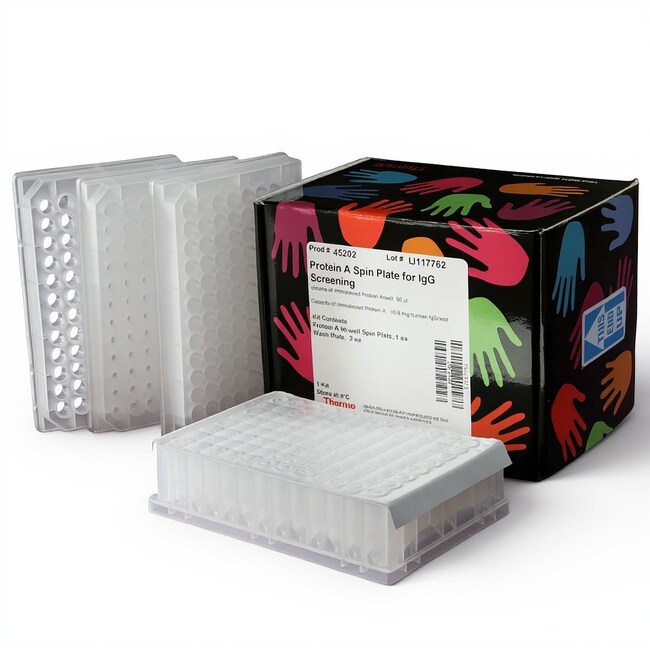
Pierce™ Protein A Spin Plate for IgG Screening
The Thermo Scientific Pierce Protein A Plus Agarose Spin Plate for IgG Screening offers a high-throughput format for quick purificationRead more
| Catalog Number | Quantity |
|---|---|
| 45202 | 1 Plate |
Catalog number 45202
Price (CNY)
4,276.00
Each
Quantity:
1 Plate
Price (CNY)
4,276.00
Each
The Thermo Scientific Pierce Protein A Plus Agarose Spin Plate for IgG Screening offers a high-throughput format for quick purification and screening of antibodies and for immunoprecipitation (IP). Each well of the 96-well spin plate can process 10-100 μl of serum, cell culture supernatant or ascites fluid samples.
Pierce Protein A Plus Agarose is a versatile, high-performance affinity resin for antibody purification. It consists of purified native Protein A that has been covalently immobilized at high density onto high-quality crosslinked 6% beaded agarose (CL-6B). Among the many available varieties of immobilized Protein A affinity resins, this one provides the most versatile combination of chromatographic features for high yield and high purity purification of whole IgG from mammalian serum samples. The agarose beads have physical and chemical properties suitable for many affinity purification systems.
Features of Pierce Protein A Plus Agarose:
• Native Protein A – immobilized Protein A is ideal for polyclonal IgG purification from human, rabbit, pig, dog or cat serum
• Agarose resin – support is crosslinked 6% beaded agarose (CL-6B), the most popular resin for protein affinity purification methods
• Inert and stable – superior manufacturing method immobilizes Protein A by charge-free, leach-resistant covalent bonds, resulting in low nonspecific binding and enabling multiple uses without decline in yield
• High capacity – this “Plus” variety of Pierce Protein A Agarose has a dense load of immobilized Protein A, providing a binding capacity greater than 34 mg human IgG/mL resin (approx. 16 to 17 mg mouse IgG/mL resin)
Protein A is a cell wall component produced by several strains of Staphylococcus aureus. The 46.7kDa-protein consists of a single polypeptide chain that is essentially devoid of carbohydrate. Native Protein A has contains four high-affinity (Ka = 10^8/mol) binding sites that are capable of interacting with the Fc region of IgG-class antibodies from selected mammalian species. IgG-binding function is optimal at pH 8.2, but efficient binding also occurs in neutral and physiological buffers (pH 7.0 to 7.6).
Protein A is a bacteria-derived protein that binds with high affinity and specificity to the Fc portion of antibodies, especially those of the IgG class. Compared to its alternative (Protein G), Protein A provides the highest binding capacity for subclasses of IgG from rabbits, pigs, dogs and cats. Protein A also has higher binding capacity for human IgG, except for IgG3, which it binds weakly. Protein A binds weakly to mouse IgG1 and is not recommended for most applications with that antibody isotype.
Pierce Protein A Plus Agarose is prepared using Thermo Scientific AminoLink Coupling Chemistry, which provides several advantages compared to traditional methods of ligand immobilization. AminoLink Immobilization results in conjugation between sugar monomers of the agarose beads and native lysine residues on the Protein A via simple amide bonds. Unlike typical cyanogen bromide (CNBr) immobilization, the AminoLink Method does not introduce any novel chemical groups that could cause undesired nonspecific binding and produces a stable, essentially irreversible bond. The result is a high-binding-capacity resin that retains functional immobilized Protein A through multiple rounds of antibody purification.
Properties of crosslinked 6% beaded agarose (CL-6B):
• Support pH Stability: 2 to 14 (short term); 3 to 13 (long term)
• Average Particle Size: 45 to 165 microns
• Exclusion Limit: 10,000 to 4,000,000 daltons
• Maximum Volumetric Flow Rate: approx. 1 mL/minute (for 1 cm diameter column)
• Maximum Linear Velocity: 30 cm per hour
• Maximum Pressure: less than 25psi (1.5 bar), defined as the maximum pressure drop across a column that the resin can withstand (Note: The indicated gauge pressure of a liquid chromatography apparatus may be measuring the total system pressure rather than the pressure drop across the column.)
More Product Data
• Using antibody-binding proteins for antibody purification
Related Products
Pierce™ Protein A Plus Agarose
Pierce Protein A Plus Agarose is a versatile, high-performance affinity resin for antibody purification. It consists of purified native Protein A that has been covalently immobilized at high density onto high-quality crosslinked 6% beaded agarose (CL-6B). Among the many available varieties of immobilized Protein A affinity resins, this one provides the most versatile combination of chromatographic features for high yield and high purity purification of whole IgG from mammalian serum samples. The agarose beads have physical and chemical properties suitable for many affinity purification systems.
Features of Pierce Protein A Plus Agarose:
• Native Protein A – immobilized Protein A is ideal for polyclonal IgG purification from human, rabbit, pig, dog or cat serum
• Agarose resin – support is crosslinked 6% beaded agarose (CL-6B), the most popular resin for protein affinity purification methods
• Inert and stable – superior manufacturing method immobilizes Protein A by charge-free, leach-resistant covalent bonds, resulting in low nonspecific binding and enabling multiple uses without decline in yield
• High capacity – this “Plus” variety of Pierce Protein A Agarose has a dense load of immobilized Protein A, providing a binding capacity greater than 34 mg human IgG/mL resin (approx. 16 to 17 mg mouse IgG/mL resin)
Protein A is a cell wall component produced by several strains of Staphylococcus aureus. The 46.7kDa-protein consists of a single polypeptide chain that is essentially devoid of carbohydrate. Native Protein A has contains four high-affinity (Ka = 10^8/mol) binding sites that are capable of interacting with the Fc region of IgG-class antibodies from selected mammalian species. IgG-binding function is optimal at pH 8.2, but efficient binding also occurs in neutral and physiological buffers (pH 7.0 to 7.6).
Protein A is a bacteria-derived protein that binds with high affinity and specificity to the Fc portion of antibodies, especially those of the IgG class. Compared to its alternative (Protein G), Protein A provides the highest binding capacity for subclasses of IgG from rabbits, pigs, dogs and cats. Protein A also has higher binding capacity for human IgG, except for IgG3, which it binds weakly. Protein A binds weakly to mouse IgG1 and is not recommended for most applications with that antibody isotype.
Pierce Protein A Plus Agarose is prepared using Thermo Scientific AminoLink Coupling Chemistry, which provides several advantages compared to traditional methods of ligand immobilization. AminoLink Immobilization results in conjugation between sugar monomers of the agarose beads and native lysine residues on the Protein A via simple amide bonds. Unlike typical cyanogen bromide (CNBr) immobilization, the AminoLink Method does not introduce any novel chemical groups that could cause undesired nonspecific binding and produces a stable, essentially irreversible bond. The result is a high-binding-capacity resin that retains functional immobilized Protein A through multiple rounds of antibody purification.
Properties of crosslinked 6% beaded agarose (CL-6B):
• Support pH Stability: 2 to 14 (short term); 3 to 13 (long term)
• Average Particle Size: 45 to 165 microns
• Exclusion Limit: 10,000 to 4,000,000 daltons
• Maximum Volumetric Flow Rate: approx. 1 mL/minute (for 1 cm diameter column)
• Maximum Linear Velocity: 30 cm per hour
• Maximum Pressure: less than 25psi (1.5 bar), defined as the maximum pressure drop across a column that the resin can withstand (Note: The indicated gauge pressure of a liquid chromatography apparatus may be measuring the total system pressure rather than the pressure drop across the column.)
More Product Data
• Using antibody-binding proteins for antibody purification
Related Products
Pierce™ Protein A Plus Agarose
For Research Use Only. Not for use in diagnostic procedures.
Specifications
DescriptionPierce Protein A Spin Plate for IgG Screening
Purification TargetIgG Antibodies
Quantity1 Plate
Column TypeAgarose Resin, Affinity
Format96-well Filter Plate
Product LinePierce
Product TypeSpin Plate
Stationary PhaseProtein A
Unit SizeEach
Contents & Storage
Upon receipt store at 4°C