Search


Citations & References (6)
Invitrogen™
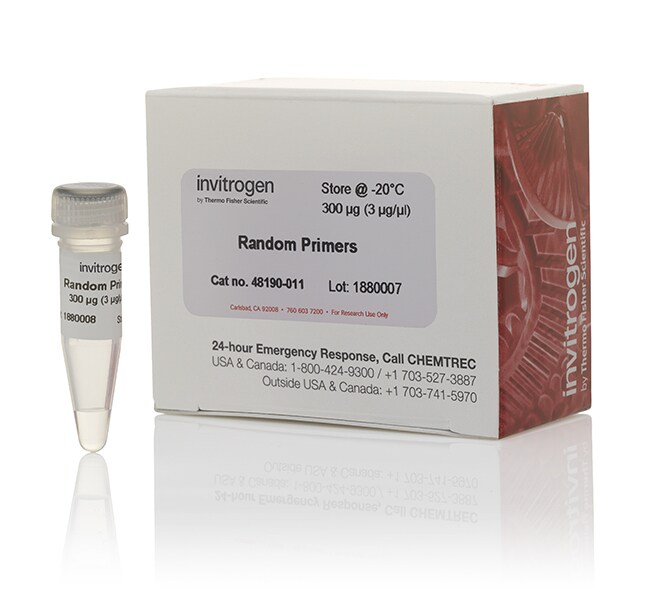
Random Primers
Random Primers are oligodeoxyribonucleotides (mostly hexamers) used to prepare labeled DNA probes from templates for filter hybridization or in situ hybridization and to prime mRNAs with or without poly(A) for cDNA synthesis.
| Catalog Number | Quantity |
|---|---|
| 48190011 | 100 μL |
Catalog number 48190011
Price (CNY)
1,208.00
飞享价
Ends: 31-Dec-2026
1,562.00Save 354.00 (23%)
Each
Quantity:
100 μL
Price (CNY)
1,208.00
飞享价
Ends: 31-Dec-2026
1,562.00Save 354.00 (23%)
Each
Random Primers are oligodeoxyribonucleotides (mostly hexamers) used to prepare labeled DNA probes from templates for filter hybridization or in situ hybridization and to prime mRNAs with or without poly(A) for cDNA synthesis. These primers are truly random and are suitable for DNA synthesis using Klenow fragments with DNA templates or for cDNA synthesis using reverse transcriptase with mRNA templates. To avoid storage buffer interference, Random Primers are supplied in a low-salt-concentration buffer.
Performance and quality testing: Incorporation of a radioactively labeled nucleotide is verified using control DNA in a Random Primers labeling reaction
For Research Use Only. Not for use in diagnostic procedures.
Specifications
For Use With (Application)cDNA Synthesis
FormLiquid
Product TypePrimer
Quantity100 μL
Shipping ConditionApproved for shipment on Wet or Dry Ice
Concentration3 μg/μL
PrimerRandom
Unit SizeEach
Contents & Storage
• Random Primers in 3 mM Tris-HCl, 0.2 mM EDTA (100 μL at 3 μg/μL)
Store at –20°C.
Guaranteed stable for 6 months when properly stored.
Store at –20°C.
Guaranteed stable for 6 months when properly stored.
Frequently asked questions (FAQs)
Can I purchase Random Primers separately?
Which components of the SuperScript III First Strand Synthesis System for RT-PCR are available for purchase separately?
What is the concentration of Random Primers (Cat. No. 48190011)?
Citations & References (6)
Citations & References
Abstract
Global Expression Profiling of Acetate-grown Escherichia coli.
Journal:J Biol Chem
PubMed ID:11815613
'This study characterized the transcript profile of Escherichia coli in acetate cultures using DNA microarray on glass slides. Glucose-grown cultures were used as a reference. At the 95% confidence level, 354 genes were up-regulated in acetate, while 370 genes were down-regulated compared with the glucose-grown culture. Generally, more metabolic genes
RasGRP, a Ras guanyl nucleotide- releasing protein with calcium- and diacylglycerol-binding motifs.
Journal:Science
PubMed ID:9582122
RasGRP, a guanyl nucleotide-releasing protein for the small guanosine triphosphatase Ras, was characterized. Besides the catalytic domain, RasGRP has an atypical pair of EF hands that bind calcium and a diacylglycerol (DAG)-binding domain. RasGRP activated Ras and caused transformation in fibroblasts. A DAG analog caused sustained activation of Ras-Erk signaling
Class II histone deacetylases act as signal-responsive repressors of cardiac hypertrophy.
Journal:Cell
PubMed ID:12202037
The heart responds to stress signals by hypertrophic growth, which is accompanied by activation of the MEF2 transcription factor and reprogramming of cardiac gene expression. We show here that class II histone deacetylases (HDACs), which repress MEF2 activity, are substrates for a stress-responsive kinase specific for conserved serines that regulate
Improvements in siRNA properties mediated by 2'-deoxy-2'-fluoro-beta-D-arabinonucleic acid (FANA).
Journal:Nucleic Acids Res
PubMed ID:16554553
RNA interference (RNAi) has emerged recently as an efficient mechanism for specific gene silencing. Short double-stranded small interfering RNAs (siRNAs) are now widely used for cellular or drug target validation; however, their use for silencing clinically relevant genes in a therapeutic setting remains problematic because of their unfavourable metabolic stability
Use of an in vivo reporter assay to test for transcriptional and translational fidelity in yeast.
Journal:J Biol Chem
PubMed ID:12006589
Eukaryotic RNA polymerase II and Escherichia coli RNA polymerase possess an intrinsic ribonuclease activity that is stimulated by the polymerase-binding proteins SII and GreB, respectively. This factor-activated hydrolysis of nascent RNA has been postulated to be involved in transcription elongation as well as removal of incorrect bases misincorporated into RNA.