Search

Invitrogen™
Dynabeads™ Streptavidin Magnetic Beads
Dynabeads Streptavidin Magnetic Beads are designed for high-specificity, low-background capture of target molecules with biotinylated affinity binders such as antibodies, antigens, or oligonucleotides. Available in various sizes and surface chemistries, these beads can be tailored to provide the best fit for specific application needs.
Have Questions?
Change view

| Catalog Number | Product Type | Quantity |
|---|---|---|
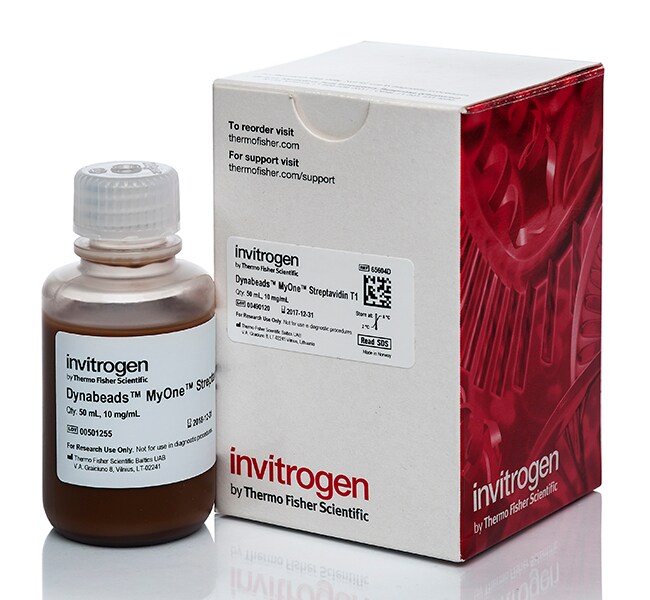
| 65604D | Dynabeads™ MyOne™ Streptavidin T1 | 50 mL |
| 65001 | Dynabeads™ MyOne™ Streptavidin C1 | 2 mL |
| 65002 | Dynabeads™ MyOne™ Streptavidin C1 | 10 mL |
| 65602 | Dynabeads™ MyOne™ Streptavidin T1 | 10 mL |
| 65601 | Dynabeads™ MyOne™ Streptavidin T1 | 2 mL |
| 65605D | Dynabeads™ Streptavidin for Target Enrichment | 2 mL |
| 65606D | Dynabeads™ Streptavidin for Target Enrichment | 10 mL |
| 65607D | Dynabeads™ Streptavidin for Target Enrichment | 50 mL |
| 11205D | Dynabeads™ M-280 Streptavidin | 2 mL |
| 11206D | Dynabeads™ M-280 Streptavidin | 10 mL |
| 60210 | Dynabeads™ M-280 Streptavidin | 100 mL |
| 65305 | Dynabeads™ M-270 Streptavidin | 2 mL |
| 65306 | Dynabeads™ M-270 Streptavidin | 10 mL |
| 60101 | Dynabeads™ kilobaseBINDER™ Kit | 200 Isolations |
| 65801D | Dynabeads™ Streptavidin Trial Kit | 4 x 1 mL |
Catalog number 65604D
Price (CNY)
93,285.00
Each
Product Type:
Dynabeads™ MyOne™ Streptavidin T1
Quantity:
50 mL
Price (CNY)
93,285.00
Each
Dynabeads Streptavidin Magnetic Beads are designed for high-specificity, low-background capture of target molecules with biotinylated affinity binders such as antibodies, antigens, or oligonucleotides. Available in various sizes and surface chemistries, these beads can be tailored to provide the best fit for specific application needs.
Dynabeads Streptavidin Magnetic Beads are compatible with high-throughput automation platforms, including KingFisher sample purification systems, ensuring seamless integration into new and existing workflows.
Key advantages of Dynabeads Streptavidin Magnetic Beads
- ISO 13485–certified manufacturing—exceptional manufacturing control to ensure robust and consistent performance between production lots, meeting international quality standards for medical devices
- Monosized, monodispersed magnetic beads—uniform particle size provides consistent and reproducible results across applications
- Dual size options—available in 1-μm and 2.8-μm diameter specifications to accommodate diverse experimental requirements and application-specific needs
- Multiple surface chemistry options—various surface functionalization chemistries available to optimize binding efficiency and compatibility for specific applications
- Application-optimized design—size and surface chemistry combinations enable best-fit selection for targeted experimental protocols and assay requirements
Precision-engineered manufacturing delivers exceptional control over critical bead properties
Dynabeads Streptavidin products are based on magnetic polystyrene-based beads that are covalently coupled with recombinant streptavidin, creating a robust platform for target capture and isolation using biotinylated affinity binders. Dynabeads Streptavidin product manufacturing enables exceptional precision over three critical parameters: size distribution, magnetization properties, and surface chemical characteristics. This ensures consistent performance across batches and applications, providing the reliability necessary for reproducible experimental outcomes.
Optimized size selection enhances application-specific performance
The Dynabeads Streptavidin product line offers two distinct size options, each engineered to excel in specific experimental contexts. The 1-μm beads, available in the Dynabeads MyOne series, are ideally suited for applications requiring fast reaction kinetics, slow sedimentation rates, and high sensitivity-to-capacity ratios. These smaller beads provide enhanced surface area contact and reduced gravitational settling, making them particularly valuable for sensitive detection assays.
In contrast, the 2.8-μm beads, found in the Dynabeads M-270 and M-280 series, are perfect for applications demanding low background binding and reduced risk of aggregation in aggregation-prone applications. These larger beads offer even easier handling and faster magnetic separation compared to the Dynabeads MyOne series, facilitating streamlined workflow processing.
Tailored surface chemistry options address diverse experimental requirements
The Dynabeads Streptavidin product line includes two distinct surface chemistry configurations designed to optimize performance across varied experimental conditions. Hydrophobic surfaces are available in Dynabeads MyOne Streptavidin T1, Dynabeads Streptavidin for Target Enrichment, and Dynabeads M-280 Streptavidin products. These surfaces are BSA-blocked after streptavidin coupling making them ideal for high signal-to-noise applications such as immunoassays, target enrichment, and on-bead PCR for next-generation sequencing.
Alternatively, hydrophilic surfaces are featured in Dynabeads MyOne Streptavidin C1, Dynabeads Streptavidin for In Vitro Transcription, and Dynabeads M-270 Streptavidin products. These surfaces contain no BSA blocking and are particularly suitable for hydrophobic targets, harsh lysis conditions, sample preparation workflows for mass spectrometry, and applications demanding low or no nuclease activity, such as on-bead reverse transcription or in vitro transcription.
For researchers uncertain about which bead type best suits their application, a Dynabeads Streptavidin Trial Kit is available. It allows for side-by-side performance evaluation of different bead formulations under your specific experimental conditions, ensuring optimal selection for your research needs.
ISO 13485 certification ensures scalable quality and OEM support
Manufactured under ISO 13485 certification, Dynabeads Streptavidin products deliver outstanding batch-to-batch consistency. This robust quality assurance framework ensures that once customers develop an assay or workflow, they can rely on reproducible results across multiple experimental iterations. This consistency makes these versatile beads an efficient solution for applications spanning the entire spectrum from fundamental research to commercial manufacturing processes. For researchers developing commercial products or services, or those requiring larger bulk volumes, specialized support is available by emailing oemdynal@thermofisher.com.
For Research Use Only.
Specifications
Bead TypeMagnetic polystyrene-based beads covalently coupled with recombinant Streptavidin
Binding Property950-1500 pmoles free biotin/mg beads
Certifications/ComplianceISO9001 and ISO13485
Concentration10 mg/mL
Diameter (Metric)1 μm (CV < 5%)
For Use With (Application)Immunoassays, IP, ChIP, RIP, cell isolations, or DNA isolation for downstream amplification reactions or NGS, requiring high sensitivity, rapid target capture with compatibility with subsequent enzymatic reactions
For Use With (Equipment)KingFisher™ Sample Purification System, DynaMag™ magnets
High-throughput CompatibilityHigh-throughput Compatible
Product LineDynabeads
Product TypeDynabeads™ MyOne™ Streptavidin T1
Quantity50 mL
Regulatory StatusRUO
Shelf Life48 months from date of manufacture
Shipping ConditionAmbient Temperature
Surface FunctionalityTosylactivated hydrophobic surface blocked with BSA
FormatBeads in Suspension
Isolation TechnologyMagnetic Bead
Unit SizeEach
Contents & Storage
Dynabeads MyOne Streptavidin T1 are supplied in PBS, pH 7.4, with 0.1% BSA and 0.02% NaN3 . Store at 2–8°C.