Search


Citations & References (3)
Thermo Scientific™
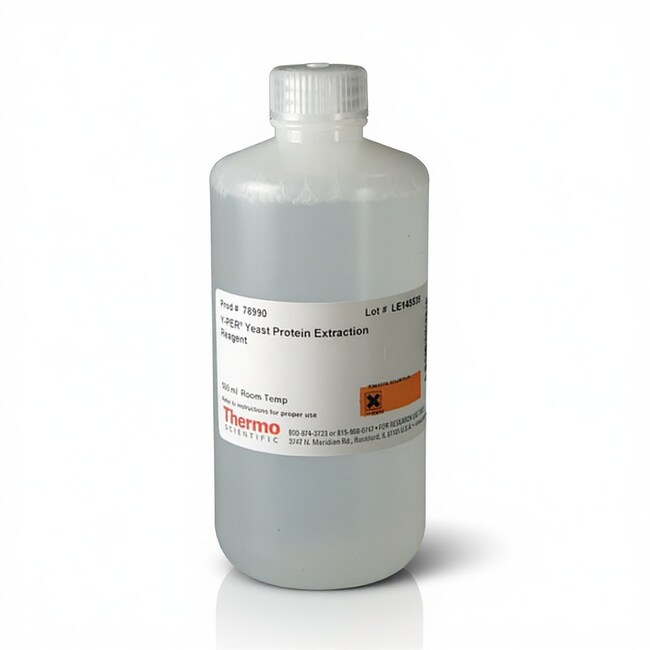
Y-PER™ Yeast Protein Extraction Reagent
Thermo Scientific Y-PER Yeast Protein Extraction Reagent is the first commercially available yeast lysis reagent using a mild detergent lysisRead more
Have Questions?
Change view

| Catalog Number | Quantity |
|---|---|
| 78990 | 500 mL |
| 78991 | 200 mL |
Catalog number 78990
Price (CNY)
6,284.00
Each
Quantity:
500 mL
Price (CNY)
6,284.00
Each
Thermo Scientific Y-PER Yeast Protein Extraction Reagent is the first commercially available yeast lysis reagent using a mild detergent lysis procedure to efficiently release functionally active solubilized proteins.
Features of Y-PER Yeast Protein Extraction Reagent:
• More protein—extracts more than twice as much protein as glass bead methods
• Less hassle—eliminates the difficulties associated with traditional glass bead lysis (e.g., clinging static-charged beads, protein-bead clumps and runaway beads)
• Optmized for yeast—validated for use with Saccharomyces cerevisiae, Schizosaccharomyces pombe and Pichia pastoris
• Versatile—effective for many different organisms, including Bacillus subtilus and both Gram-positive and Gram-negative bacteria; suitable for use in a diverse range of situations
The detergent-based cell lysis buffer eliminates the need to use glass beads or mechanical treatments involving strong reducing agents, chemicals, pH and temperature extremes to disrupt the proteinaceous cell envelope required for protein extractions. The popular glass bead lysis protocol requires special equipment and must be performed at 4°C. The low yields of protein commonly obtained with this technique are the result of denaturation and proteins nonspecifically binding to the glass beads. However, Y-PER Reagent uses a simple room temperature protocol that can be completed in 20 minutes and requires no special equipment.
Y-PER Reagent offers an easy to use standard protocol for protein extractions involving addition of an appropriate volume of Y-PER Reagent to pelleted yeast cells, followed by incubation at room temperature for approximately 20 minutes and then spin down the debris. The resulting supernatant is a concentrated protein solution, surpassing typical yields obtained with traditional glass bead disruption.
The unicellular nature of yeast, combined with its ability to perform post-translational modifications that closely mimic processes in higher eukaryotes, have made them important research tools. The many vectors available, as well as the development of recombinant expression systems, have given yeast an irreplaceable role in the research sector.Y-PER Reagent is effective for S. cerevisiae and other popular species, making it applicable for use in fusion-tagged protein purification and reporter enzyme assays with these model organisms. The lysis reagent also can be used for genomic and plasmid DNA extraction from yeast.
Related Products
Y-PER™ Plus Dialyzable Yeast Protein Extraction Reagent
Features of Y-PER Yeast Protein Extraction Reagent:
• More protein—extracts more than twice as much protein as glass bead methods
• Less hassle—eliminates the difficulties associated with traditional glass bead lysis (e.g., clinging static-charged beads, protein-bead clumps and runaway beads)
• Optmized for yeast—validated for use with Saccharomyces cerevisiae, Schizosaccharomyces pombe and Pichia pastoris
• Versatile—effective for many different organisms, including Bacillus subtilus and both Gram-positive and Gram-negative bacteria; suitable for use in a diverse range of situations
The detergent-based cell lysis buffer eliminates the need to use glass beads or mechanical treatments involving strong reducing agents, chemicals, pH and temperature extremes to disrupt the proteinaceous cell envelope required for protein extractions. The popular glass bead lysis protocol requires special equipment and must be performed at 4°C. The low yields of protein commonly obtained with this technique are the result of denaturation and proteins nonspecifically binding to the glass beads. However, Y-PER Reagent uses a simple room temperature protocol that can be completed in 20 minutes and requires no special equipment.
Y-PER Reagent offers an easy to use standard protocol for protein extractions involving addition of an appropriate volume of Y-PER Reagent to pelleted yeast cells, followed by incubation at room temperature for approximately 20 minutes and then spin down the debris. The resulting supernatant is a concentrated protein solution, surpassing typical yields obtained with traditional glass bead disruption.
The unicellular nature of yeast, combined with its ability to perform post-translational modifications that closely mimic processes in higher eukaryotes, have made them important research tools. The many vectors available, as well as the development of recombinant expression systems, have given yeast an irreplaceable role in the research sector.Y-PER Reagent is effective for S. cerevisiae and other popular species, making it applicable for use in fusion-tagged protein purification and reporter enzyme assays with these model organisms. The lysis reagent also can be used for genomic and plasmid DNA extraction from yeast.
Related Products
Y-PER™ Plus Dialyzable Yeast Protein Extraction Reagent
For Research Use Only. Not for use in diagnostic procedures.
Specifications
FormatLiquid
Quantity500 mL
Volume (Metric)500 mL
Product LineY-PER
Product TypeYeast Protein Extraction Reagent
Unit SizeEach
Contents & Storage
Store product at room temperature.
Frequently asked questions (FAQs)
Can you provide the shelf-life for the Y-PER Yeast Protein Extraction Reagent?
Does Y-PER Yeast Protein Extraction Reagent (Cat. No. 78990) yield samples that are compatible with the Pierce BCA Protein Assay Kit (Cat. No. 23225)?
Citations & References (3)
Citations & References
Abstract
The hCds1 (Chk2)-FHA domain is essential for a chain of phosphorylation events on hCds1 that is induced by ionizing radiation.
Journal:J Biol Chem
PubMed ID:11390408
'hCds1 (Chk2) is an evolutionarily conserved kinase that functions in DNA damage response and cell cycle checkpoint. The Cds1 family of kinases are activated by a family of large phosphatidylinositol 3-kinase-like kinases. In humans, ataxia telangiectasia-mutated (ATM) and ataxia-telangiectasia and Rad3-related kinases activate hCds1 by phosphorylating Thr(68) . hCds1 and
Noncatalytic role of the FKBP52 peptidyl-prolyl isomerase domain in the regulation of steroid hormone signaling.
Journal:Mol Cell Biol
PubMed ID:17938211
Hormone-dependent transactivation by several of the steroid hormone receptors is potentiated by the Hsp90-associated cochaperone FKBP52, although not by the closely related FKBP51. Here we analyze the mechanisms of potentiation and the functional differences between FKBP51 and FKBP52. While both have peptidyl-prolyl isomerase activity, this is not required for potentiation,
WOX1 is essential for tumor necrosis factor-, UV light-, staurosporine-, and p53-mediated cell death, and its tyrosine 33-phosphorylated form binds and stabilizes serine 46-phosphorylated p53.
Journal:J Biol Chem
PubMed ID:16219768
WW domain-containing oxidoreductase WOX1, also named WWOX or FOR, undergoes Tyr33 phosphorylation at its first N-terminal WW domain and subsequent nuclear translocation in response to sex steroid hormones and stress stimuli. The activated WOX1 binds tumor suppressor p53, and both proteins may induce apoptosis synergistically. Functional suppression of WOX1 by