Search


引用和文献 (3)
Thermo Scientific™
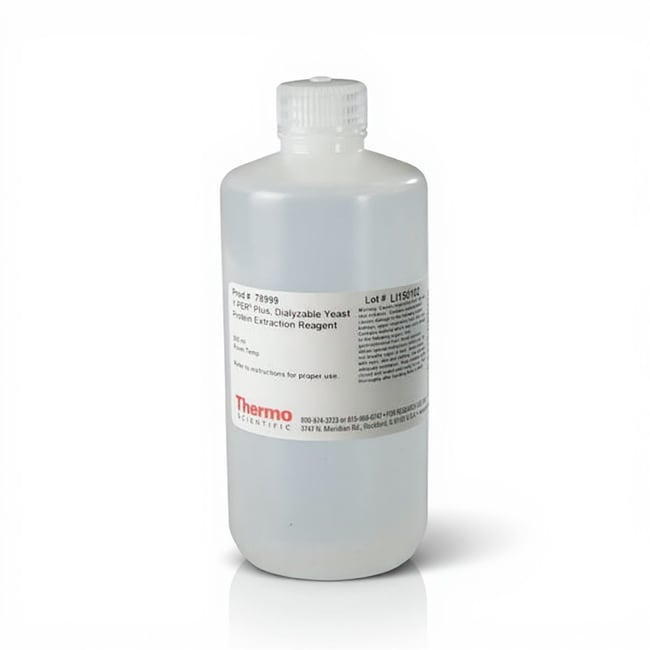
Y-PER™ Plus 可透析酵母菌蛋白质提取试剂
Thermo Scientific Y-PER-Plus 可透析酵母菌蛋白质提取试剂可有效裂解酵母菌和细菌细胞,进而提取并溶解蛋白进行分析。Y-PER Plus 可透析酵母菌蛋白质提取试剂的特点:•为室温储存而设计的稳定配方• 只需 20 分钟无干预孵育,即可获得蛋白质提取物•无需严格的机械破碎或长时间酶处理•了解更多信息
| 货号 | 数量 |
|---|---|
| 78999 | 500 mL |
货号 78999
价格(CNY)
6,203.00
Each
数量:
500 mL
价格(CNY)
6,203.00
Each
Thermo Scientific Y-PER-Plus 可透析酵母菌蛋白质提取试剂可有效裂解酵母菌和细菌细胞,进而提取并溶解蛋白进行分析。
Y-PER Plus 可透析酵母菌蛋白质提取试剂的特点:
•为室温储存而设计的稳定配方
• 只需 20 分钟无干预孵育,即可获得蛋白质提取物
•无需严格的机械破碎或长时间酶处理
• 基于 Tris 的缓冲液具有非常低的离子强度并且不包含氯化钠
• 简单配方不含还原剂或螯合剂
• 完全可透析配方,可将提取的蛋白完全交换到下游技术所需的任何缓冲液中
• 与 Thermo Scientific Pierce BCA 和考马斯 Plus 蛋白检测兼容
产品详情(使用建议):
•新鲜细胞和冷冻细胞:Y-PER-Plus 试剂能够从新鲜收获和冷冻细胞中同等地提取蛋白质
• 细胞密度和菌株变化:生物体成长率、成长温度和培养基成分的差异影响从给定培养容量中采集细胞的数量。因此,含有关用于给定细胞团(湿细胞糊)重量的Y-PER-Plus 试剂量的几条建议。
•毕赤酵母:为实现裂解在如YEPD的富培养基中培养的细胞,必须在对数生长期间采集细胞。为强化固定相细胞裂解,在裂解之前,直接将 DTT 或 TCEP-HCl 添加(分别达到 0.1 M 和 20 至 50 mM 的最终浓度)至 Y-PER-Plus 试剂中,以释放更多的可溶蛋白质。为获得最佳结果,每 1 克细胞团使用 2.5 至 5.0 mL Y-PER-Plus 试剂;按比例相应增加或减少。添加还原剂的另一种替代方法是添加蛋白酶抑制剂并在 45°C 下孵育。
•酿酒酵母:为获得最佳结果,在对数期采集细胞。为增加固定相细胞得率,在提取之前直接将 DTT 或 TCEP·HCl 添加(分别达到 0.1 M 和 20 至 50 mM 的最终浓度)至 Y-PER-Plus 试剂中。无论富培养基或合成培养基,效率结果没有差异。为获得最佳结果,每 1 克细胞团使用 2.5 至 5.0 mL Y-PER Plus 试剂;按比例相应增加或减少。
•粟酒裂殖酵母:为获得最佳结果,请使用原始 Y-PER 试剂(产品编号 78990)从粟酒裂殖酵母中提取蛋白质。
•枯草芽孢杆菌:Y-PER-Plus 试剂不能从枯草芽孢杆菌孢子中提取蛋白质。当使用能够形成孢子的菌株时,在对数期采集细胞。对于不能形成孢子的菌株,可在采集前让细胞成长至饱和态。每 1 g 细胞团使用 2.5 至 5.0 mL Y-PER-Plus 试剂;按比例相应增加或减少。
•大肠杆菌:每 1 g 细胞团使用 2.5 至 5.0 mL Y-PER-Plus 试剂;按比例相应增加或减少。
•酶活性:由于所有蛋白在结构、可溶性和稳定性方面有差异,在有Y-PER-Plus试剂情况下,一种特定的蛋白可能不能保持最佳的活性。例如,原始 Y-PER 试剂可有效测定 β-半乳糖苷酶活性,但 Y-PER-Plus 试剂会降低其动力学。Y-PER-Plus 试剂与谷胱甘肽 S 转移酶 (GST) 和 His 标签蛋白的标准亲和纯化方案兼容。
相关产品
Y-PER™ 酵母菌蛋白质提取试剂
Y-PER Plus 可透析酵母菌蛋白质提取试剂的特点:
•为室温储存而设计的稳定配方
• 只需 20 分钟无干预孵育,即可获得蛋白质提取物
•无需严格的机械破碎或长时间酶处理
• 基于 Tris 的缓冲液具有非常低的离子强度并且不包含氯化钠
• 简单配方不含还原剂或螯合剂
• 完全可透析配方,可将提取的蛋白完全交换到下游技术所需的任何缓冲液中
• 与 Thermo Scientific Pierce BCA 和考马斯 Plus 蛋白检测兼容
产品详情(使用建议):
•新鲜细胞和冷冻细胞:Y-PER-Plus 试剂能够从新鲜收获和冷冻细胞中同等地提取蛋白质
• 细胞密度和菌株变化:生物体成长率、成长温度和培养基成分的差异影响从给定培养容量中采集细胞的数量。因此,含有关用于给定细胞团(湿细胞糊)重量的Y-PER-Plus 试剂量的几条建议。
•毕赤酵母:为实现裂解在如YEPD的富培养基中培养的细胞,必须在对数生长期间采集细胞。为强化固定相细胞裂解,在裂解之前,直接将 DTT 或 TCEP-HCl 添加(分别达到 0.1 M 和 20 至 50 mM 的最终浓度)至 Y-PER-Plus 试剂中,以释放更多的可溶蛋白质。为获得最佳结果,每 1 克细胞团使用 2.5 至 5.0 mL Y-PER-Plus 试剂;按比例相应增加或减少。添加还原剂的另一种替代方法是添加蛋白酶抑制剂并在 45°C 下孵育。
•酿酒酵母:为获得最佳结果,在对数期采集细胞。为增加固定相细胞得率,在提取之前直接将 DTT 或 TCEP·HCl 添加(分别达到 0.1 M 和 20 至 50 mM 的最终浓度)至 Y-PER-Plus 试剂中。无论富培养基或合成培养基,效率结果没有差异。为获得最佳结果,每 1 克细胞团使用 2.5 至 5.0 mL Y-PER Plus 试剂;按比例相应增加或减少。
•粟酒裂殖酵母:为获得最佳结果,请使用原始 Y-PER 试剂(产品编号 78990)从粟酒裂殖酵母中提取蛋白质。
•枯草芽孢杆菌:Y-PER-Plus 试剂不能从枯草芽孢杆菌孢子中提取蛋白质。当使用能够形成孢子的菌株时,在对数期采集细胞。对于不能形成孢子的菌株,可在采集前让细胞成长至饱和态。每 1 g 细胞团使用 2.5 至 5.0 mL Y-PER-Plus 试剂;按比例相应增加或减少。
•大肠杆菌:每 1 g 细胞团使用 2.5 至 5.0 mL Y-PER-Plus 试剂;按比例相应增加或减少。
•酶活性:由于所有蛋白在结构、可溶性和稳定性方面有差异,在有Y-PER-Plus试剂情况下,一种特定的蛋白可能不能保持最佳的活性。例如,原始 Y-PER 试剂可有效测定 β-半乳糖苷酶活性,但 Y-PER-Plus 试剂会降低其动力学。Y-PER-Plus 试剂与谷胱甘肽 S 转移酶 (GST) 和 His 标签蛋白的标准亲和纯化方案兼容。
相关产品
Y-PER™ 酵母菌蛋白质提取试剂
仅供科研使用。不可用于诊断程序。
规格
产品规格液体
数量500 mL
容积(公制)500 mL
产品线Y-PER
产品类型酵母蛋白提取试剂
Unit SizeEach
内容与储存
接收后,在室温下储存。产品在环境温度下运输。
常见问题解答 (FAQ)
Can you provide the shelf-life for the Y-PER Plus Dialyzable Yeast Protein Extraction Reagent?
引用和文献 (3)
引用和文献
Abstract
The hCds1 (Chk2)-FHA domain is essential for a chain of phosphorylation events on hCds1 that is induced by ionizing radiation.
Journal:J Biol Chem
PubMed ID:11390408
'hCds1 (Chk2) is an evolutionarily conserved kinase that functions in DNA damage response and cell cycle checkpoint. The Cds1 family of kinases are activated by a family of large phosphatidylinositol 3-kinase-like kinases. In humans, ataxia telangiectasia-mutated (ATM) and ataxia-telangiectasia and Rad3-related kinases activate hCds1 by phosphorylating Thr(68) . hCds1 and
Noncatalytic role of the FKBP52 peptidyl-prolyl isomerase domain in the regulation of steroid hormone signaling.
Journal:Mol Cell Biol
PubMed ID:17938211
Hormone-dependent transactivation by several of the steroid hormone receptors is potentiated by the Hsp90-associated cochaperone FKBP52, although not by the closely related FKBP51. Here we analyze the mechanisms of potentiation and the functional differences between FKBP51 and FKBP52. While both have peptidyl-prolyl isomerase activity, this is not required for potentiation,
WOX1 is essential for tumor necrosis factor-, UV light-, staurosporine-, and p53-mediated cell death, and its tyrosine 33-phosphorylated form binds and stabilizes serine 46-phosphorylated p53.
Journal:J Biol Chem
PubMed ID:16219768
WW domain-containing oxidoreductase WOX1, also named WWOX or FOR, undergoes Tyr33 phosphorylation at its first N-terminal WW domain and subsequent nuclear translocation in response to sex steroid hormones and stress stimuli. The activated WOX1 binds tumor suppressor p53, and both proteins may induce apoptosis synergistically. Functional suppression of WOX1 by