Search


Citations & References (67)
Invitrogen™
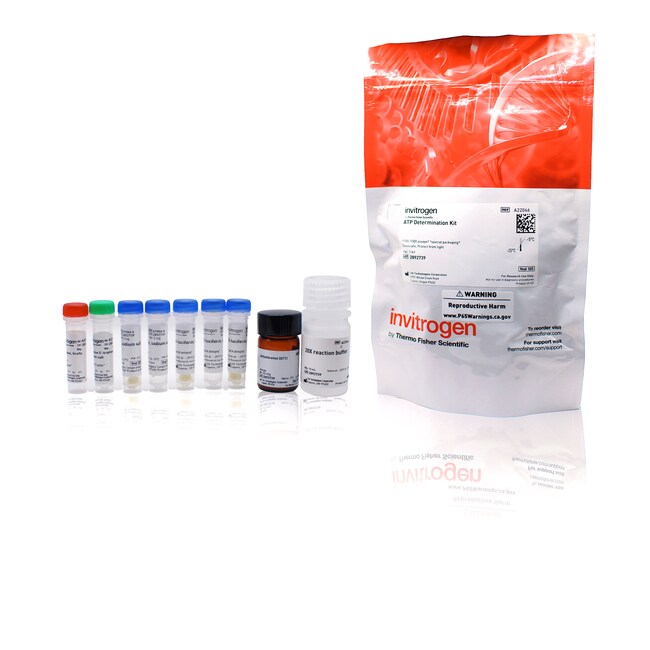
ATP Determination Kit
Detect and quantify ATP in biochemical and cell viability assays with the ATP Determination Kit. This luminescence-based ATP assay utilizes the luciferase-luciferin reaction, offering exceptional sensitivity to detect as little as 0.1 picomole of ATP using a luminometer or microplate reader.
| Catalog Number | Quantity |
|---|---|
| A22066 | 1 Kit |
Catalog number A22066
Price (CNY)
4,069.00
飞享价
Ends: 31-Dec-2026
5,573.00Save 1,504.00 (27%)
Each
Quantity:
1 Kit
Price (CNY)
4,069.00
飞享价
Ends: 31-Dec-2026
5,573.00Save 1,504.00 (27%)
Each
The ATP Determination Kit is a highly sensitive luminescence assay designed for the quantitative detection of ATP levels in biochemical and cell viability assays. This ATP assay kit utilizes the reaction between recombinant firefly luciferase and its substrate D-luciferin and is based on luciferase's absolute requirement for ATP in producing light (emission maximum approximately 560 nm at pH 7.8). With its exceptional sensitivity, capable of detecting as little as 0.1 picomole of ATP, this assay is well-suited for kinetic studies and can be used with luminometers or microplate readers equipped with a luminescence mode, such as the Thermo Scientific Varioskan ALF and LUX Multimode Microplate Readers.
This luciferase ATP assay includes sufficient reagents for ten 96-well plates and offers a unique advantage over other commercially available ATP detection kits by providing the luciferase and luciferin components separately, allowing researchers to optimize the reaction conditions for their specific instruments and samples.
Features of the ATP Determination Kit include:
- Utilizes a luminescence-based system to monitor light emission, enabling sensitive and accurate quantification of ATP levels
- Offers exceptional sensitivity, capable of detecting as little as 0.1 picomole of pre-existing ATP or ATP generated in kinetic systems
- Employs a unique formulation where the luciferase and luciferin components are packaged separately, allowing researchers to optimize assay conditions for their specific samples and instruments
- Includes a generous supply of reagents, sufficient for performing 200 ATP assays using 500 μL sample volumes or 1,000 ATP assays using 100 μL sample volumes (enough for ten 96-well plate assays)
- Facilitates quantitative analysis of ATP levels in a wide range of biological and environmental samples and experimental systems
- Leverages the highly specific and sensitive bioluminescence reaction between luciferin and luciferase in the presence of ATP, providing a reliable and reproducible method for ATP quantification
- Compatible with various luminometers and microplate readers with a luminescence mode, making it a versatile tool for ATP detection in diverse research settings
Principle of the ATP-dependent bioluminescent reaction
The ATP Determination Kit is based on the absolute requirement of luciferase for ATP to produce light. In the presence of Mg2+, the luciferase enzyme catalyzes the reaction of luciferin, ATP, and O2 to form oxyluciferin, AMP, CO2, pyrophosphate, and light with an emission of approximately 560 nm at pH 7.8. The luminescent signal generated is directly proportional to the amount of ATP, allowing for the measurement of ATP levels.
Measure ATP levels in solution or cell lysates
The assay reagents in the ATP Determination Kit are not permeable to live and intact cells, making this assay suitable for measuring extracellular ATP or ATP from samples in solution. To measure intracellular ATP levels for cell health or viability assays, cell lysis is required to release ATP from the cells. Lysis buffer options that are compatible with the luciferase-luciferin reaction include the Pierce Luciferase Cell Lysis Buffer (2X) (Cat. No. 16189) and the 20X cell lysis buffer formulation listed below. The 20X buffer should be diluted 1:20 with water and used immediately for cell lysis prior to running the luciferase ATP assay.
20X lysis buffer:
- 200 mM Tris (pH 7.5)
- 2 M NaCl
- 20 mM EDTA
- 0.2% Triton X-100
Comprehensive and versatile ATP assay kit
ATP is a critical molecule found in all living cells and is the energy source for various biological processes, including muscle contraction, nerve impulse propagation, and biochemical synthesis. ATP levels are often measured to determine cellular viability and metabolism, assess mitochondria function and activity, or detect bacterial and microbial contamination. This luciferase-based ATP detection kit provides a versatile and sensitive method for measuring ATP production in various enzymatic reactions, including ATPase and NADPH oxidase, and monitoring ATP release from cells.
The luciferin–luciferase luminescence assay can be used to detect low-level bacterial contamination in biological samples such as blood, milk, and urine, along with environmental samples for testing of water, soil, and sludge. ATP detection has also been used to study the effects of antibiotics on bacterial populations, determine cell proliferation and cytotoxicity in both bacterial and mammalian cells, and distinguish cytostatic versus cytocidal potential of anticancer drugs on malignant cell growth.
For Research Use Only. Not for use in diagnostic procedures.
Specifications
Detection MethodLuminescence
FormatTube, 96-well plate
Label TypeLuciferin
Quantity1 Kit
Shipping ConditionWet Ice
SubstrateD-Luciferin
Sufficient For200 to 1000 Assays
For Use With (Equipment)Luminometer (Microplate), Luminometer (Tube-based), Microplate Reader
Product TypeATP Determination Kit
Unit SizeEach
Contents & Storage
Store in freezer -5°C to -30°C and protect from light.
Frequently asked questions (FAQs)
What luminescence wavelength range do I need to use on my instrument?
How long do I need to incubate my samples with the ATP Determination Kit reaction solution before reading the luminescence?
What type of microplate should I use with the ATP Determination Kit?
Can I use the ATP Determination Kit to measure ATP levels and cell health/viability in live cells?
Is the ATP Determination Kit suitable for frozen heart tissue, tissue homogenate, or serum or plasma (Cat. No. A22066)?
Citations & References (67)
Citations & References
Abstract
A hyperfused mitochondrial state achieved at G1-S regulates cyclin E buildup and entry into S phase.
Journal:Proc Natl Acad Sci U S A
PubMed ID:19617534
Mitochondria undergo fission-fusion events that render these organelles highly dynamic in cells. We report a relationship between mitochondrial form and cell cycle control at the G(1)-S boundary. Mitochondria convert from isolated, fragmented elements into a hyperfused, giant network at G(1)-S transition. The network is electrically continuous and has greater ATP
Cytoplasmic dynein/dynactin drives kinetochore protein transport to the spindle poles and has a role in mitotic spindle checkpoint inactivation.
Journal:J Cell Biol
PubMed ID:11756470
'We discovered that many proteins located in the kinetochore outer domain, but not the inner core, are depleted from kinetochores and accumulate at spindle poles when ATP production is suppressed in PtK1 cells, and that microtubule depolymerization inhibits this process. These proteins include the microtubule motors CENP-E and cytoplasmic dynein,
Comparison of MTT and ATP-based assays for the measurement of viable cell number.
Journal:J Biolumin Chemilumin
PubMed ID:7762413
'Cell viability assays are widely used to assess the effect chemotherapeutic drugs and other agents on cell lines and have shown promise for the prediction of tumour chemosensitivity. In this study we have compared two viability assays using Daudi and CCRF-CEM cell lines over a range of 1500-100,000 cells/well of
Calorie restriction induces mitochondrial biogenesis and bioenergetic efficiency.
Journal:Proc Natl Acad Sci U S A
PubMed ID:16446459
'Age-related accumulation of cellular damage and death has been linked to oxidative stress. Calorie restriction (CR) is the most robust, nongenetic intervention that increases lifespan and reduces the rate of aging in a variety of species. Mechanisms responsible for the antiaging effects of CR remain uncertain, but reduction of oxidative
Dynamics of bacteriophage T4 presynaptic filament assembly from extrinsic fluorescence measurements of Gp32-single-stranded DNA interactions.
Journal:J Biol Chem
PubMed ID:16829679
'In the bacteriophage T4 homologous recombination system, presynaptic filament assembly on single-stranded (ssDNA) DNA requires UvsX recombinase, UvsY mediator, and Gp32 ssDNA-binding proteins. Gp32 exerts both positive and negative effects on filament assembly: positive by denaturing ssDNA secondary structure, and negative by competing with UvsX for ssDNA binding sites. UvsY