Search


Citations & References (77)
Invitrogen™
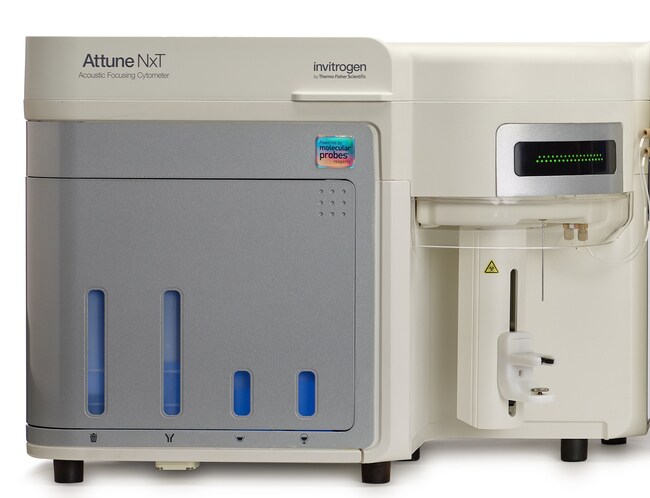
Attune™ NxT Flow Cytometer, blue/yellow
The 2020 Attune NxT Flow Cytometer has expanded functionalities to drive your research forward. Designed and developed to remove commonRead more
| Catalog Number | Quantity |
|---|---|
| A24861 | 1 each |
Catalog number A24861
Price (CNY)
-
Quantity:
1 each
The 2020 Attune NxT Flow Cytometer has expanded functionalities to drive your research forward. Designed and developed to remove common barriers associated with flow cytometry, the evolutionary capabilities of the Attune NxT Flow Cytometer offer adaptable optical configuration options so you can get the most out of your multicolor analysis.
• New CytKick and CytKick Max autosampler—more efficiency for high-throughput assays
• New 21 CFR part 11 compliant software for regulated laboratories on Windows 10 operating system
• Improved workflow for run protocol and instrument settings management
Fast flow
The innovative combination of acoustic focusing technology coupled with traditional hydrodynamic focusing results in acquisition speeds up to 10X faster than other flow cytometers. This technology reduces the time needed to obtain results.
• True 35,000 event/sec (+10% coincidence rates)
• Maximum electronic speed of 65,000 events/sec
• Analyze small or limited samples faster than ever
• Efficiently run traditionally long assays
The Attune NxT Flow Cytometer is ideal for immunophenotyping and signaling studies, cell cycle analysis, detection of rare events, stem cell analysis, cancer and apoptosis studies, microbiological assays, and more.
Fit for your lab today and in the future
The instrument’s modular design provides the flexibility to meet future capability needs with a variety of upgrade options. Purchase what you need now and easily upgrade later. The small footprint of the instrument requires minimal bench space, even allowing use in a cell culture hood.
• Flexibility—1 to 4 lasers, 14 colors, and 16 parameters
• Field upgradeable—choose to add additional lasers when you decide
• Customizable band pass filters for expanded fluorochrome choices
Tune into your data
The Attune NxT Flow Cytometer easily runs most samples including cardiomyocytes. The system is designed with a clog-resistant syringe-driven system to push the sample with a force of up to 75 psi.
• Flexibility in sample concentrations and sample types
• Elimination of time-consuming concentration steps with No-Wash, No-Lyse Filter Kit
• Analysis of dilute samples, including CSF, stem cells, mouse bone marrow, mouse blood, and thin needle aspirates
• Acquisition of a high volume of samples in minimal time
• New CytKick and CytKick Max autosampler—more efficiency for high-throughput assays
• New 21 CFR part 11 compliant software for regulated laboratories on Windows 10 operating system
• Improved workflow for run protocol and instrument settings management
Fast flow
The innovative combination of acoustic focusing technology coupled with traditional hydrodynamic focusing results in acquisition speeds up to 10X faster than other flow cytometers. This technology reduces the time needed to obtain results.
• True 35,000 event/sec (+10% coincidence rates)
• Maximum electronic speed of 65,000 events/sec
• Analyze small or limited samples faster than ever
• Efficiently run traditionally long assays
The Attune NxT Flow Cytometer is ideal for immunophenotyping and signaling studies, cell cycle analysis, detection of rare events, stem cell analysis, cancer and apoptosis studies, microbiological assays, and more.
Fit for your lab today and in the future
The instrument’s modular design provides the flexibility to meet future capability needs with a variety of upgrade options. Purchase what you need now and easily upgrade later. The small footprint of the instrument requires minimal bench space, even allowing use in a cell culture hood.
• Flexibility—1 to 4 lasers, 14 colors, and 16 parameters
• Field upgradeable—choose to add additional lasers when you decide
• Customizable band pass filters for expanded fluorochrome choices
Tune into your data
The Attune NxT Flow Cytometer easily runs most samples including cardiomyocytes. The system is designed with a clog-resistant syringe-driven system to push the sample with a force of up to 75 psi.
• Flexibility in sample concentrations and sample types
• Elimination of time-consuming concentration steps with No-Wash, No-Lyse Filter Kit
• Analysis of dilute samples, including CSF, stem cells, mouse bone marrow, mouse blood, and thin needle aspirates
• Acquisition of a high volume of samples in minimal time
For Research Use Only. Not for use in diagnostic procedures.
Specifications
For Use With (Equipment)Attune™ NxT Acoustic Focusing Cytometer
FormatTube(s)
Frequency50/60 Hz
Laser FeaturesBlue Excitation Laser (488 nm), Yellow Laser (561 nm)
Product LineAttune
Quantity1 each
Shipping ConditionRoom Temperature
Unit SizeEach
Contents & Storage
• Attune NxT Flow Cytometer
• Minitower Windows 10 64-bit computer with Attune Cytometric Software
• Power cord with adapters
• USB cable
• Attune Shutdown Solution
• Attune Wash Solution
• Attune Focusing Fluid
• Attune NxT Flow Cell Cleaning Solution
• Attune Performance Tracking Beads
• Quick reference card
• Minitower Windows 10 64-bit computer with Attune Cytometric Software
• Power cord with adapters
• USB cable
• Attune Shutdown Solution
• Attune Wash Solution
• Attune Focusing Fluid
• Attune NxT Flow Cell Cleaning Solution
• Attune Performance Tracking Beads
• Quick reference card
Frequently asked questions (FAQs)
My Attune NxT Flow Cytometer performance test keeps failing. What steps can I take to minimize the number of failed performance tests?
Can I use the Attune Nxt Flow Cytometer to detect bacteria?
Of all the Attune NxT filters you offer, I don't see one that matches our application. Can I use a filter other than what you offer?
With the Attune Nxt Flow Cytometer, if I wish to only start with a single laser, can I expand to more lasers and channels?
What makes the Attune Nxt Flow Cytometer better than standard flow cytometers?
Citations & References (77)
Citations & References
Abstract
Shifting the paradigm: the putative mitochondrial protein ABCB6 resides in the lysosomes of cells and in the plasma membrane of erythrocytes.
Journal:PLoS One
PubMed ID:22655043
ABCB6, a member of the adenosine triphosphate-binding cassette (ABC) transporter family, has been proposed to be responsible for the mitochondrial uptake of porphyrins. Here we show that ABCB6 is a glycoprotein present in the membrane of mature erythrocytes and in exosomes released from reticulocytes during the final steps of erythroid
Molecular integrity and global gene expression of breast and lung cancer stem cells under long-term storage and recovery.
Journal:Cell Tissue Bank
PubMed ID:22592563
'Cryopreservation is a common procedure widely used in biological and clinical sciences. Similar protocols are also applied in preserving cancer stem cells, a field with high promises and challenges. Specific cell surface membrane proteins are considered to be biomarkers of cancer stem cells and they may play a critical role
CD44 is a negative cell surface marker for pluripotent stem cell identification during human fibroblast reprogramming.
Journal:
PubMed ID:24416407
'Induced pluripotent stem cells (iPSCs) are promising tools for disease research and cell therapy. One of the critical steps in establishing iPSC lines is the early identification of fully reprogrammed colonies among unreprogrammed fibroblasts and partially reprogrammed intermediates. Currently, colony morphology and pluripotent stem cell surface markers are used to
Enhanced dispersibility and cellular transmembrane capability of single-wall carbon nanotubes by polycyclic organic compounds as chaperon.
Journal:Nanoscale
PubMed ID:22628008
'The common aggregation of single-wall carbon nanotube (SWCNT) in solution is the critical obstacle to elucidate their unique physico-chemical characteristics and biological properties. Therefore, it is very important to overcome this barrier through manipulation of the weak interaction of small molecules with nanotube surface limited interface. A highly dispersed SWCNT
CD86 is an activation receptor for NK cell cytotoxicity against tumor cells.
Journal:
PubMed ID:24349559
'CTLA4Ig has been successfully used in the clinic for suppression of T cell activation. However, patients treated with CTLA4Ig experienced reduced incidence of tumors than predicted, but the underlying mechanism remains unknown. In this paper, we showed that brief administration of CTLA4Ig significantly reduced tumor metastasis and prolonged the survival