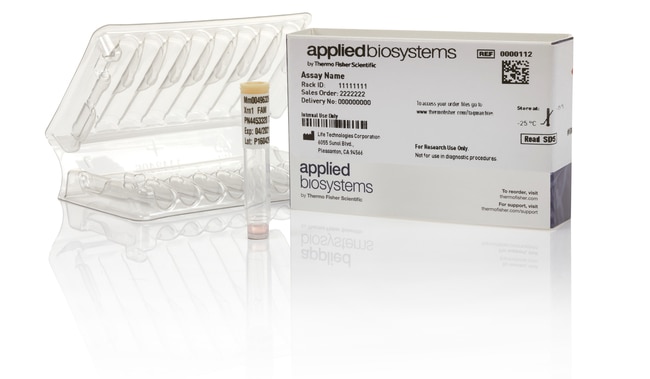
TaqMan™ Advanced miRNA Assay
Applied Biosystems™

TaqMan™ Advanced miRNA Assay

Applied Biosystems TaqMan Advanced miRNA Assays enable highly sensitive and specific quantification of mature miRNAs using qPCR.
Have Questions?
Catalog NumberQuantity
A25576S (250 reactions), inventoried
Catalog number A25576
Price (CNY)
4,084.00
Each
Order now
Quantity:
S (250 reactions), inventoried

Applied Biosystems TaqMan Advanced miRNA Assays enable highly sensitive and specific quantification of mature miRNAs using qPCR. Together with the TaqMan Advanced miRNA cDNA Synthesis Kit, this solution provides a streamlined upfront workflow that is ideal for analysis of multiple miRNA targets from a single sample or low-level RNA samples such as serum and plasma.

  • Universal RT—one RT step for all TaqMan Advanced miRNA Assays
  • Sensitivity—detect as few as 60 copies input into cDNA synthesis
  • Specificity—detect only the mature miRNA and distinguish between highly homologous targets
  • Small sample input—detect and quantify mature miRNA from as little as 1 pg total RNA or 2 μL plasma
  • Compatibility with biofluids including human serum, plasma, and tissue

Pre-formulated assay

  • 2 unlabeled PCR primers (900 nM each final 1X concentration)
  • 1 FAM dye-labeled TaqMan MGB probe (250 nM final 1X concentration)

TaqMan miRNA Assay selection guide

TaqMan MicroRNA Assays

  • Description: TaqMan MicroRNA Assays employ a novel target-specific stem–loop primer during cDNA synthesis to produce a template for real-time PCR
  • RT chemistry: miRNA-specific RT
  • Throughput: Best for 1–10 targets
  • Coverage: 205 species available, coverage for miRBase v.21

TaqMan Advanced miRNA Assays

  • Description: TaqMan Advanced miRNA Assays employ a universal RT step for a streamlined workflow, and a universal miR-Amp step to enable highly sensitive detection by real-time PCR
  • RT chemistry: Universal RT
  • Throughput: Best for > 10 targets
  • Coverage: All human, mouse, and rat miRNAs; coverage for miRBase v.21
For Research Use Only. Not for use in diagnostic procedures.
Specifications
For Use With (Equipment)7500 System, 7500 Fast System, 7900HT System, StepOne™, StepOnePlus™, ViiA™ 7 System, QuantStudio™ 3, QuantStudio™ 5, QuantStudio™ 6 Flex, QuantStudio™ 7 Flex, QuantStudio 6 Pro, QuantStudio 7 Pro, QuantStudio™ 12k Flex, QuantStudio™ Absolute Q Digital PCR System
FormatTube
No. of Reactions250 Reactions
Product LineTaqMan™
Product TypeAdvanced miRNA Assay
QuantityS (250 reactions), inventoried
Shipping ConditionRoom Temperature
Volume250 μL
Concentration20X
Detection MethodPrimer-probe
GC-Rich PCR PerformanceHigh
PCR MethodqPCR
Reaction SpeedStandard
Unit SizeEach
Contents & Storage
1 tube containing a 20X mix of pre-formulated assay (1 probe and 2 primers).

Store at -15 to -25°C.

Frequently asked questions (FAQs)

What is the "alias" associated with the TaqMan miRNA assays?

An alias is the miRBAse ID for a given miRNA from an earlier version. Alias information is found in the Details section of the search results. The miRBase release version shown in parentheses represents when the alias miRBase ID was last listed.

Why is an assay for human named with the name of another species?

An assay for a human miRNA may have a lower species name because the target sequence was first introduced and published in miRBase for that species and only later found in human. For example, mmu-miR-124a was first introduced as a mouse miRNA. The human miRNA was introduced later.

What is the miRBAse accession number?

Accession numbers are unique identifiers assigned to both hairpin (e.g.: MI0000015) and mature (e.g.: MIMAT0000029) sequences. While miRBase names may change, the accession numbers are stable and remain associated with a specific sequence.

What is the miRBase ID?

The mirBase ID is the official miRBase name given to a mature miRNA sequence. There may be multiple miRBase IDs for a given mature miRNA sequence because many miRNAs are conserved across species (for example, several hundred human miRNAs have the identical sequence in common with the mouse species). The miRBase ID consist of a 3 letter species identifier, including the first letter of the genus and the first two letters of the species, followed by the expression “miR”, and then a numeric suffix, e.g.: hsa-miR-212. Since two distinct mature miRNAs can be derived from the different arms of the same stem-loop precursor, a -5p or -3p suffix specifies the particular arm of the stem from which they come, e.g.: hsa-miR-501-5p is derived from the 5' end of the stem, while hsa-miR-501-3p is derived from the 3' end. The miRNA gene and hairpin precursor locus name is given lower case: hsa-mir-212. If a mature miRNA is predicted to be expressed from more than one hairpin precursor, then a numeric suffix is added to the precursor name. For example, hsa-miR-101 is expressed from two precursor loci, hsa-mir-101-1 and hsa-mir-101-2. Closely related miRNAs are given lettered suffixes (hsa-miR-19a-3p and hsa-miR-19b-3p) and are expressed from similarly named precursors (hsa-mir-19a-3p and hsa-mir-19b-3p).

miRBase continues to re-annotate the miRNA sequences as more information becomes available. Updated versions of miRBase are released on a regular basis. At the time of print (June 2013), it was up to v20.

Is the TaqMan Advanced miRNA Assay (Cat. No. A25576) shipped at room temperature?

Yes. Like our other TaqMan assays, the miRNA assays are shipped at ambient temperatures and are stable for multiple days.

Find additional tips, troubleshooting help, and resources within our TaqMan Protein Assay Support Center.