Search

Thermo Scientific™
BS3 (bis(sulfosuccinimidyl)suberate)
Thermo Scientific Pierce BS3 (Sulfo-DSS) is bis(sulfosuccinimidyl)suberate, an amine-to-amine crosslinker that is homobifunctional, water-soluble, non-cleavable and membrane impermeable.BS3 contains anRead more
Have Questions?
Change view

| Catalog Number | Quantity |
|---|---|
| A39266 | 10 x 2 mg |
| 21580 | 50 mg |
| 21586 | 1 g |
Catalog number A39266
Price (CNY)
1,547.00
飞享价
Ends: 31-Dec-2026
2,242.00Save 695.00 (31%)
Each
Quantity:
10 x 2 mg
Price (CNY)
1,547.00
飞享价
Ends: 31-Dec-2026
2,242.00Save 695.00 (31%)
Each
Thermo Scientific Pierce BS3 (Sulfo-DSS) is bis(sulfosuccinimidyl)suberate, an amine-to-amine crosslinker that is homobifunctional, water-soluble, non-cleavable and membrane impermeable.
BS3 contains an amine-reactive N-hydroxysulfosuccinimide (NHS) ester at each end of an 8-carbon spacer arm. NHS esters react with primary amines at pH 7-9 to form stable amide bonds, along with release of the N-hydroxysulfosuccinimide leaving group. Proteins, including antibodies, generally have several primary amines in the side chain of lysine (K) residues and the N-terminus of each polypeptide that are available as targets for NHS-ester crosslinking reagents.
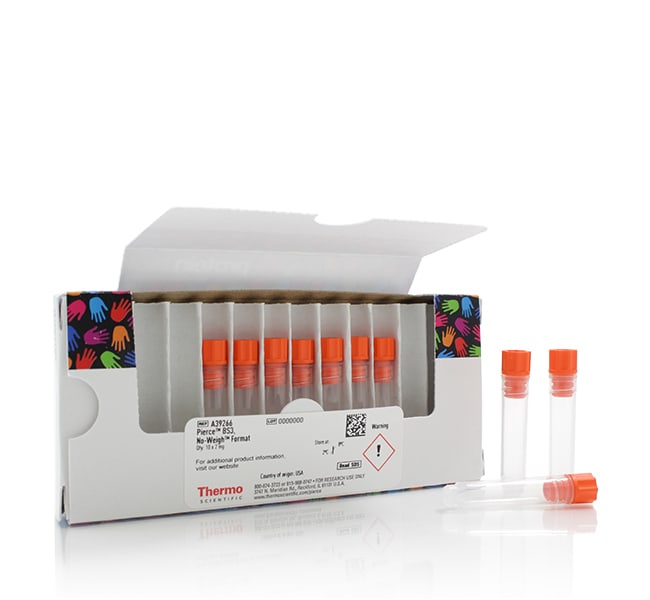
No-Weigh microtube handling:
Each of the eight microtubes contains 2 mg of crosslinker. Puncture foil with a pipette tip and add DMSO or DMF to the DSS or aqueous buffer to the BS3. Store the microtube strip in the foil pouch provided. Used microtubes may be cut from the unused microtubes and discarded.
Features of BS3:
• Reactive groups: sulfo-NHS ester (both ends)
• Reactive towards: amino groups (primary amines)
• Amine-reactive Sulfo-NHS ester reacts rapidly with any primary amine-containing molecule
• Water-soluble; compare with DSS
• Membrane-impermeable, allowing for cell surface labeling
• High-purity, crystalline reagent can be used to create high-purity crosslinked conjugates
Because it contains the hydrophilic sulfonyl moiety, BS3 crosslinker is soluble up to ∼100 mM in water and many commonly used buffers, thus avoiding the use of organic solvents which may perturb protein structure. DSS, the non-water soluble analog of BS3 is also available for applications that require a less hydrophilic crosslinker (e.g., to effect intracellular crosslinking). DSS and BS3 have essentially identical crosslinking activity toward primary amines.
Properties of BS3:
• Alternative names: Sulfo-DSS
• Molecular formula: C16H18N2O14S2Na2
• Molecular weight: 572.43
• Spacer arm length: 11.4 Å (8 atoms)
• CAS number: 82436-77-9
• Reactive groups: NHS esters, react with primary amines at pH 7.0-9.0
Applications:
• Crosslink cell-surface proteins prior to cell lysis and immunoprecipitation
• Identify receptor-ligand interactions by chemical crosslinking
• 'Fix' protein interactions to allow identification of weak or transient protein interactions
• Identify near-neighbor protein interactions
• Protein crosslinking to create bioconjugates via single-step reactions
• Immobilize proteins onto amine-coated surfaces
BS3 Specifications:
We manufacture BS3 to the highest specifications to produce the most specific bioconjugates, ensure the integrity of your data and to provide you with the highest degree of consistency. Each lot of BS3 is tested to meet the following minimum specifications:
• Purity: > 93% by quantitative NMR (the highest standard for crosslinker purity)
• Solubility: > 5.8 mg/mL in DI water, clear solution with no insoluble material
Product References
Crosslinker Application Guide -- search for recent literature references for this product
Related Products
Pierce™ Premium Grade BS3
DSS (disuccinimidyl suberate)
BS(PEG)5 (PEGylated bis(sulfosuccinimidyl)suberate)
BS(PEG)9 (PEGylated bis(sulfosuccinimidyl)suberate)
BS3 contains an amine-reactive N-hydroxysulfosuccinimide (NHS) ester at each end of an 8-carbon spacer arm. NHS esters react with primary amines at pH 7-9 to form stable amide bonds, along with release of the N-hydroxysulfosuccinimide leaving group. Proteins, including antibodies, generally have several primary amines in the side chain of lysine (K) residues and the N-terminus of each polypeptide that are available as targets for NHS-ester crosslinking reagents.
No-Weigh microtube handling:
Each of the eight microtubes contains 2 mg of crosslinker. Puncture foil with a pipette tip and add DMSO or DMF to the DSS or aqueous buffer to the BS3. Store the microtube strip in the foil pouch provided. Used microtubes may be cut from the unused microtubes and discarded.
Features of BS3:
• Reactive groups: sulfo-NHS ester (both ends)
• Reactive towards: amino groups (primary amines)
• Amine-reactive Sulfo-NHS ester reacts rapidly with any primary amine-containing molecule
• Water-soluble; compare with DSS
• Membrane-impermeable, allowing for cell surface labeling
• High-purity, crystalline reagent can be used to create high-purity crosslinked conjugates
Because it contains the hydrophilic sulfonyl moiety, BS3 crosslinker is soluble up to ∼100 mM in water and many commonly used buffers, thus avoiding the use of organic solvents which may perturb protein structure. DSS, the non-water soluble analog of BS3 is also available for applications that require a less hydrophilic crosslinker (e.g., to effect intracellular crosslinking). DSS and BS3 have essentially identical crosslinking activity toward primary amines.
Properties of BS3:
• Alternative names: Sulfo-DSS
• Molecular formula: C16H18N2O14S2Na2
• Molecular weight: 572.43
• Spacer arm length: 11.4 Å (8 atoms)
• CAS number: 82436-77-9
• Reactive groups: NHS esters, react with primary amines at pH 7.0-9.0
Applications:
• Crosslink cell-surface proteins prior to cell lysis and immunoprecipitation
• Identify receptor-ligand interactions by chemical crosslinking
• 'Fix' protein interactions to allow identification of weak or transient protein interactions
• Identify near-neighbor protein interactions
• Protein crosslinking to create bioconjugates via single-step reactions
• Immobilize proteins onto amine-coated surfaces
BS3 Specifications:
We manufacture BS3 to the highest specifications to produce the most specific bioconjugates, ensure the integrity of your data and to provide you with the highest degree of consistency. Each lot of BS3 is tested to meet the following minimum specifications:
• Purity: > 93% by quantitative NMR (the highest standard for crosslinker purity)
• Solubility: > 5.8 mg/mL in DI water, clear solution with no insoluble material
Product References
Crosslinker Application Guide -- search for recent literature references for this product
Related Products
Pierce™ Premium Grade BS3
DSS (disuccinimidyl suberate)
BS(PEG)5 (PEGylated bis(sulfosuccinimidyl)suberate)
BS(PEG)9 (PEGylated bis(sulfosuccinimidyl)suberate)
For Research Use Only. Not for use in diagnostic procedures.
Specifications
Cell PermeabilityNo
FormSolid
Labeling MethodChemical Labeling
Molecular Weight (g/mol)572.43
PEGylatedNo
Product LineNo-Weigh, Pierce
Quantity10 x 2 mg
Reactive MoietySulfo-NHS Ester
Shipping ConditionAmbient
SolubilityWater
Spacer Arm Length11.4 Å
Water SolubleYes
Chemical ReactivityAmine-Amine
CleavableNo
Crosslinker TypeHomobifunctional
FormatStandard, Single-use, Premium-grade
Product TypeCrosslinker
SpacerMedium (10 to 30 Å)
Unit SizeEach
Contents & Storage
Upon receipt store desiccated at 4°C.