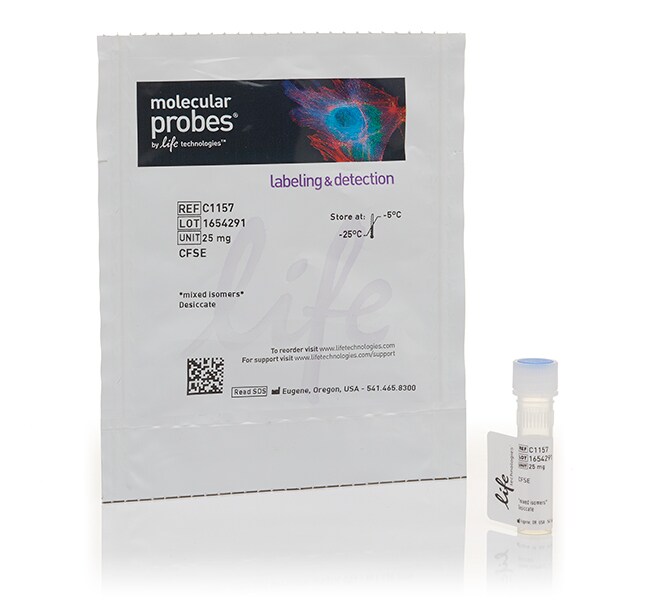
5(6)-CFDA, SE; CFSE (5-(and-6)-Carboxyfluorescein Diacetate, Succinimidyl Ester), mixed isomers
Invitrogen™

5(6)-CFDA, SE; CFSE (5-(and-6)-Carboxyfluorescein Diacetate, Succinimidyl Ester), mixed isomers

CFDA, SE is a fixable-cell-permeant, fluorescein-based tracer for very long-term cell labeling. The dye is also available in our convenient,Read more
Have Questions?
Catalog NumberQuantity
C115725 mg
Catalog number C1157
Price (CNY)
3,992.00
飞享价
Ends: 31-Dec-2025
5,305.00
Save 1,313.00 (25%)
Each
Add to cart
Quantity:
25 mg
Price (CNY)
3,992.00
飞享价
Ends: 31-Dec-2025
5,305.00
Save 1,313.00 (25%)
Each
Add to cart
CFDA, SE is a fixable-cell-permeant, fluorescein-based tracer for very long-term cell labeling. The dye is also available in our convenient, easy-to-use Vybrant CFDA-SE Cell Tracer Kit (V12883).
For Research Use Only. Not for use in diagnostic procedures.
Specifications
Detection MethodFluorescence
Dye TypeCFDA SE (CFSE)
Excitation Wavelength Range492⁄517
For Use With (Equipment)Fluorescence Microscope, Flow Cytometer
FormSolid
Quantity25 mg
Shipping ConditionRoom Temperature
SolubilityDMSO (Dimethylsulfoxide)
Label TypeClassic Dyes
Product TypeTracer
Unit SizeEach
Contents & Storage
Contains 1 vial of CFSE (25 mg). Store in freezer (-5 to -30°C).

Frequently asked questions (FAQs)

I'm trying to label my cells in suspension and track them over time by labeling with CFDA SE, but after labeling them they will no longer adhere to a surface (whereas unlabeled cells adhere well). I've tried to label at 10 and 20 µM. What is causing this?

This dye will bind to proteins via primary amines. Too high of a concentration can lead to cell toxicity or unintended modification of cell function. The solution is to reduce the concentration and/or staining time, or to go with a non-protein-binding tracking reagent, such as Qtracker cell labeling reagents.

Find additional tips, troubleshooting help, and resources within our Cell Analysis Support Center.

I want to do a cell migration study for around 4 hours and need to fluorescently label the cells with a dye. What do you recommend?

Calcein, AM and FDA (fluorescein diaceate) are examples of some dyes used for this application. Since these dyes are not incorporated or covalently attached to any cellular components, they may have a short retention time as some cell types may actively efflux the dye out of the cells. The CellTracker and CellTrace dyes include either a mild thiol-reactive chloromethyl group or amine-reactive succinnimidyl ester group to allow for covalent binding to cellular components, providing for better retention. As with any reagent, one should empirically determine retention times for the cell type used.

Find additional tips, troubleshooting help, and resources within our Cell Analysis Support Center.

I labeled my cells with Calcein, AM, but when I imaged the next day, there was no fluorescence from Calcein. Why?

Calcein, AM is a good choice for cell tracking and as a general cytoplasmic stain. However, it doesn't bind to anything and may be actively pumped out of the cells within a couple hours, which is likely what happened. The retention of Calcein within live cells is dependent upon the inherent properties of the cell type and culture conditions.

For long-term imaging, you may wish to consider a reactive cytoplasmic stains such as CFDA, SE or the CellTracker and CellTrace dyes.

Find additional tips, troubleshooting help, and resources within our Cell Analysis Support Center.

I want to track my cells with a nucleic acid stain, like DAPI or Hoechst dye. Do you recommend this?

This is not recommended. When these stains bind to DNA and RNA, they may affect the normal function of the nucleic acids, disrupting transcription, as well as replication. Other reagents, such as CellTracker dyes or Qtracker reagents are more optimized for tracking without disrupting normal activity. If a nuclear label is still desired, though, and the cells are mammalian and non-hematopoietic, CellLight nuclear reagents can transiently transfect cells to express GFP or RFP on a nuclear-expressing protein for up to several days without affecting function.

Find additional tips, troubleshooting help, and resources within our Cell Tracing and Tracking Support Center.

I want to track my cells over time, and you have a lot of options to choose from. How do I pick the right one?

Please see this Web link (http://www.thermofisher.com/us/en/home/life-science/cell-analysis/cell-tracing-tracking-and-morphology/cell-tracking.html) to help you choose the right option for your application. Start by planning how long you want to track your cells, then consider the mechanism of binding. Calcein dyes are very uniform in label and are good for short-term cell migration, but may be rapidly effluxed from some cell types. Lipophilic cyanine dyes, such as DiI, DiO, and similar dyes label cell membranes, don’t disrupt function, and can last longer, but have the potential to cross to other cells if membranes fuse. They are also lost upon permeabilization. CellTracker dyes are better for longer-term labeling, as they possess a mildly reactive chloromethyl moiety that allows covalent binding to cellular components. CFDA SE also covalently binds to cellular components. With all the reagents, their retention within cells is dependent upon the rate of cell division and the inherent properties of the cell (active efflux, membrane and protein turnover rates, etc.) and reagents that allow for covalent attachment exhibit longer retention than those that do not.

The longest-lasting and brightest options are the Qtracker reagents, which are taken up through endocytosis. These are so bright individual quantum dots can be detected, and are also robust enough to survive not only fixation and permeabilization, but even the heat and solvents used in paraffin processing.

Find additional tips, troubleshooting help, and resources within our Cell Tracing and Tracking Support Center.

Citations & References (471)

Citations & References
Abstract
Fas/Fas ligand interactions promote activation-induced cell death of NK T lymphocytes.
Authors:Leite-de-Moraes MC,Herbelin A,Gouarin C,Koezuka Y,Schneider E,Dy M
Journal:Journal of immunology (Baltimore, Md. : 1950)
PubMed ID:11035073
Phenotypic and functional effects of heat shock protein 90 inhibition on dendritic cell.
Authors:Bae J,Mitsiades C,Tai YT,Bertheau R,Shammas M,Batchu RB,Li C,Catley L,Prabhala R,Anderson KC,Munshi NC
Journal:Journal of immunology (Baltimore, Md. : 1950)
PubMed ID:17548610
Calcein: a novel marker for lymphocytes which enter lymph nodes.
Authors:Weston SA, Parish CR
Journal:Cytometry
PubMed ID:1451604
Previous studies have identified unique cell surface antigens which are associated with the specific binding of lymphocytes to high endothelial venules (HEV). Evidence is presented in this paper which demonstrates that uptake of the fluorescent dye calcein by lymphocytes represents an additional marker for the lymph node homing subpopulation of ... More
Platelet-endothelial interaction in tumor angiogenesis and microcirculation.
Authors:Manegold PC, Hutter J, Pahernik SA, Messmer K, Dellian M
Journal:Blood
PubMed ID:12584142
Activated platelets release angiogenic growth factors and have therefore been proposed to contribute to tumor angiogenesis within a potentially prothrombotic tumor microcirculation. The aim of the study was to investigate interactions of platelets with the angiogenic microvascular endothelium of highly vascularized solid tumors during growth and in response to endothelial ... More
Primitive, quiescent, Philadelphia-positive stem cells from patients with chronic myeloid leukemia are insensitive to STI571 in vitro.
Authors:Graham SM, Jørgensen HG, Allan E, Pearson C, Alcorn MJ, Richmond L, Holyoake TL
Journal:Blood
PubMed ID:11756187
In clinical trials, the tyrosine kinase inhibitor STI571 has proven highly effective in reducing leukemic cell burden in chronic myeloid leukemia (CML). The overall sensitivity of CML CD34(+) progenitor cells to STI571 and the degree to which cell death was dependent on cell cycle status were determined. Stem cells (Lin(-)CD34(+)) ... More