Search


Citations & References (4)
Invitrogen™
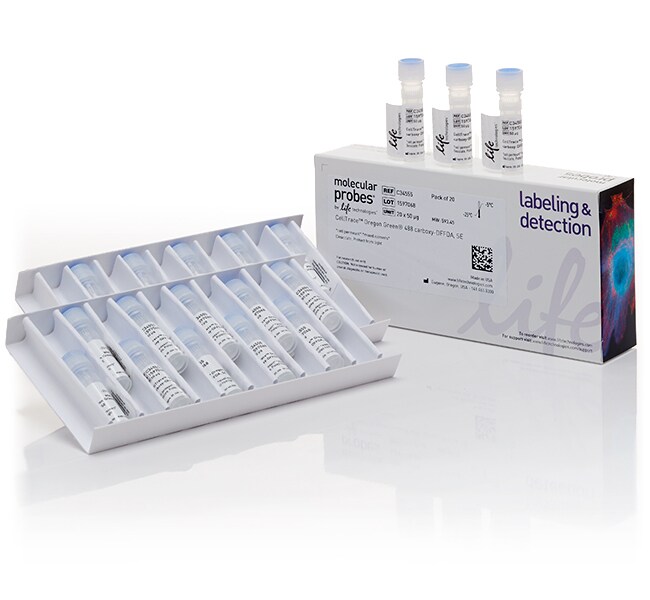
CellTrace™ Oregon Green™ 488 Carboxylic Acid Diacetate, Succinimidyl Ester (Carboxy-DFFDA, SE), cell permeant, mixed isomers
Like CFDA SE, CellTrace™ Oregon Green® 488 (carboxy-DFFDA SE) should be a useful tool for following proliferating cells. This OregonRead more
| Catalog Number | Quantity |
|---|---|
| C34555 | 20 x 50 μg |
Catalog number C34555
Price (CNY)
5,060.00
飞享价
Ends: 31-Dec-2026
6,723.00Save 1,663.00 (25%)
Each
Quantity:
20 x 50 μg
Price (CNY)
5,060.00
飞享价
Ends: 31-Dec-2026
6,723.00Save 1,663.00 (25%)
Each
Like CFDA SE, CellTrace™ Oregon Green® 488 (carboxy-DFFDA SE) should be a useful tool for following proliferating cells. This Oregon Green® 488 probe passively diffuses into cells, where it is colorless and nonfluorescent until its acetate groups are removed by intracellular esterases to yield a highly fluorescent, amine-reactive dye. Upon reaction with intracellular amines, the probe forms Oregon Green® 488 conjugates that are well-retained by cells. Unlike fluorescein conjugates, Oregon Green® 488 conjugates exhibit bright, photostable green fluorescence that is independent of pH at typical cellular pH values (pH-6-8).
For Research Use Only. Not for use in diagnostic procedures.
Specifications
Detection MethodFluorescence
Dye TypeOregon Green™ 488
Emission Wavelength488
FormSolid
Quantity20 x 50 μg
Reagent TypeCell Tracker Compounds, Cell Labeling Reagents
Shipping ConditionRoom Temperature
SolubilityDMSO (Dimethylsulfoxide)
For Use With (Application)Cell Viability and Proliferation
For Use With (Equipment)Fluorescence Microscope, Flow Cytometer
Product LineCellTrace, Oregon Green
Product TypeCarboxy-DFFDA SE
Unit SizeEach
Contents & Storage
Contains 20 vials of Oregon Green™ 488 carboxylic acid diacetate, SE (50 μg/vial). Store in freezer (-5 to -30°C) and protect from light.
Frequently asked questions (FAQs)
I want to do a cell migration study for around 4 hours and need to fluorescently label the cells with a dye. What do you recommend?
I labeled my cells with Calcein, AM, but when I imaged the next day, there was no fluorescence from Calcein. Why?
I am storing the DMSO stock solutions of the CellTrace cell proliferation reagents and am not obtaining a good signal with my cells compared to freshly dissolved dye stock. Why does the product not work after storage?
I am using the CellTrace Cell Proliferation reagents and am not obtaining good separation of my cell generation peaks. How can I improve the peak separation?
Can I store the stock solutions of the CellTrace reagents and how do you recommend storing them?
Citations & References (4)
Citations & References
Abstract
Method for assessment of viability and morphological changes of bacteria in the early stage of colony formation on a simulated natural environment.
Journal:Appl Environ Microbiol
PubMed ID:16820503
'A quantitative analysis of changes in the physiological status of bacterial cells is a fundamental type of study in microbiological research. We devised a method for measuring the viability of bacteria in the early stage of colony formation on a simulated natural environment. In this method, a solid medium containing
Functional capacity of Mycobacterium tuberculosis-specific T cell responses in humans is associated with mycobacterial load.
Journal:J Immunol
PubMed ID:21775682
'High Ag load in chronic viral infections has been associated with impairment of Ag-specific T cell responses; however, the relationship between Ag load in chronic Mycobacterium tuberculosis infection and functional capacity of M. tuberculosis-specific T cells in humans is not clear. We compared M. tuberculosis-specific T cell-associated cytokine production and
Three-dimensional culture for expansion and differentiation of mouse embryonic stem cells.
Journal:Biomaterials
PubMed ID:16860386
'Differentiation of embryonic stem (ES) cells typically requires cell-cell aggregation in the form of embryoid bodies (EBs). This process is not very well controlled and final cell numbers can be limited by EB agglomeration and the inability to drive differentiation towards a desired cell type. This study compares three-dimensional (3D)
Myosin light chain kinase mediates transcellular intravasation of breast cancer cells through the underlying endothelial cells: a three-dimensional FRET study.
Journal:J Cell Sci
PubMed ID:20067998
'The transient and localized signaling events between invasive breast cancer cells and the underlying endothelial cells have remained poorly characterized. We report a novel approach integrating vascular engineering with three-dimensional time-lapse fluorescence resonance energy transfer (FRET) imaging to dissect how endothelial myosin light chain kinase (MLCK) is modulated during tumor