Search


Citations & References (9)
Invitrogen™
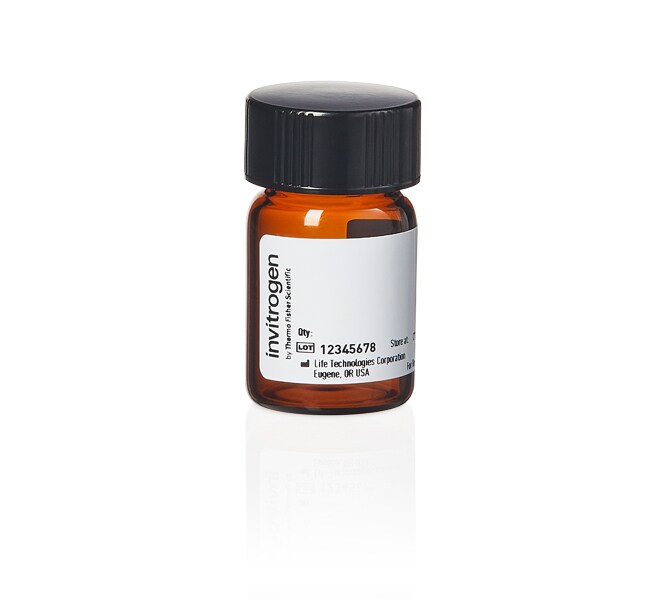
BODIPY™ 576/589 NHS Ester (Succinimidyl Ester)
BODIPY™ 576/589 dye is bright, red fluorescent dye with similar excitation and emission to Rhodamine Red™ and Alexa Fluor™568. ItRead more
| Catalog Number | Quantity |
|---|---|
| D2225 also known as D-2225 | 5 mg |
Catalog number D2225
also known as D-2225
Price (CNY)
6,805.00
Each
Quantity:
5 mg
Price (CNY)
6,805.00
Each
BODIPY™ 576/589 dye is bright, red fluorescent dye with similar excitation and emission to Rhodamine Red™ and Alexa Fluor™568. It has a high extinction coefficient and fluorescence quantum yield and is relatively insensitive to solvent polarity and pH change. In contrast to the highly water soluble fluorophores Alexa Fluor™ 488 dye and fluorescein (FITC), BODIPY™ dyes have unique hydrophobic properties ideal for staining lipids, membranes, and other lipophilic compounds. BODIPY™ 576/589 dye has a relatively long excited-state lifetime (typically 5 nanoseconds or longer), which is useful for fluorescence polarization-based assays and a large two-photon cross-section for multiphoton excitation. In addition to reactive dye formulations, we offer BODIPY™ 576/589 dye conjugated to a variety of antibodies, peptides, proteins, tracers, and amplification substrates optimized for cellular labeling and detection.
The NHS ester (or succinimidyl ester) of BODIPY™ 576/589 is the most popular tool for conjugating the dye to a protein or antibody. NHS esters can be used to label the primary amines (R-NH2) of proteins, amine-modified oligonucleotides, and other amine-containing molecules. The resulting BODIPY™ 576/589 conjugates exhibit bright fluorescence, narrow emission bandwidths, and relatively long excited-state lifetimes, which can be useful for fluorescence polarization assays and two-photon excitation (TPE) microscopy.
This reactive dye contains a C3 alkyl spacer between the fluorophore and the NHS ester group. This spacer helps to separate the fluorophore from its point of attachment, potentially reducing the interaction of the fluorophore with the biomolecule to which it is conjugated.
Detailed information about this BODIPY™ 576/589 NHS ester:
Fluorophore label: BODIPY™ 576/589 dye
Reactive group: NHS ester (succinimidyl ester)
Reactivity: Primary amines on proteins and ligands, amine-modified oligonucleotides
Ex/Em of the conjugate: 575/588 nm
Extinction coefficient: 83,000 cm-1M-1
Molecular weight: 426.19
Typical Conjugation Reaction
Amine-reactive reagents can be conjugated with virtually any protein or peptide; the provided protocol is optimized for IgG antibodies. The reaction can be scaled for any amount of protein, but the concentration of the protein should be at least 2 mg/mL for optimal results. We recommend trying three different degrees of labeling, using three different molar ratios of the reactive reagent to protein.
The BODIPY™ NHS ester is typically dissolved in high-quality anhydrous dimethylformamide (DMF) or dimethylsulfoxide (DMSO), and the reaction is carried out in 0.1-0.2 M sodium bicarbonate buffer, pH 8.3, at room temperature for 1 hour. Because the pKa of the terminal amine is lower than that of the lysine epsilon-amino group, you may achieve more selective labeling of the amine terminus using a buffer closer to neutral pH.
Conjugate Purification
Labeled antibodies are typically separated from free BODIPY™ dye using a gel filtration column, such as Sephadex™ G-25, BioGel™ P-30, or equivalent. For much larger or smaller proteins, select a gel filtration medium with an appropriate molecular weight cut-off or purify by dialysis. We offer several purification kits optimized for different quantities of antibody conjugate:
Antibody Conjugate Purification Kit for 0.5-1 mg (A33086)
Antibody Conjugate Purification Kit for 20-50 μg (A33087)
Antibody Conjugate Purification kit for 50-100 μg (A33088)
Learn More About Protein and Antibody Labeling
We offer a wide selection of Molecular Probes™ antibody and protein labeling kits to fit your starting material and your experimental setup. See our Antibody Labeling kits or use our Labeling Chemistry Selection Tool for other choices. To learn more about our labeling kits, read Kits for Labeling Proteins and Nucleic Acids—Section 1.2 in The Molecular Probes™ Handbook.
We’ll Make a Custom Conjugate for You
If you can’t find what you’re looking for in our online catalog, we’ll prepare a custom antibody or protein conjugate for you. Our custom conjugation service is efficient and confidential, and we stand by the quality of our work. We are ISO 13485:2000 certified.
The NHS ester (or succinimidyl ester) of BODIPY™ 576/589 is the most popular tool for conjugating the dye to a protein or antibody. NHS esters can be used to label the primary amines (R-NH2) of proteins, amine-modified oligonucleotides, and other amine-containing molecules. The resulting BODIPY™ 576/589 conjugates exhibit bright fluorescence, narrow emission bandwidths, and relatively long excited-state lifetimes, which can be useful for fluorescence polarization assays and two-photon excitation (TPE) microscopy.
This reactive dye contains a C3 alkyl spacer between the fluorophore and the NHS ester group. This spacer helps to separate the fluorophore from its point of attachment, potentially reducing the interaction of the fluorophore with the biomolecule to which it is conjugated.
Detailed information about this BODIPY™ 576/589 NHS ester:
Fluorophore label: BODIPY™ 576/589 dye
Reactive group: NHS ester (succinimidyl ester)
Reactivity: Primary amines on proteins and ligands, amine-modified oligonucleotides
Ex/Em of the conjugate: 575/588 nm
Extinction coefficient: 83,000 cm-1M-1
Molecular weight: 426.19
Typical Conjugation Reaction
Amine-reactive reagents can be conjugated with virtually any protein or peptide; the provided protocol is optimized for IgG antibodies. The reaction can be scaled for any amount of protein, but the concentration of the protein should be at least 2 mg/mL for optimal results. We recommend trying three different degrees of labeling, using three different molar ratios of the reactive reagent to protein.
The BODIPY™ NHS ester is typically dissolved in high-quality anhydrous dimethylformamide (DMF) or dimethylsulfoxide (DMSO), and the reaction is carried out in 0.1-0.2 M sodium bicarbonate buffer, pH 8.3, at room temperature for 1 hour. Because the pKa of the terminal amine is lower than that of the lysine epsilon-amino group, you may achieve more selective labeling of the amine terminus using a buffer closer to neutral pH.
Conjugate Purification
Labeled antibodies are typically separated from free BODIPY™ dye using a gel filtration column, such as Sephadex™ G-25, BioGel™ P-30, or equivalent. For much larger or smaller proteins, select a gel filtration medium with an appropriate molecular weight cut-off or purify by dialysis. We offer several purification kits optimized for different quantities of antibody conjugate:
Antibody Conjugate Purification Kit for 0.5-1 mg (A33086)
Antibody Conjugate Purification Kit for 20-50 μg (A33087)
Antibody Conjugate Purification kit for 50-100 μg (A33088)
Learn More About Protein and Antibody Labeling
We offer a wide selection of Molecular Probes™ antibody and protein labeling kits to fit your starting material and your experimental setup. See our Antibody Labeling kits or use our Labeling Chemistry Selection Tool for other choices. To learn more about our labeling kits, read Kits for Labeling Proteins and Nucleic Acids—Section 1.2 in The Molecular Probes™ Handbook.
We’ll Make a Custom Conjugate for You
If you can’t find what you’re looking for in our online catalog, we’ll prepare a custom antibody or protein conjugate for you. Our custom conjugation service is efficient and confidential, and we stand by the quality of our work. We are ISO 13485:2000 certified.
For Research Use Only. Not for use in diagnostic procedures.
Specifications
Chemical ReactivityAmine
Emission588 nm
Excitation575 nm
Label or DyeBODIPY™ 576⁄589
Product TypeDye
Quantity5 mg
Reactive MoietyActive Ester, Succinimidyl Ester
Shipping ConditionRoom Temperature
Label TypeBODIPY Dyes
Product LineBODIPY
Unit SizeEach
Contents & Storage
Store in freezer (-5 to -30°C) and protect from light.
Citations & References (9)
Citations & References
Abstract
Wavelength-resolved fluorescence detection in capillary electrophoresis.
Journal:Anal Chem
PubMed ID:7864386
'A multichannel laser-induced fluorescence detector for capillary electrophoresis is described. The detection system combines yoctomole limits of detection with the simultaneous acquisition of entire fluorescence emission spectra. An Ar/Kr mixed-gas ion laser provides great flexibility in excitation wavelengths, and a holographic grating and charge-coupled device detector combination allows a 500-nm
FRET analysis of protein conformational change through position-specific incorporation of fluorescent amino acids.
Journal:Nat Methods
PubMed ID:17060916
'We designed and synthesized new, fluorescent, non-natural amino acids that emit fluorescence of wavelengths longer than 500 nm and are accepted by an Escherichia coli cell-free translation system. We synthesized p-aminophenylalanine derivatives linked with BODIPY fluorophores at the p-amino group and introduced them into streptavidin using the four-base codon CGGG
Detection of the DeltaF508 mutation in the CFTR gene by means of time-resolved fluorescence methods.
Journal:Bioelectrochem Bioenerg
PubMed ID:10379562
A rapid recognition in the base sequence of nucleic acids is an important prerequisite toward the diagnosis of genetic diseases and their carrier states. We have developed a hybridisation method in which a fluorescently labeled oligonucleotide is used to detect point mutations in a target by a simple fluorescence lifetime
Molecular dynamics of labeled oligonucleotide probes used for the detection of point mutations in DNA.
Journal:Nucleosides Nucleotides
PubMed ID:10408923
The fluorescent label BODIPY 576-589 linked to the 5-end of an oligonucleotide via alkyl chain linkers can be used as a probe to detect point mutations in DNA. We have employed fluorescence anisotropy decay and dynamic fluorescence resonance energy transfer (FRET) in order to investigate the molecular origin of the
Systematic evaluation of transcellular activities of secretory phospholipases A2. High activity of group V phospholipases A2 to induce eicosanoid biosynthesis in neighboring inflammatory cells.
Journal:J Biol Chem
PubMed ID:16476735
The mechanisms by which secretory phospholipase A2 (PLA2) exerts cellular effects are not fully understood. To elucidate these mechanisms, we systematically and quantitatively assessed the activities of human group IIA, V, and X PLA2s on originating and neighboring cells using orthogonal fluorogenic substrates in various mixed cell systems. When HEK293