Search


Citations & References (22)
Invitrogen™
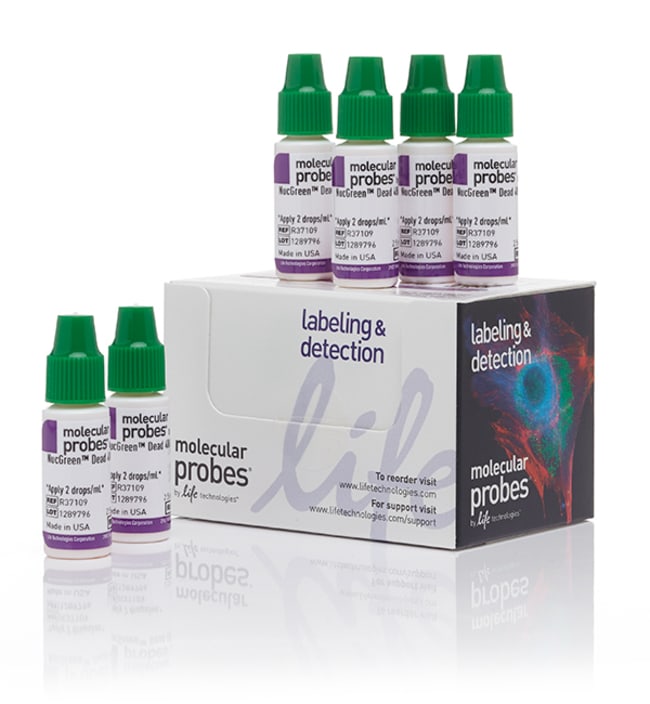
NucGreen™ Dead 488 ReadyProbes™ Reagent (SYTOX™ Green)
NucGreen Dead 488 ReadyProbes Reagent is a room temperature-stable solution of SYTOX Green Nucleic Acid Stain (Cat. No. S7020), whichRead more
| Catalog Number | Quantity |
|---|---|
| R37109 | 6 Bottles kit |
Catalog number R37109
Price (CNY)
3,861.00
Each
Quantity:
6 Bottles kit
Price (CNY)
3,861.00
Each
NucGreen Dead 488 ReadyProbes Reagent is a room temperature-stable solution of SYTOX Green Nucleic Acid Stain (Cat. No. S7020), which is a cell-impermeant stain that emits exceptionally bright, green fluorescence when bound to DNA. Cells that have lost plasma membrane integrity are stained within minutes, making this an extremely useful stain to estimate live/dead cell ratios and to measure cytotoxicity in kinetic live-cell assays. It is also suitable for staining nuclei in fixed cell preparations and tissue sections.
Also available: SYTOX Green Nucleic Acid Stain (5 mM solution in DMSO).
• Exceptionally bright green fluorescence upon binding to DNA
• Rapid staining of damaged, dead, or fixed cells without wash steps
• Ready-to-use liquid formulation in convenient dropper bottle—no need to dilute, weigh, or pipette
• Stability at room temperature—keep handy at your scope or cell
See other ReadyProbes reagents for cell staining
See other nuclear stains for imaging
Cell imaging applications
The membrane-impermeable NucGreen Dead 488 reagent is a high-affinity DNA stain that easily stains cells with compromised cell membranes, yet does not enter living cells. It is therefore ideal for discrimination of live and dead cells. The fluorescence increases more than 500-fold on binding to dsDNA in cells with compromised cell membranes (dying or dead cells), in fixed cells, and tissue slices. The spectral properties, with excitation/emission at 504/523 nm when bound to DNA, are ideal for standard FITC filters. .
Suggestions for use
• NucGreen Dead 488 reagent may be added directly to cells in full media or buffer solutions
• It easily stains nuclei of fixed cells and tissue slices
• In most cases, 2 drops/ml and an incubation time of 15 to 30 minutes will give bright nuclear staining; however, optimization may be needed for some cell types, conditions, and applications. In such cases, simply add more or fewer drops until the optimal staining intensity is obtained. In most cases, staining intensity increases with time if cells are not washed prior to imaging.
• NucGreen Dead 488 dye is excited with a maximum at 504 nm when bound to DNA, with an emission maximum at 523 nm. It is detected through standard GFP and FITC filters.
Visualize staining your cell without wasting your reagents, antibodies, or time with our new Stain-iT Cell Staining Simulator.
Also available: SYTOX Green Nucleic Acid Stain (5 mM solution in DMSO).
• Exceptionally bright green fluorescence upon binding to DNA
• Rapid staining of damaged, dead, or fixed cells without wash steps
• Ready-to-use liquid formulation in convenient dropper bottle—no need to dilute, weigh, or pipette
• Stability at room temperature—keep handy at your scope or cell
See other ReadyProbes reagents for cell staining
See other nuclear stains for imaging
Cell imaging applications
The membrane-impermeable NucGreen Dead 488 reagent is a high-affinity DNA stain that easily stains cells with compromised cell membranes, yet does not enter living cells. It is therefore ideal for discrimination of live and dead cells. The fluorescence increases more than 500-fold on binding to dsDNA in cells with compromised cell membranes (dying or dead cells), in fixed cells, and tissue slices. The spectral properties, with excitation/emission at 504/523 nm when bound to DNA, are ideal for standard FITC filters. .
Suggestions for use
• NucGreen Dead 488 reagent may be added directly to cells in full media or buffer solutions
• It easily stains nuclei of fixed cells and tissue slices
• In most cases, 2 drops/ml and an incubation time of 15 to 30 minutes will give bright nuclear staining; however, optimization may be needed for some cell types, conditions, and applications. In such cases, simply add more or fewer drops until the optimal staining intensity is obtained. In most cases, staining intensity increases with time if cells are not washed prior to imaging.
• NucGreen Dead 488 dye is excited with a maximum at 504 nm when bound to DNA, with an emission maximum at 523 nm. It is detected through standard GFP and FITC filters.
Visualize staining your cell without wasting your reagents, antibodies, or time with our new Stain-iT Cell Staining Simulator.
For Research Use Only. Not for use in diagnostic procedures.
Specifications
Cell PermeabilityCell-impermeant
Detection MethodFluorescence
Dye TypeOther Label(s) or Dye(s)
FormLiquid
Quantity6 Bottles kit
Sub Cellular LocalizationNucleus
ColorGreen
Emission Wavelength Range523
Excitation Wavelength Range504 nm
For Use With (Application)Viability Assay
For Use With (Equipment)Confocal Microscope, Floid Cell Imaging System, Fluorescence Microscope, Flow Cytometer
Product LineNucGreen, ReadyProbes
Product TypeNucleic Acid Stain
Unit SizeEach
Contents & Storage
6 x 2.5 mL dropper bottles
Store at ≤ 25°C
Store at ≤ 25°C
Frequently asked questions (FAQs)
Can I use the ReadyProbes reagents for flow cytometry?
What is the difference between NucBlue Live reagents stain and NucGreen Dead reagents stain?
Citations & References (22)
Citations & References
Abstract
Development of a high-content screen for the identification of inhibitors directed against the early steps of the cytomegalovirus infectious cycle.
Journal:
PubMed ID:25446405
'Human cytomegalovirus (CMV) is a latent and persistent virus whose proliferation increases morbidity and mortality of immune-compromised individuals. The current anti-CMV therapeutics targeting the viral DNA polymerase or the major immediate-early (MIE) gene locus are somewhat effective at limiting CMV-associated disease. However, due to low bioavailability, severe toxicity, and the
Influenza A virus uses intercellular connections to spread to neighboring cells.
Journal:
PubMed ID:25428869
'In the extracellular environment, cell-free virions seek out naive host cells over long distances and between organisms. This is the primary mechanism of spread for most viruses. Here we provide evidence for an alternative pathway previously undescribed for orthomyxoviruses, whereby the spread of influenza A virus (IAV) infectious cores to
Effects of macro- versus nanoporous silicon substrates on human aortic endothelial cell behavior.
Journal:
PubMed ID:25246859
Human aortic endothelial cells play a key role in the pathogenesis of atherosclerosis, which is a common, progressive, and multifactorial disease that is the clinical endpoint of an inflammatory process and endothelial dysfunction. Study and development of new therapies against cardiovascular disease must be tested in vitro cell models, prior
Distinct myeloid cell subsets promote meningeal remodeling and vascular repair after mild traumatic brain injury.
Journal:Nat Immunol
PubMed ID:29662169
'Mild traumatic brain injury (mTBI) can cause meningeal vascular injury and cell death that spreads into the brain parenchyma and triggers local inflammation and recruitment of peripheral immune cells. The factors that dictate meningeal recovery after mTBI are unknown at present. Here we demonstrated that most patients who had experienced
Differentiation of ciliated human midbrain-derived LUHMES neurons.
Journal:J Cell Sci
PubMed ID:34005365