Search


Citations & References (6)
Invitrogen™
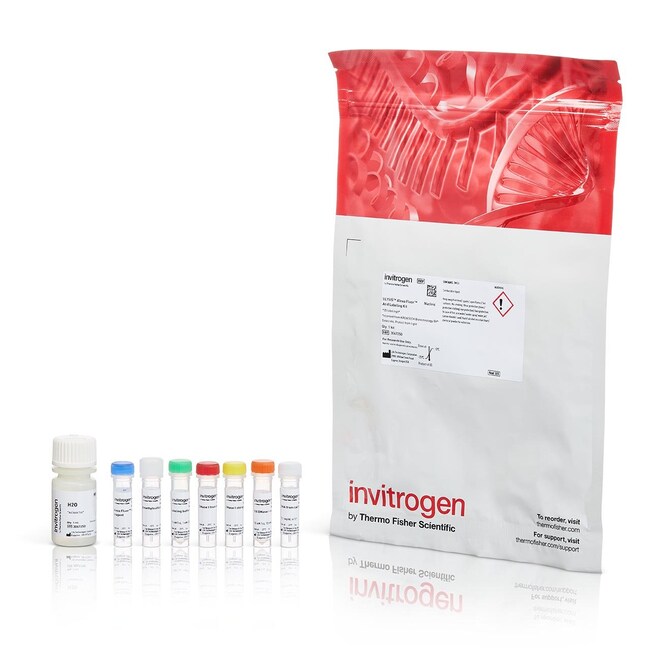
ULYSIS™ Alexa Fluor™ Nucleic Acid Labeling Kit
Achieve unparalleled precision and sensitivity in your fluorescence-based applications from FISH to real-time PCR. With a streamlined, non-enzymatic labeling process and a broad selection of vibrant dyes, ULYSIS kits ensure your nucleic acids are ready for any challenge.
Have Questions?
Change view

| Catalog Number | Label or Dye | Excitation/Emission |
|---|---|---|
| U21660 | Alexa Fluor 647 | 650/670 nm |
| U21654 | Alexa Fluor 594 | 588/615 nm |
Catalog number U21660
Price (CNY)
8,899.00
1 kit
Label or Dye:
Alexa Fluor 647
Excitation/Emission:
650/670 nm
Price (CNY)
8,899.00
1 kit
ULYSIS nucleic acid labeling kits provide a unique method for attaching a fluorescent dye to nucleic acids. The labeling reagent in the kit reacts with the N7 of guanine to form a stable coordination complex, and the reaction is simple and fast - just heat denature DNA (5 minutes), add the label (react for 15 minutes), then purify.
Features include:
- Labeling reaction complete in as little as 15 minutes
- Available in several Alexa Fluor dye colors
- Non-enzymatic labeling—avoids the potential biases and limitations associated with enzymatic labeling methods
- Flexibility—compatible with a wide range of experimental conditions and protocols
- High sensitivity—provides strong fluorescence signals, enabling detection of low-abundance targets
Reliable labeling with the Universal Linkage System
This series of ULYSIS kits was developed to enable rapid and simple coupling of Alexa Fluor dyes to purine bases in nucleic acid polymers. The method, the Universal Linkage System (ULS), makes use of a platinum dye complex that forms a stable adduct with the N7 position of guanine and, to a lesser extent, adenine bases in DNA, RNA, PNA, and oligonucleotides. The result is a reliable nonenzymatic method for nucleic acid labeling.
Labeling is fast and easy
The labeling reaction typically takes only 15 minutes, and separation of the labeled nucleic acids from the unreacted ULS complex can be accomplished with a simple spin-column procedure. DNA longer than ∼1,000 base pairs require a 10-minute DNase digestion before labeling, which both optimizes labeling and fragments the probe for efficient hybridization.
For Research Use Only. Not for use in diagnostic procedures.
Specifications
ColorFar-red
Excitation/Emission650/670 nm
For Use With (Application)Dot blot, Northern blot, Southern blot, RNA in situ hybridization, DNA in situ hybridization, Multicolor fluorescence in situ hybridization (mFISH), Comparative genome hybridization (CGH), Microarray analysis
Includes Label or DyeYes
Labeling MethodDirect Labeling
Product LineAlexa Fluor, Ulysis
Product TypeNucleic Acid Labeling Kit
Quantity1 Kit
Shipping ConditionRoom Temperature
Detection MethodFluorescence
Final Product TypeProbes (Labeled RNA), Probes (Labeled DNA), Oligos (Labeled)
FormatKit
Labeling TargetDNA (General), Oligos, RNA (General)
Label or DyeAlexa Fluor 647
Sample TypeDNA/RNA
Unit Size1 kit
Contents & Storage
Store in freezer (-5 to -30°C) and protect from light.
Needed but not included: gel filtration-based spin columns for purification of the labeled DNA from excess labeling reagent
Needed but not included: gel filtration-based spin columns for purification of the labeled DNA from excess labeling reagent
Frequently asked questions (FAQs)
Is ULYSIS labeling compatible with microarray analysis?
Can probes labeled with the ULYSIS Nucleic Acid Labeling Kits be stored for later use?
Do you have any tips on using the ULYSIS Nucleic Acid Labeling Kits for RNA labeling?
Can the ULYSIS kits be used on probes longer than 1,000 base pairs or even plasmids?
How stable is the ULYSIS labeled DNA to high temperature?
Citations & References (6)
Citations & References
Abstract
A systematic search for new mammalian noncoding RNAs indicates little conserved intergenic transcription.
Journal:BMC Genomics
PubMed ID:16083503
'BACKGROUND: Systematic identification and functional characterization of novel types of noncoding (nc)RNA in genomes is more difficult than it is for protein coding mRNAs, since ncRNAs typically do not possess sequence features such as splicing or translation signals, or long open reading frames. Recent "tiling" microarray studies have reported that
A custom microarray platform for analysis of microRNA gene expression.
Journal:Nat Methods
PubMed ID:15782152
'MicroRNAs are short, noncoding RNA transcripts that post-transcriptionally regulate gene expression. Several hundred microRNA genes have been identified in Caenorhabditis elegans, Drosophila, plants and mammals. MicroRNAs have been linked to developmental processes in C. elegans, plants and humans and to cell growth and apoptosis in Drosophila. A major impediment in
Expression profile analysis of microRNA (miRNA) in mouse central nervous system using a new miRNA detection system that examines hybridization signals at every step of washing.
Journal:Gene
PubMed ID:17229533
'MicroRNAs (miRNAs) are small noncoding RNAs, with a length of 19 to 23 nucleotides, which appear to be involved in the regulation of gene expression by inhibiting the translation of messenger RNA. Expression profile analysis of miRNAs is necessary to understand their complex role in the regulation of gene expression
Identification and characterization of bacterial pathogens causing bloodstream infections by DNA microarray.
Journal:J Clin Microbiol
PubMed ID:16825354
'Bloodstream infections are potentially life-threatening and require rapid identification and antibiotic susceptibility testing of the causative pathogen in order to facilitate specific antimicrobial therapy. We developed a prototype DNA microarray for the identification and characterization of three important bacteremia-causing species: Staphylococcus aureus, Escherichia coli, and Pseudomonas aeruginosa. The array consisted
Probing microRNAs with microarrays: tissue specificity and functional inference.
Journal:RNA
PubMed ID:15496526
MicroRNAs (miRNAs) are short, stable, noncoding RNAs involved in post-transcriptional gene silencing via hybridization to mRNA. Few have been thoroughly characterized in any species. Here, we describe a method to detect miRNAs using micro-arrays, in which the miRNAs are directly hybridized to the array. We used this method to analyze