在 HPLC/UHPLC 分析中,最常用的检测器是 UV-Vis(紫外-可见)检测器。但如果你的分析物没有发色团、无法用 UV-Vis 检测,又该怎么办?
你很可能会转向更“通用”的检测器,例如荷电气溶胶检测器(CAD)与蒸发光散射检测器(ELSD)。无论是否存在发色团,这类检测器都可测量不挥发以及许多半挥发化合物。
CAD和ELSD都是蒸发式气溶胶检测器,它们根据相对挥发性区分分析物与流动相。因此,两者具有类似的检测范围(非挥发性和半挥发性分析物),并且基本操作要求相同:
- 使用高质量、在蒸发后残留极少的挥发性流动相及添加剂
- 持续供应纯净气体,通常为氮气
- 稳定且无渗漏的色谱柱
如果你对这个话题不陌生,可能已经知道色谱圈长期存在“CAD 与 ELSD 哪个更好”的争论。
下面我们从各自的检测原理出发,进一步看看差异。
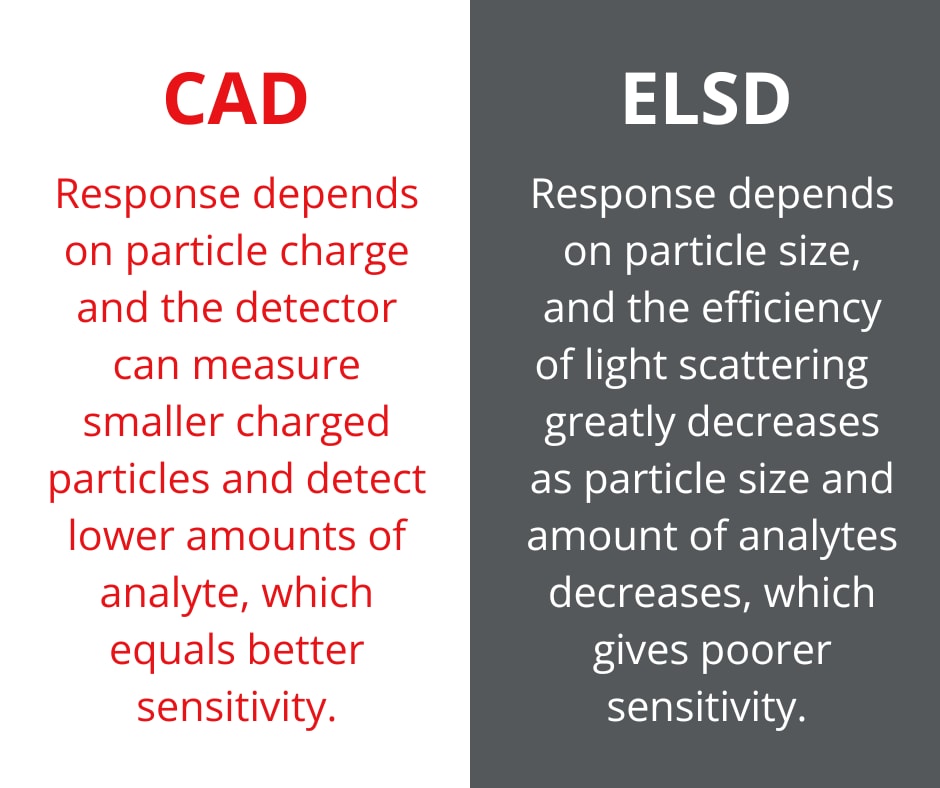
荷电气溶胶的测量在原理层面、并且在实际表现上,通常比光散射更灵敏,这会显著影响整体分析性能。
原因如下:
- 在CAD中,颗粒通过与电离氮气碰撞获得电荷,并且充电过程与化学结构无关。颗粒上的电荷通过高灵敏度的静电计进行测量,信号与颗粒大小(分析物的质量)成正比。分析物含量越多,颗粒尺寸越大,携带的电荷也越多,从而产生更高的响应。
- 对于ELSD,通过干燥气溶胶颗粒散射的光来确定分析物的含量。与CAD一样,信号也与颗粒大小成正比。但这种关系要复杂得多,因为散射光的强度会根据颗粒大小呈指数变化,导致复杂的S型响应曲线。在ELSD中,对于较小的颗粒几乎得不到信号或信号极低,并且分析物间属性—如折射率、光吸收和荧光—都可能影响响应。
因此,即使CAD和ELSD具有功能上的相似性,检测器测量分析物质量的机制却有显著不同。如文献所示,在动态范围、线性范围、灵敏度、精密度和准确性方面,CAD往往优于ELSD。
CAD优于ELSD的主要方式1-23有已发表的数据支持
1. 从实际角度来看,CAD的检测限比ELSD高出10倍或更多
这种在报告中的定量差异检测限(LOD) 两种检测器之间的差异源于颗粒大小。
CAD的灵敏度远高于ELSD,因为它可以定量检测更小的颗粒(更少量的分析物)。对于ELSD,颗粒必须足够大才能有效散射光,对于直径小于约50纳米的颗粒几乎没有信号。
与ELSD不同,CAD对直径仅为10纳米的颗粒仍能保持良好的灵敏度。
2. CAD本身具有更宽的动态范围,通常是ELSD的两倍
当需要在高浓度另一种物质存在时测量低浓度分析物时,宽动态范围至关重要,例如杂质分析.
CAD(电荷气溶胶检测器)具有固有的动态范围高达四个数量级,因此您可以轻松测量同一样品中不同浓度范围的分析物,无需在不同增益范围下重新分析样品。
ELSD(蒸发光散射检测器)则大不相同,因为用于测量光散射的光电倍增管或光电二极管的动态范围相对较小,通常只有两个数量级。为此会采用各种处理技术来尝试扩展其动态范围,而CAD则无需这些措施。
3. CAD响应在大约两个数量级内足够线性,因此许多方法可以使用线性校准模型
CAD响应在两个数量级内呈线性关系,并且具有四个数量级的动态范围。而ELSD响应通常只在一个数量级内呈线性,动态范围为两个数量级。因此,大多数分析需要在进行线性校准前进行对数转换,这增加了不必要的复杂性,尤其是在方法验证和受监管实验室使用时。
此外,使用CAD时,您可以利用一种独特的数据采集参数叫做幂函数值(PFV)设置用于优化在给定方法和定量范围内响应足够线性的区间。
由于非线性响应也会影响峰形和信噪比,优化PFV还可以更准确且简化地计算测得的色谱分辨率和检测限。
4. CAD响应均一且不受化学结构影响,这为无标准定量提供了支持
响应均一性(一致性)在对分析物进行定量时非常重要,尤其是当缺乏单独校准标准品时,如药物研发、杂质分析以及化合物库管理。
CAD比ELSD在无标准定量方面更准确,原因有两点:其一是跨多种化学结构的分析物响应相似,其二是可以应用反梯度来补偿过程中响应变化。标准自由量化有两个重要原因:一是因为在各种化学结构中,不同分析物的响应相似;二是你可以应用反向梯度来补偿分析过程中响应的变化。梯度洗脱.
相比之下,分析物的理化性质对ELSD响应的影响可能比CAD更大。例如,分析物的折射率、光吸收和荧光等特性都被报道会影响ELSD响应。
此外,在使用ELSD时,你选择作为替代标准的峰可能不会像你关注的目标峰那样表现一致。
5. ELSD响应曲线复杂的形状常常导致更多限制和更大的不准确性
CAD和ELSD的响应曲线完全相反(见图1)。在整个范围内,ELSD响应曲线在弯曲程度和方向上都显示出剧烈变化。这些急剧变化通常与不精确和不准确相关,因为散射光强度随着粒径呈指数变化,从而产生复杂的S型响应曲线。
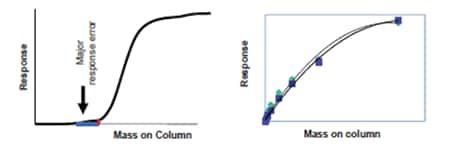
这种复杂行为很大程度上可以通过考虑较小气溶胶颗粒(小于约50纳米),即在低分析物浓度及任何色谱峰边缘占主导地位的颗粒所产生的预期信号来解释。
对于这个粒径范围,理论上浓度下降导致颗粒直径减少一半,应会引起散射光强度约64倍的下降,这与10成正比。6对于瑞利散射这种灵敏度的损失通常表现为ELSD信号的突然消失或急剧下降。
对于CAD,相同的粒径减小只会导致每个颗粒电荷量约减少两倍,从而产生更简单且更接近线性的关系,许多直接对比研究表明CAD在精密度和准确性方面优于ELSD。
6. ELSD不是线性检测器,通过高浓度标准品推算的“估算”LOD和LOQ毫无意义
通常做法是通过高浓度标准品信噪比外推来估算线性检测器的检出限(LOD)或定量限(LOQ),但用这种方法推算ELSD的结果往往极具误导性。
原因在于ELSD对较小颗粒响应出现显著“骤降”,因此应通过实际分析来确定LOD和LOQ。逐渐降低分析物浓度进行分析.
线性评估应包括对准确度或回收率的仔细检查,尤其是在低浓度时。
探索您的实验室如何受益于使用带电气溶胶检测技术
如您所见,CAD在分析上相比ELSD具有诸多优势,这直接源自电气溶胶检测与光散射检测各自的特点。
了解如何加速您的工作药物发现提升配方稳定性HPLC-CAD 技术立即体验。
文献参考
- Sensitive Determination of Saponins in Radix et Rhizoma Notoginseng by Charged Aerosol Detector Coupled with HPLC
- Comparison between evaporative light scattering detection and charged aerosol detection for the analysis of saikosaponins
- Comparison of universal detectors for high-temperature micro liquid chromatography
- Control of impurities in L‐aspartic acid and L‐alanine by high‐performance liquid chromatography coupled with a corona charged aerosol detector
- Alternatives to amino acid analysis for the purity control of pharmaceutical grade L-alanine
- Impurity Control in Topiramate with High Performance Liquid Chromatography
- Comparison of two aerosol‐based detectors for the analysis of gabapentin in pharmaceutical formulations by hydrophilic interaction chromatography
- Size exclusion chromatography with Corona charged aerosol detector for the analysis of polyethylene glycol polymer
- A non-derivative method for the quantitative analysis of isosteroidal alkaloids from Fritillaria by high performance liquid chromatography combined with charged aerosol detection
- Evaluation of charged aerosol detection (CAD) as a complementary technique for high‐throughput LC‐MS‐UV‐ELSD analysis of drug discovery screening libraries
- Quantitative study of the stratum corneum lipid classes by normal phase liquid chromatography: comparison between two universal detectors
- Aerosol based detectors for the investigation of phospholipid hydrolysis in a pharmaceutical suspension formulation
- Polyketide analysis using mass spectrometry, evaporative light scattering, and charged aerosol detector systems
- Comparison between charged aerosol detection and light scattering detection for the analysis of Leishmania membrane phospholipids
- Recent applications of the Charged Aerosol Detector for liquid chromatography in drug quality control
- Comparison of ultraviolet detection, evaporative light scattering detection and charged aerosol detection methods for liquid‐chromatographic determination of anti‐diabetic drugs
- Quantitative comparison of a corona‐charged aerosol detector and an evaporative light‐ scattering detector for the analysis of a synthetic polymer by supercritical fluid chromatography
- Review of operating principle and applications of the charged aerosol detector
- Performance evaluation of evaporative light scattering detection and charged aerosol detection in reversed phase liquid chromatography
- Performance evaluation of charged aerosol and evaporative light scattering detection for the determination of ginsenosides by LC
- HPLC determinations of enantiomeric ratios
- Comparison of ELSD and CAD methods for determination of phosphatidylcholine content in polyene phosphatidycholine injection
- Kiser, M. M.; Dolan, J. W. Selecting the best curve fit. LC GC North America 2004, 22(2), 112–117.
- Almeida, A. M. d., et al. Linear regression for calibration lines revisited: weighting schemes for bioanalytical methods. Journal of Chromatography B 2002, 774(2), 215–222.

新兴技术:用于食品安全与质量分析的液相色谱-质谱联用技术
在最近的一篇综述中,Yolanda Picó 将液相色谱-... Bioprocessing Staff
了解更多
使用氢气作为GC和GC-MS的载气:安全高效
与许多其他科学和工业领域一样,分析化学正... Daniela Cavagnino, M.S.
了解更多
寡核苷酸和mRNA分析资源汇总
寡核苷酸治疗方法的复杂性不断增加,分析需... Chris Knowles, Ph.D.
了解更多
食品中的有毒气体与环氧乙烷的威胁
引言 环氧乙烷(Ethylene Oxide,EtO)自1991年以æ�... Bioprocessing Staff
了解更多