Search


Citations & References (7)
Thermo Scientific™
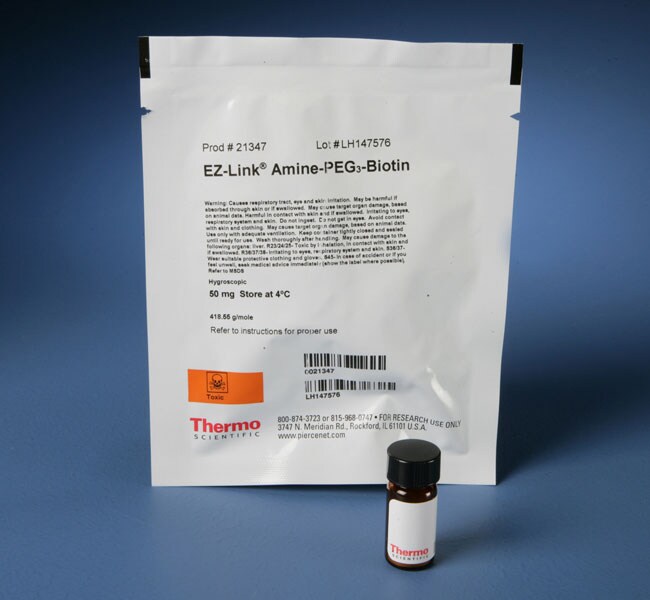
EZ-Link™ Amine-PEG3-Biotin
Thermo Scientific EZ-Link Amine-PEG3-Biotin is a water-soluble biotin compounds containing a polyethylene glycol (PEG) spacer arm and a terminal primaryRead more
| Catalog Number | Quantity |
|---|---|
| 21347 | 50 mg |
Catalog number 21347
Price (CNY)
7,209.00
Each
Quantity:
50 mg
Price (CNY)
7,209.00
Each
Thermo Scientific EZ-Link Amine-PEG3-Biotin is a water-soluble biotin compounds containing a polyethylene glycol (PEG) spacer arm and a terminal primary amine for conjugation via EDC and other crosslinker methods.
Features of EZ-Link Amine-PEG3-Biotin:
• Biotinylation—label molecules and surfaces for assays or affinity purification methods involving avidin or streptavidin probes and resins
• Amine-activated—primary amine can be crosslinked to proteins and material surfaces using EDC and other crosslinkers
• Pegylated—polyethylene glycol (PEG) groups in spacer arm enhances water solubility of biotinylated molecules
• Medium length—spacer arm (total length added to target) is 22.9 angstroms
Amine-PEG2-Biotin and Amine-PEG3-Biotin are the shorter two of three amine-modified biotin compounds that contain polyethylene glycol (PEG) spacer arms. The short PEG segments are hydrophilic and confer greater solubility to labeled proteins compared to reagents having only hydrocarbon spacers. The primary amines of these pegylated biotin reagents can be conjugated to carboxyl groups on carboxy termini, aspartate residues or glutamate residues using EDC (Part No. 22980), a water-soluble carbodiimide crosslinker. EDC activates carboxyl groups to bind to the—NH2 group of the amino-biotin, forming an amide bond.
We manufacture biotin reagents to ensure the highest possible overall product integrity, consistency and performance for the intended research applications.
Amino-biotin compounds can be conjugated to functional groups of proteins and other molecules in a variety of ways. The most common method is to crosslink the terminal primary amine to carboxyl groups using . Carboxyl groups (-COOH) occur in aspartate or glutamate residues and the carboxy-terminus of polypeptides. When activated with EDC (Part No. 22980), carboxylates react with amino (—NH2) groups to form amide bonds. Carboxylate molecules and surface materials can be pre-activated using EDC with Sulfo-NHS (Part No. 24510) for subsequent reaction to primary amines (see NHS-ester Chemistry).
Related Products
EZ-Link™ Amine-PEG2-Biotin
Features of EZ-Link Amine-PEG3-Biotin:
• Biotinylation—label molecules and surfaces for assays or affinity purification methods involving avidin or streptavidin probes and resins
• Amine-activated—primary amine can be crosslinked to proteins and material surfaces using EDC and other crosslinkers
• Pegylated—polyethylene glycol (PEG) groups in spacer arm enhances water solubility of biotinylated molecules
• Medium length—spacer arm (total length added to target) is 22.9 angstroms
Amine-PEG2-Biotin and Amine-PEG3-Biotin are the shorter two of three amine-modified biotin compounds that contain polyethylene glycol (PEG) spacer arms. The short PEG segments are hydrophilic and confer greater solubility to labeled proteins compared to reagents having only hydrocarbon spacers. The primary amines of these pegylated biotin reagents can be conjugated to carboxyl groups on carboxy termini, aspartate residues or glutamate residues using EDC (Part No. 22980), a water-soluble carbodiimide crosslinker. EDC activates carboxyl groups to bind to the—NH2 group of the amino-biotin, forming an amide bond.
We manufacture biotin reagents to ensure the highest possible overall product integrity, consistency and performance for the intended research applications.
Amino-biotin compounds can be conjugated to functional groups of proteins and other molecules in a variety of ways. The most common method is to crosslink the terminal primary amine to carboxyl groups using . Carboxyl groups (-COOH) occur in aspartate or glutamate residues and the carboxy-terminus of polypeptides. When activated with EDC (Part No. 22980), carboxylates react with amino (—NH2) groups to form amide bonds. Carboxylate molecules and surface materials can be pre-activated using EDC with Sulfo-NHS (Part No. 24510) for subsequent reaction to primary amines (see NHS-ester Chemistry).
Related Products
EZ-Link™ Amine-PEG2-Biotin
For Research Use Only. Not for use in diagnostic procedures.
Specifications
Cell PermeabilityCell-Impermeant
Label TypeBiotin & Analogs
Product LineEZ-Link
Product TypeAmine-PEG3-Biotin
Quantity50 mg
Reactive MoietyAmine
Chemical ReactivityCarboxylic Acid, Ketone, Aldehyde
Label or DyeBiotin
SolubilityWater
SpacerMid-length, Pegylated
Unit SizeEach
Contents & Storage
Store at 4°C.
Citations & References (7)
Citations & References
Abstract
Site-specific incorporation of quadricyclane into a protein and photocleavage of the quadricyclane ligation adduct.
Journal:Bioorg Med Chem
PubMed ID:29754834
'The quadricyclane (QC) ligation is a bioorthogonal reaction between a quadricyclane moiety and a nickel bis(dithiolene) derivative. Here we show that a QC amino acid can be incorporated into a protein site-specifically using the pyrrolysine-based genetic code expansion platform, and subsequently used for ligation chemistry. Additionally, we exploited the photolability
Application of the fluctuation theorem for noninvasive force measurement in living neuronal axons.
Journal:Mol Biol Cell
PubMed ID:30281391
'Although its importance is recently widely accepted, force measurement has been difficult in living biological systems, mainly due to the lack of the versatile noninvasive force measurement methods. The fluctuation theorem, which represents the thermodynamic properties of small fluctuating nonequilibrium systems, has been applied to the analysis of the thermodynamic
Capsular Polysaccharide (CPS) Release by Serotype 3 Pneumococcal Strains Reduces the Protective Effect of Anti-Type 3 CPS Antibodies.
Journal:Clin Vaccine Immunol
PubMed ID:26677201
The efficacy of the serotype 3 (ST3) pneumococcal conjugate vaccine (PCV) remains unclear. While the synthesis of capsular polysaccharide (CPS) of most serotypes is wzy dependent, the strains of two serotypes, 3 and 37, synthesize CPS by the synthase-dependent pathway, resulting in a polysaccharide that is not covalently linked to
RNA Aptamers with Specificity for Heparosan and Chondroitin Glycosaminoglycans.
Journal:ACS Omega
PubMed ID:30411046
In this study, two respective groups of RNA aptamers have been selected against two main classes of glycosaminoglycans (GAGs), heparosan, and chondroitin, as they have proven difficult to specifically detect in biological samples. GAGs are linear, anionic, polydisperse polysaccharides found ubiquitously in nature, yet their detection remains problematic. GAGs comprised
Glycosaminoglycans from bovine eye vitreous humour and interaction with collagen type II.
Journal:Glycoconj J
PubMed ID:29305777
Glycosaminoglycans (GAGs) play an important role in stabilizing the gel state of eye vitreous humour. In this study, the composition of GAGs present in bovine eye vitreous was characterized through disaccharide analysis by liquid chromatography-mass spectrometry. The interaction of GAGs with collagen type II was assessed using surface plasmon resonance