Search


引用和文献 (5)
Thermo Scientific™
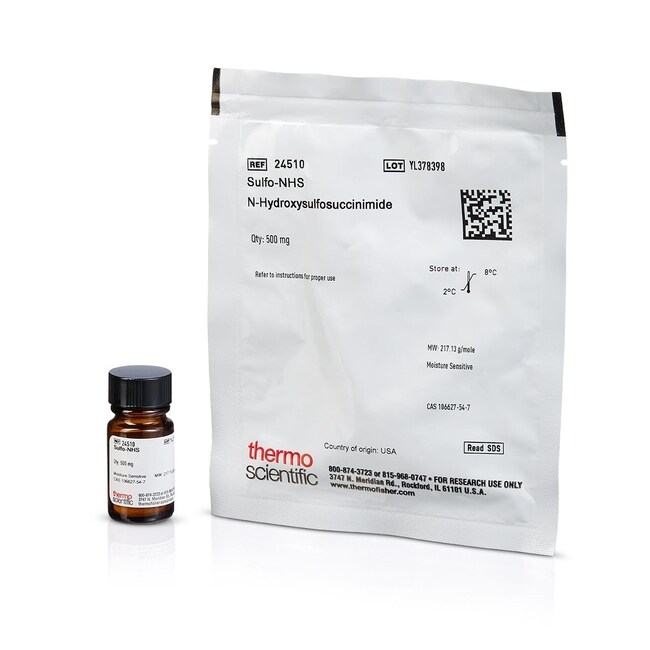
Sulfo-NHS(N-羟基磺基琥珀酰亚胺),No-Weigh™ 规格
Thermo Scientific Pierce Sulfo-NHS是一款用于将羧基转换为氨基反应性NHS酯的化学修饰试剂,适用于生物偶联、交联、标记和固定等操作。Sulfo-NHS的特点:• Sulfo-NHS提高EDC介导的偶联效率• 能够利用任何含羧基分子形成氨基反应性NHS酯或Sulfo-NHS酯• Sulfo-NHS衍生物通常直接溶于水了解更多信息
Have Questions?
更改视图

| 货号 | 数量 |
|---|---|
| 24510 | 500 mg |
| A39269 | 10 x 2 mg |
| 24525 | 5 g |
货号 24510
价格(CNY)
4,048.00
Each
数量:
500 mg
价格(CNY)
4,048.00
Each
Thermo Scientific Pierce Sulfo-NHS是一款用于将羧基转换为氨基反应性NHS酯的化学修饰试剂,适用于生物偶联、交联、标记和固定等操作。
Sulfo-NHS的特点:
• Sulfo-NHS提高EDC介导的偶联效率
• 能够利用任何含羧基分子形成氨基反应性NHS酯或Sulfo-NHS酯
• Sulfo-NHS衍生物通常直接溶于水(可直接加入生理缓冲液中),不可穿透细胞膜(可用于标记细胞表面)
• 高纯度的晶体Sulfo-NHS可用于生成高品质活化衍生物
Sulfo-NHS(N-羟基琥珀酰亚胺)能够控制和修饰碳二亚胺交联反应,包括活化羧酸根(—COOH)以偶联伯胺基(—NH2)。通过将Sulfo-NHS与一种含羧基分子及一种脱水试剂(如碳二亚胺EDC(EDAC))混合,可以方便地合成相关衍生物。该方法是制备许多类型蛋白标记试剂的基础,包括氨基反应性荧光染料、生物素亲和标签和聚乙二醇化化合物。
应用:
• 提高EDC偶联反应效率
• 将羧基转化为氨基反应性Sulfo-NHS酯
• 在蛋白与羧基包被微珠或表面之间实现高效交联
• 使用氨基反应性Sulfo-NHS酯活化纳米颗粒
Sulfo-NHS的规格:
我们按照最高标准生产N-羟基琥珀酰亚胺以获得最特异的生物偶联物,进而确保数据的完整性,并为您提供最高水平的实验一致性。每一批次的Sulfo-NHS均经过测试,符合以下标准:
• 纯度—定量NMR检测纯度≥95%(交联剂纯度的最高标准)
每批次的平均纯度高于99%
• 可溶性—2 mg/mL下溶解于去离子水,形成清澈的无色溶液
• 鉴别检测—IR扫描只显示N-羟基琥珀酰亚胺的特性峰值
产品参考文献:
交联剂应用指南— 搜索本品最新参考文献
相关资源:
交联综述
交联化学原理
相关产品:
EDC(碳二亚胺交联剂)
生物偶联技术(书籍)
交联剂一览(选择指南)
NHS激活生物素标记试剂
NHS激活荧光标记试剂
NHS激活琼脂糖树脂
NHS激活磁珠
Sulfo-NHS的特点:
• Sulfo-NHS提高EDC介导的偶联效率
• 能够利用任何含羧基分子形成氨基反应性NHS酯或Sulfo-NHS酯
• Sulfo-NHS衍生物通常直接溶于水(可直接加入生理缓冲液中),不可穿透细胞膜(可用于标记细胞表面)
• 高纯度的晶体Sulfo-NHS可用于生成高品质活化衍生物
Sulfo-NHS(N-羟基琥珀酰亚胺)能够控制和修饰碳二亚胺交联反应,包括活化羧酸根(—COOH)以偶联伯胺基(—NH2)。通过将Sulfo-NHS与一种含羧基分子及一种脱水试剂(如碳二亚胺EDC(EDAC))混合,可以方便地合成相关衍生物。该方法是制备许多类型蛋白标记试剂的基础,包括氨基反应性荧光染料、生物素亲和标签和聚乙二醇化化合物。
应用:
• 提高EDC偶联反应效率
• 将羧基转化为氨基反应性Sulfo-NHS酯
• 在蛋白与羧基包被微珠或表面之间实现高效交联
• 使用氨基反应性Sulfo-NHS酯活化纳米颗粒
Sulfo-NHS的规格:
我们按照最高标准生产N-羟基琥珀酰亚胺以获得最特异的生物偶联物,进而确保数据的完整性,并为您提供最高水平的实验一致性。每一批次的Sulfo-NHS均经过测试,符合以下标准:
• 纯度—定量NMR检测纯度≥95%(交联剂纯度的最高标准)
每批次的平均纯度高于99%
• 可溶性—2 mg/mL下溶解于去离子水,形成清澈的无色溶液
• 鉴别检测—IR扫描只显示N-羟基琥珀酰亚胺的特性峰值
产品参考文献:
交联剂应用指南— 搜索本品最新参考文献
相关资源:
交联综述
交联化学原理
相关产品:
EDC(碳二亚胺交联剂)
生物偶联技术(书籍)
交联剂一览(选择指南)
NHS激活生物素标记试剂
NHS激活荧光标记试剂
NHS激活琼脂糖树脂
NHS激活磁珠
仅供科研使用。不可用于诊断程序。
规格
细胞渗透性否
描述Sulfo-NHS
形式粉末
标记方法化学标记
分子量217.13
聚乙二醇化否
产品线Pierce
数量500 mg
反应一部分碳二亚胺
运输条件环境
溶解度水
水溶性是
化学反应性胺基 - 羧基
可裂解否
交联剂类型异型双功能团试剂
产品规格标准品,一次性使用,优级
产品类型交联剂
间隔子短 (<10 Å)
Unit SizeEach
内容与储存
接收后,储存在 4°C 下。
常见问题解答 (FAQ)
Can NHS and EDC stock solutions be made for long-term storage before use?
Are there any substances that interfere with NHS reactions?
What is the difference between NHS and Sulfo-NHS?
How are NHS and Sulfo-NHS used?
What are NHS and Sulfo-NHS used for?
引用和文献 (5)
引用和文献
Abstract
Investigation of platelet responses and clotting characteristics of in situ albumin binding surfaces.
Journal:J Biomater Appl
PubMed ID:20819918
'The response of biomaterial surfaces when exposed to blood is in part dependent upon the nature and composition of the adsorbed layer of proteins. Surfaces passivated with albumin have been shown to reduce platelet adhesion and activation. In an attempt to develop surfaces that can selectively and specifically bind albumin,
Mouse monoclonal antibodies to anthrax edema factor protect against infection.
Journal:Infect Immun
PubMed ID:21911463
'Bacillus anthracis is the causative agent of anthrax, and the tripartite anthrax toxin is an essential element of its pathogenesis. Edema factor (EF), a potent adenylyl cyclase, is one of the toxin components. In this work, anti-EF monoclonal antibodies (MAb) were produced following immunization of mice, and four of the
Metabolism of vertebrate amino sugars with N-glycolyl groups: elucidating the intracellular fate of the non-human sialic acid N-glycolylneuraminic acid.
Journal:J Biol Chem
PubMed ID:22692205
'The two major mammalian sialic acids are N-acetylneuraminic acid and N-glycolylneuraminic acid (Neu5Gc). The only known biosynthetic pathway generating Neu5Gc is the conversion of CMP-N-acetylneuraminic acid into CMP-Neu5Gc, which is catalyzed by the CMP-Neu5Ac hydroxylase enzyme. Given the irreversible nature of this reaction, there must be pathways for elimination or
Surface modification, functionalization and bioconjugation of colloidal inorganic nanoparticles.
Journal:Philos Trans A Math Phys Eng Sci
PubMed ID:20156828
Inorganic colloidal nanoparticles are very small, nanoscale objects with inorganic cores that are dispersed in a solvent. Depending on the material they consist of, nanoparticles can possess a number of different properties such as high electron density and strong optical absorption (e.g. metal particles, in particular Au), photoluminescence in the
The conserved His-144 in the PsbP protein is important for the interaction between the PsbP N-terminus and the Cyt b559 subunit of photosystem II.
Journal:J Biol Chem
PubMed ID:22707728
The PsbP protein regulates the binding properties of Ca(2+) and Cl(-), and stabilizes the Mn cluster of photosystem II (PSII); however, the binding site and topology in PSII have yet to be clarified. Here we report that the structure around His-144 and Asp-165 in PsbP, which is suggested to be