Search
Invitrogen
CD305 (LAIR1) Monoclonal Antibody (NKTA255), PE, eBioscience™
{{$productOrderCtrl.translations['antibody.pdp.commerceCard.promotion.promotions']}}
{{$productOrderCtrl.translations['antibody.pdp.commerceCard.promotion.promocode']}}: {{promo.promoCode}} {{promo.promoTitle}} {{promo.promoDescription}}. {{$productOrderCtrl.translations['antibody.pdp.commerceCard.promotion.learnmore']}}
{{$ctrl.translations['antibody.pdp.skuNotes.additionalInformation']}}:
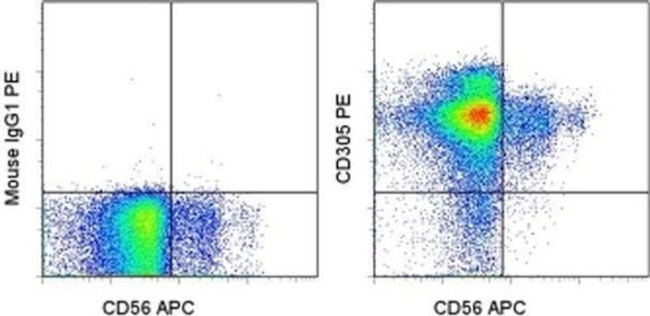
图: 1 / 1
CD305 (LAIR1) Antibody (12-3059-42) in Flow
Staining of normal human peripheral blood cells with Anti-Human CD56 (NCAM) APC (Product # 17-0567-42) and Mouse IgG1 K Isotype Control PE (Product # 12-4714-81) (left) or Anti-Human CD305 (LAIR1) PE (right). Cells in the lymphocyte gate were used for analysis.
Please note: We are reviewing Western blot images included in the antibody testing data in our catalog, including those provided by third parties. Unless expressly labeled or annotated as “raw-unedited”, Western blot images included in the antibody testing data in our catalog may have been edited, optimized or otherwise adjusted for presentation.

产品信息
12-3059-42
产品规格
种属反应
Human
已发表种属
Human
宿主/亚型
Mouse
/ IgG1
分类
Monoclonal
类型
Antibody
克隆号
NKTA255
偶联物
PE
PE
PE
激发/发射光谱
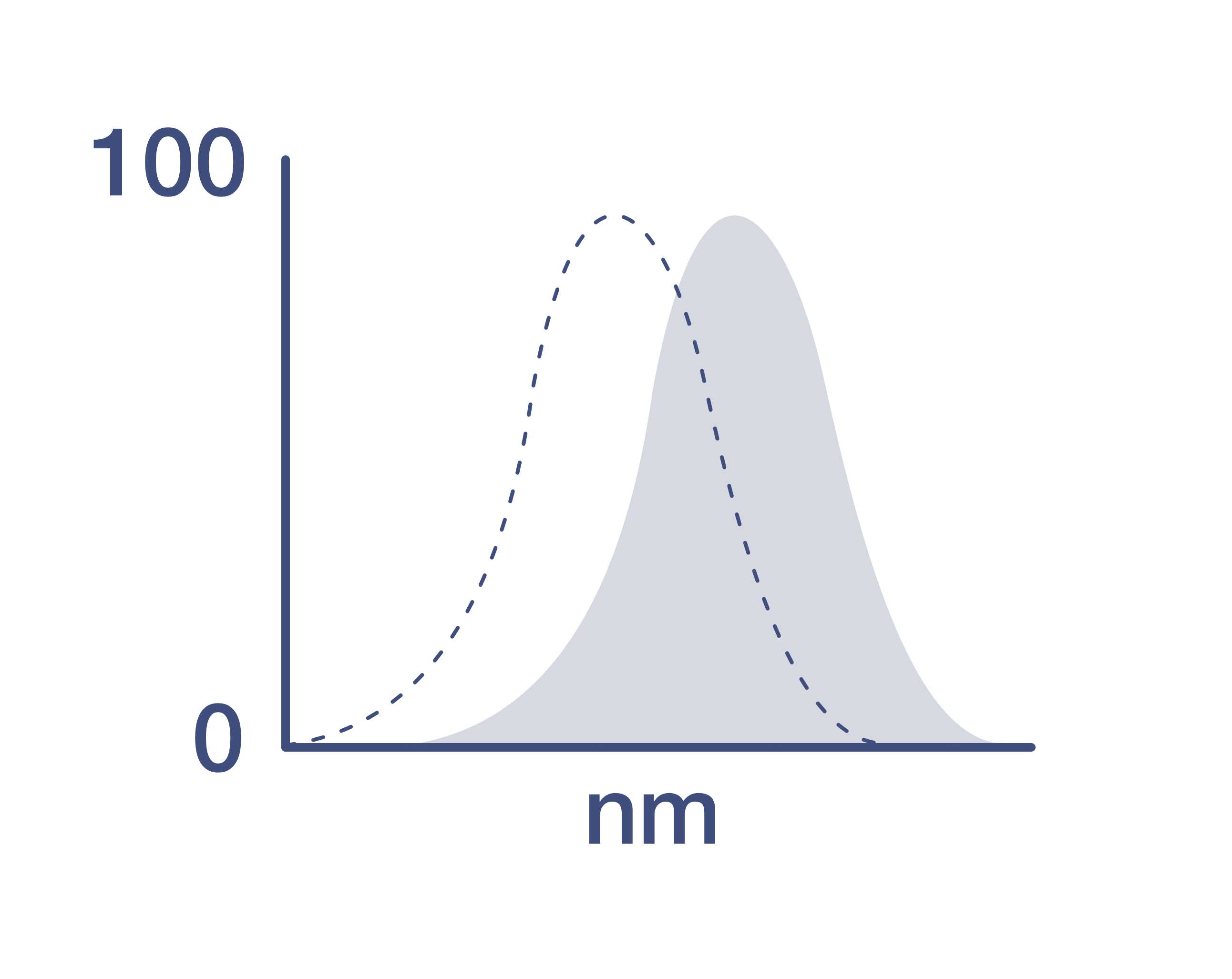
565/576 nm
查看光谱
形式
Liquid
浓度
5 µL/Test
纯化类型
Affinity chromatography
保存液
PBS, pH 7.2, with BSA
内含物
0.09% sodium azide
保存条件
4°C, store in dark, DO NOT FREEZE!
运输条件
Ambient (domestic); Wet ice (international)
RRID
产品详细信息
Description: This NKTA255 monoclonal antibody reacts with human CD305, which is also known as leukocyte-associated Ig-like receptor (LAIR) 1. CD305 is a type I transmembrane glycoprotein that possesses an extracellular Ig-like domain and two intracellular ITIMs. CD305 is expressed on nearly all immune cells, including T, NK, and B cells, as well as monocytes, dendritic cells, eosinophils, basophils, and mast cells. In humans, this molecule is also expressed on CD34+ hematopoietic progenitor cells and thymocytes. Several isoforms of CD305 exist due to alternative splicing, and their expression may differ between cell types. As an inhibitory receptor, CD305 blocks cytokine-mediated signaling, cell proliferation, and apoptosis. Studies have also identified collagens as the ligands for CD305.
The NKTA255 antibody has been reported to inhibit NK cytolytic activity.
Applications Reported: This NKTA255 antibody has been reported for use in flow cytometric analysis.
Applications Tested: This NKTA255 antibody has been pre-titrated and tested by flow cytometric analysis of human peripheral blood cells. This can be used at 5 µL (0.06 µg) per test. A test is defined as the amount (µg) of antibody that will stain a cell sample in a final volume of 100 µL. Cell number should be determined empirically but can range from 10^5 to 10^8 cells/test.
Excitation: 488-561 nm; Emission: 578 nm; Laser: Blue Laser, Green Laser, Yellow-Green Laser.
Filtration: 0.2 µm post-manufacturing filtered.
靶标信息
CD305, also known as LAIR1, is a type I transmembrane glycoprotein with an extracellular Ig-like domain and two intracellular ITIMs. It is expressed on a wide range of immune cells, including T, NK, and B cells, monocytes, dendritic cells, eosinophils, basophils, and mast cells. In humans, CD305 is also present on CD34+ hematopoietic progenitor cells and thymocytes. Several isoforms exist due to alternative splicing, with expression varying between cell types. CD305 functions as an inhibitory receptor, playing a key role in regulating immune responses. It blocks cytokine-mediated signaling, cell proliferation, and apoptosis. In NK, B, and T cells, CD305 modulates cytolytic functions and cytokine production, down-regulating IL2 and IFNG in CD4+ T cells while inducing transforming growth factor beta. In B cells, it reduces IgG and IgE production and decreases IL8, IL10, and TNF secretion. Activation of CD305 through tyrosine phosphorylation recruits phosphatases PTPN6 and PTPN11, although it may also function independently of SH2-containing phosphatases. It inhibits differentiation of peripheral blood precursors into dendritic cells and has been shown to induce apoptosis in myeloid leukemia cell lines. Collagens are identified as ligands for CD305, underscoring its role in immune regulation.
仅用于科研。不用于诊断过程。未经明确授权不得转售。
How to use the Panel Builder
Watch the video to learn how to use the Invitrogen Flow Cytometry Panel Builder to build your next flow cytometry panel in 5 easy steps.
生物信息学
蛋白别名: immunoglobulin heavy chain variable region; LAIR1; leukocyte-associated Ig-like receptor 1; membrane glycoprotein; unnamed protein product
基因别名: CD305; LAIR-1
UniProt ID: (Human) Q6GTX8
Entrez Gene ID: (Human) 3903
Disclaimer

Clicking the images or links will redirect you to a website hosted by BenchSci that provides third-party scientific content. Neither the content nor the BenchSci technology and processes for selection have been evaluated by us; we are providing them as-is and without warranty of any kind, including for use or application of the Thermo Fisher Scientific products presented.

