Search
Agrisera
14-3-3 GRF/General regulatory element Polyclonal Antibody
{{$productOrderCtrl.translations['antibody.pdp.commerceCard.promotion.promotions']}}
{{$productOrderCtrl.translations['antibody.pdp.commerceCard.promotion.viewpromo']}}
{{$productOrderCtrl.translations['antibody.pdp.commerceCard.promotion.promocode']}}: {{promo.promoCode}} {{promo.promoTitle}} {{promo.promoDescription}}. {{$productOrderCtrl.translations['antibody.pdp.commerceCard.promotion.learnmore']}}
Additional Information:
{{banner.description}}
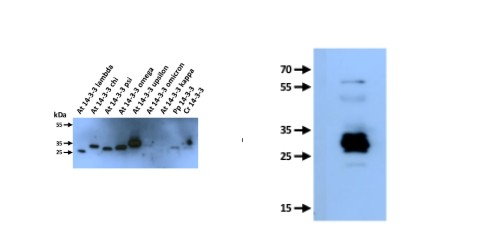
图: 1 / 1
14-3-3 GRF/General regulatory element Antibody (AS12-2119) in WB
Left panel: 150 ng of recombinant Arabidopsis thaliana, Physcomitrella patens and Chlamydomonas reinhardtii GRFs (see more details below) were separated on 12% SDS-PAGE and blotted 1 h to PVDF by semi dry blotting (0.8 m A/cm 2 for 60 min). Blots were blocked with 2% skimmed milk powder dissolved in TBST (0.1% Tween 20) for 1 h at room temperature (RT) with agitation. Blot was incubated in the primary antib... View More

产品信息
AS12-2119
产品规格
种属反应
Algae,
Plant
宿主/亚型
Rabbit
分类
Polyclonal
类型
Antibody
抗原
Conserved surface-exposed peptide conjugated to KLH.
偶联物
形式
Lyophilized
保存液
whole serum
内含物
no preservative
保存条件
-20°C, Avoid Freeze/Thaw Cycles
运输条件
Ambient (domestic); Wet ice (international)
产品详细信息
Store lyophilized/reconstituted at -20°C; once reconstituted make aliquots to avoid repeated freeze-thaw cycles. Please remember to spin the tubes briefly prior to opening them to avoid any losses that might occur from material adhering to the cap or sides of the tube.
For reconstitution add 50 µL of sterile water.
Specific Species Reactivity: Aesculus hippocastanum, Arabidopsis halleri, Arabidopsis thaliana, Lilium longiflorum, Mesembryanthemum crystallinum, Neochloris oloabundans (algae), Oryza sativa, Picrorhiza kurroa, Phaseolus vulgaris, Panax notoginseng, Zea mays, Vicia faba
靶标信息
14-3-3 GRFs are a conserved family of acidic, dimeric adaptor proteins in plants that bind phosphorylated client proteins to modulate their activity, stability, localization, and complex assembly. Acting as central hubs in signal transduction, GRFs integrate cues from light, hormones (e.g., ABA, GA, auxin), carbon/nitrogen status, and stress pathways to coordinate metabolism and development. Key roles include regulation of primary carbon flux (e.g., activation/inhibition of enzymes such as nitrate reductase, SPS, H+-ATPases), control of ion transport and stomatal function, modulation of transcription factors and kinases, and participation in circadian and photomorphogenic responses. Plant genomes encode multiple GRF isoforms with overlapping yet distinct expression and client specificities, enabling tissue- and stimulus-specific regulation. 14-3-3 binding typically recognizes phosphoserine/phosphothreonine motifs, is reversible, and can be tuned by competing ligands, redox state, and cellular compartmentation. Altered GRF abundance or interaction networks affect growth, stress resilience, nutrient use efficiency, and yield-related traits.
仅用于科研。不用于诊断过程。未经明确授权不得转售。
篇参考文献 (0)
您是否在文献中引用过该产品?请点击下方按钮邮件告知我们。
生物信息学
蛋白别名: 14-3-3; 14-3-3 protein; 14-3-3-like protein; 14-3-3lambda; AFT1; AT5G10450; F12B17.200; F12B17_200; G-box regulating factor; General regulatory factor; GF14; GF14 lambda; GF14-like; GRF
Disclaimer

Clicking the images or links will redirect you to a website hosted by BenchSci that provides third-party scientific content. Neither the content nor the BenchSci technology and processes for selection have been evaluated by us; we are providing them as-is and without warranty of any kind, including for use or application of the Thermo Fisher Scientific products presented.

