Search
Proteintech
TNFAIP3 Monoclonal Antibody (3A11G6)
{{$productOrderCtrl.translations['antibody.pdp.commerceCard.promotion.promotions']}}
{{$productOrderCtrl.translations['antibody.pdp.commerceCard.promotion.promocode']}}: {{promo.promoCode}} {{promo.promoTitle}} {{promo.promoDescription}}. {{$productOrderCtrl.translations['antibody.pdp.commerceCard.promotion.learnmore']}}
{{$ctrl.translations['antibody.pdp.skuNotes.additionalInformation']}}:
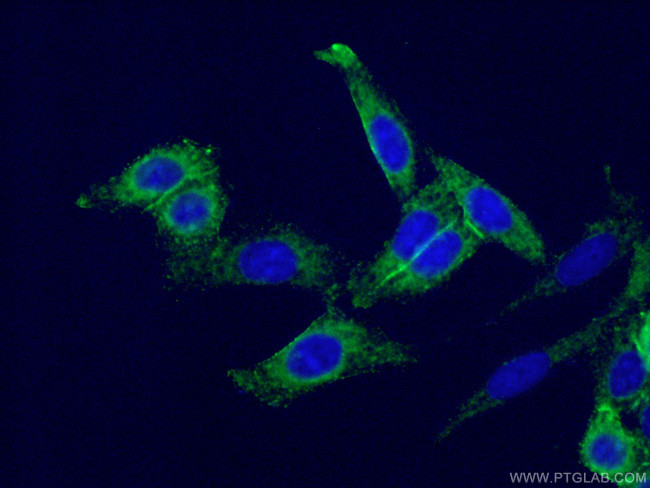
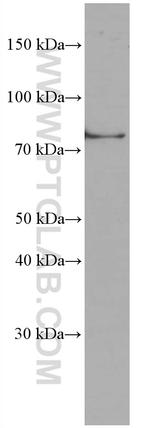
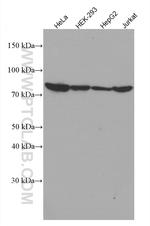
Please note: We are reviewing Western blot images included in the antibody testing data in our catalog, including those provided by third parties. Unless expressly labeled or annotated as “raw-unedited”, Western blot images included in the antibody testing data in our catalog may have been edited, optimized or otherwise adjusted for presentation.


产品信息
66695-1-IG
应用
建议稀释比
已发表文章
产品规格
种属反应
Human,
Rat
已发表种属
Human,
Mouse
宿主/亚型
Mouse
/ IgG1
分类
Monoclonal
类型
Antibody
克隆号
3A11G6
抗原
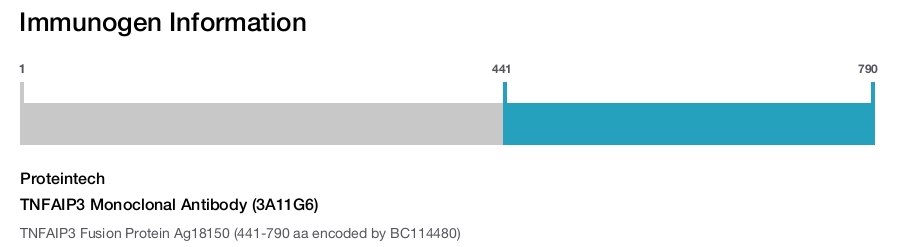
TNFAIP3 Fusion Protein Ag18150 (441-790 aa encoded by BC114480)
偶联物
Unconjugated
Unconjugated
Unconjugated
形式
Liquid
浓度
1 mg/mL
规格
150 µg
纯化类型
Protein G
保存液
PBS, pH 7.3, with 50% glycerol
内含物
0.02% sodium azide
保存条件
-20°C
运输条件
Wet ice (domestic); Dry ice (international)
产品详细信息
Immunogen sequence: EAYEPLAWN PEESTGGPHS APPTAPSPFL FSETTAMKCR SPGCPFTLNV QHNGFCERCH NARQLHASHA PDHTRHLDPG KCQACLQDVT RTFNGICSTC FKRTTAEASS SLSTSLPPSC HQRSKSDPSR LVRSPSPHSC HRAGNDAPAG CLSQAARTPG DRTGTSKCRK AGCVYFGTPE NKGFCTLCFI EYRENKHFAA ASGKVSPTAS RFQNTIPCLG RECGTLGSTM FEGYCQKCFI EAQNQRFHEA KRTEEQLRSS QRRDVPRTTQ STSRPKCARA SCKNILACRS EELCMECQHP NQRMGPGAHR GEPAPEDPPK QRCRAPACDH FGNAKCNGYC NECFQFKQMY G (441-790 aa encoded by BC114480)
靶标信息
TNFAIP3, also known as A20, is located in chromosome band 6q23, a region that is often deleted in B cell lymphomas. Recently, it was identified as a tumor suppressor gene in Hodgkin lymphoma and several subtypes of non-Hodgkin lymphomas. TNFAIP3 was initially identified as a zinc-finger protein that is rapidly and transiently induced by TNF-a, inhibiting NF-kappa-B-dependent gene expression, and protecting cells from TNF-a-cytotoxicity. Overexpression of TNFAIP3 also inhibits the TLR2- and TLR4-mediated interleukin-8 synthesis in airway epithelial cells, suggesting that TNFAIP3 also acts as a negative regulator of TLR-mediated inflammatory responses, thereby protecting the host against harmful over-responses to pathogens. At least two isoforms of TNFAIP3 are known to exist.
仅用于科研。不用于诊断过程。未经明确授权不得转售。
生物信息学
蛋白别名: OTU domain-containing protein 7C; putative DNA-binding protein A20; RP11-356I2.3; TNFAIP3 (A20); tumor necrosis factor inducible protein A20; tumor necrosis factor, alpha induced protein 3; tumor necrosis factor, alpha-induced protein 3; unnamed protein product; zinc finger protein A20
基因别名: A20; AIFBL1; AISBL; OTUD7C; TNFA1P2
UniProt ID: (Human) P21580
Entrez Gene ID: (Human) 7128, (Rat) 683206
B-1 B cell homeostasis
response to molecule of bacterial origin
immune system process
regulation of germinal center formation
negative regulation of chronic inflammatory response
protein deubiquitination
negative regulation of protein ubiquitination
response to muramyl dipeptide
negative regulation of interleukin-1 beta production
negative regulation of interleukin-2 production
negative regulation of interleukin-6 production
negative regulation of tumor necrosis factor production
negative regulation of toll-like receptor 3 signaling pathway
negative regulation of toll-like receptor 5 signaling pathway
protein K11-linked deubiquitination
negative regulation of viral-induced cytoplasmic pattern recognition receptor signaling pathway
regulation of cell proliferation
negative regulation of I-kappaB kinase/NF-kappaB signaling
positive regulation of protein catabolic process
negative regulation of innate immune response
negative regulation of smooth muscle cell proliferation
negative regulation of inflammatory response
negative regulation of B cell activation
cellular response to hydrogen peroxide
negative regulation of nucleotide-binding oligomerization domain containing 1 signaling pathway
negative regulation of nucleotide-binding oligomerization domain containing 2 signaling pathway
protein K63-linked deubiquitination
protein K48-linked ubiquitination
protein K48-linked deubiquitination
cellular response to lipopolysaccharide
protein deubiquitination involved in ubiquitin-dependent protein catabolic process
tolerance induction to lipopolysaccharide
establishment of protein localization to vacuole
cellular response to oxygen-containing compound
negative regulation of extrinsic apoptotic signaling pathway via death domain receptors
positive regulation of hepatocyte proliferation
negative regulation of CD40 signaling pathway
negative regulation of endothelial cell apoptotic process
negative regulation of extrinsic apoptotic signaling pathway
regulation of tumor necrosis factor-mediated signaling pathway
negative regulation of toll-like receptor 2 signaling pathway
negative regulation of toll-like receptor 4 signaling pathway
nucleotide-binding domain, leucine rich repeat containing receptor signaling pathway
negative regulation of bone resorption
regulation of defense response to virus by host
regulation of vascular wound healing
negative regulation of osteoclast proliferation
Disclaimer

Clicking the images or links will redirect you to a website hosted by BenchSci that provides third-party scientific content. Neither the content nor the BenchSci technology and processes for selection have been evaluated by us; we are providing them as-is and without warranty of any kind, including for use or application of the Thermo Fisher Scientific products presented.

